
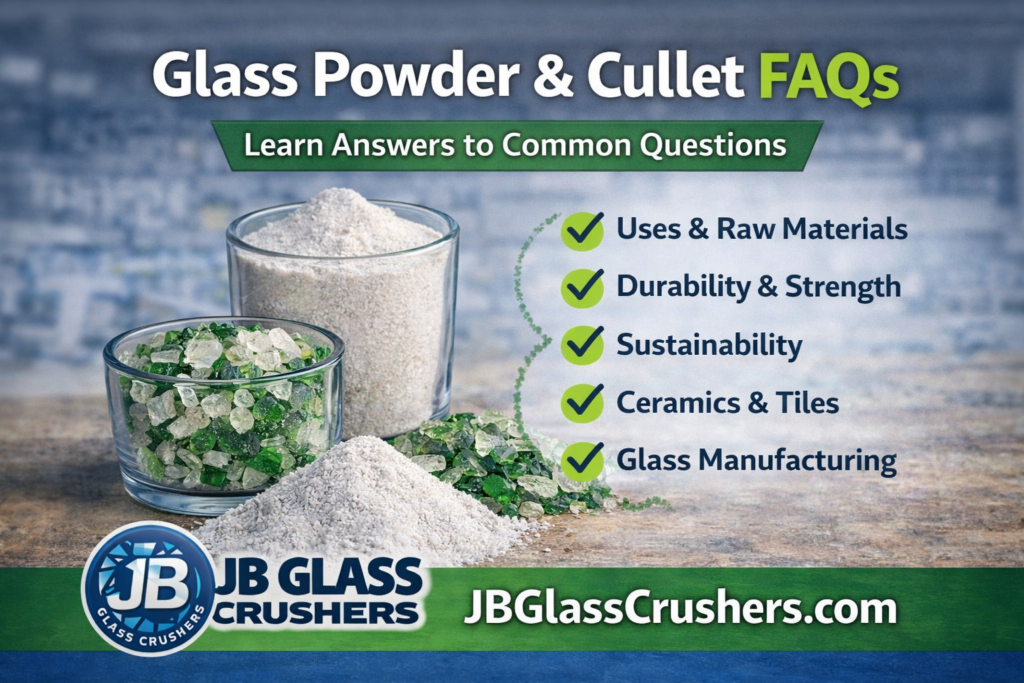
Q1. What raw materials are used to make glass powder?
Glass Powder is primarily made from post-consumer container glass, flat glass waste, factory scrap (internal cullet), and occasionally virgin glass. The source determines colour, chemical purity, and application suitability.
Q2. Does grinding glass create harmful dust?
Only during manufacturing. Industrial grinding produces silica-containing dust, so factories use enclosed systems, dust collectors, and PPE.
The final delivered glass powder is stable and safe when handled normally.
Reach out to JBGlassCrushers
Q3. What is the shelf life of glass powder?
Indefinite. Glass powder does not degrade, rot, or react under normal storage. As long as it is kept dry and sealed, it lasts forever. Download specs here: Technical Data Sheet
Q4. What is the difference between recycled and virgin glass powder?
- Virgin glass powder → made from new glass; generally lighter in colour and highly consistent.
- Recycled glass powder → made from waste glass; more sustainable and cost-effective with similar performance.
Q5. Is glass powder chemically reactive?
As a fine powder (<75 μm) it shows pozzolanic reactivity, meaning it reacts with calcium hydroxide in cement to form additional C-S-H, enhancing strength and durability.
Concrete & Construction FAQs
Q6. Does glass powder cause alkali-silica reaction (ASR)?
Not when finely ground.
Coarse glass particles may increase ASR risk, but fine powder reduces or eliminates ASR expansion due to pozzolanic effects.
Q7. How much glass powder can replace cement in concrete?
Typical replacement levels:
- 10–20% → optimal performance
- 25–30% → possible depending on mix design
- >30% → may reduce early strength unless very fine powder is used
Q8. Does glass powder change the colour of concrete?
Very fine white/clear glass powder usually lightens the concrete slightly, improving aesthetic value.
Coloured powders can be used intentionally for decorative effects.
Q9. Does adding glass powder improve durability?
Yes. Studies show improvements in:
- Compressive strength (long term)
- Chloride resistance
- Sulfate resistance
- Reduced permeability
- Denser microstructure
Q10. Can glass cullet replace natural sand?
Yes, cullet (0–3 mm) can partially replace river sand or M-sand in concrete, blocks, plaster and pavers, reducing dependence on natural sand mining.
Q11. Can glass cullet be used in asphalt?
Yes. “Glassphalt” (asphalt with glass aggregate) has:
- Better skid resistance
- Good durability
- Lower environmental footprint
Tiles, Ceramics & Terrazzo FAQs
Q12. Why do ceramic manufacturers use glass powder?
Because glass acts as a flux, reducing firing temperature and saving energy.
It improves glaze smoothness, colour, and vitrification.
Q13. Is coloured glass powder used for terrazzo floors?
Yes. Green, amber, mixed, and blue cullet/powder provide a bright, reflective finish for terrazzo and epoxy floors.
Q14. Can glass powder replace feldspar or quartz in ceramics?
In many cases, yes.
Its fluxing behaviour allows partial replacement of feldspar, lowering firing cost and enhancing glaze properties.
Glass Manufacturing FAQs
Q15. What percentage of cullet can float glass plants use?
Float glass plants normally use 10–30% cullet, depending on quality, colour consistency, and furnace design.
Q16. Why do glass manufacturers prefer cullet?
- Reduces melting temperature
- Lowers fuel consumption
- Reduces emissions (CO₂, NOx, SOx)
- Extends furnace life
Q17. Does cullet need to be colour-sorted for remelting?
Yes.
Glass manufacturers typically require sorted cullet:
- Flint (white/clear)
- Green
- Amber
Mixed-colour cullet is generally used for construction or filtration, not remelting.
Filtration & Special Applications FAQs
Q18. Is glass filter media better than sand?
In many applications, yes.
Glass filter media has:
- Higher filtration efficiency
- Lower bacterial retention
- Longer service life
- Reduced backwashing frequency
Q19. Is glass powder used in coatings and paints?
Yes.
It provides hardness, abrasion resistance, anti-slip textures and improves surface reflectivity in industrial coatings.
Q20. Is glass cullet used in landscaping?
Yes, coloured and clear cullets are used in:
- Garden beds
- Pathways
- Decorative aggregates
- Water features
They do not fade or degrade in sunlight.
Pricing & Supply FAQs
Q21. What affects the price of glass powder?
Pricing depends on:
- Grade & fineness
- Colour purity
- Processing (washing, drying, grinding)
- Packaging (bags/jumbo bags)
- Delivery distance
Contact us for Request Pricing
Q22. Do you export glass powder & cullet?
If you do, answer with your format. If not, I can write a short export policy blurb.
See export details here About Us
Q23. Do you provide test reports?
Yes—manufacturers usually provide:
- Sieve analysis
- Chemical composition (XRF)
- Bulk density
- Moisture content
- Contaminant limits
I can write a QC + testing section for your site if needed.
Environmental FAQs
Q24. Is glass powder eco-friendly?
Yes.
It reduces:
- Cement consumption
- CO₂ emissions
- Natural sand mining
- Landfill waste
It supports the circular economy and green-building certifications like IGBC, GRIHA, and LEED.
Q25. Can broken glass from households be recycled into powder?
Yes, even mixed-colour and broken glass can be processed into powder or cullet for construction, tiles, and filtration—even if it’s not suitable for remelting.
Q26. How does glass powder help fight sand shortages?
By replacing part of natural sand in concrete and mortars, glass powder reduces demand for river sand and M-sand—helping protect rivers, groundwater and ecosystems.
Technical & Material FAQs
Q27. Can glass powder replace fly ash or slag?
Yes. Fine glass powder behaves like a pozzolanic SCM, similar to Class F fly ash. In mixes with supply shortages of fly ash, glass powder is an excellent alternative.
Q28. How does fineness affect the performance of glass powder?
- <75 μm = High reactivity
- 75–300 μm = Moderate strength influence
- 300–1000 μm = Acts as filler or fine aggregate
Finer powder increases the pozzolanic effect and reduces ASR risk.
Q29. Does mixed-colour glass affect the performance of powder?
Not in concrete or mortar uses. Mixed colours only matter for glass remelting, not for construction.
Q30. Does glass powder change the setting time of concrete?
Fine glass powder may slightly extend the initial set, but improves long-term strength.
Q31. Can glass cullet be used in high-strength concrete (M40+)?
Yes—if used as fine aggregate or SCM, but mix optimisation and lab trials are recommended.
Q32. Does glass cullet absorb water?
No. Glass cullet is non-porous, so it absorbs less water than natural sand.
Manufacturing & Processing FAQs
Q33. How is cullet cleaned before use?
Through a combination of:
- Magnetic separation
- Optical colour sorting
- Washing and drying
- Crushing and screening
- Removing ceramics and metals
Q34. What machines are used to make glass powder?
- Hammer mill
- Ball mill
- Raymond mill
- Jet mill
- Vibratory classifier / cyclone separator
Q35. What happens to labels and metal caps during recycling?
Automated plants remove them using:
- Label scrapers
- Air classifiers
- Eddy-current separators for aluminium
- Magnetic separators for steel
Q36. How clean must cullet be for remelting?
Furnace-ready cullet must have:
- <20–30 g/tonne ceramics
- <10 g/tonne metals
- <0.5% organic residue
This varies by manufacturer.
Safety FAQs
Q37. Is glass powder hazardous?
No — finished product is stable and non-reactive. During manufacturing, dust must be controlled.
Q38. Can glass cullet cause injury?
Not usually—industrial cullet is rounded by crushing, not sharp like broken glass.
Q39. Is glass powder safe for children or pets?
It should be stored safely, but once mixed in concrete or resin, it becomes part of a solid matrix and is completely safe.
Q40. Can glass powder be inhaled?
Like any fine mineral powder, it should not be inhaled. Workers should use masks when handling.
Sustainability FAQs
Q41. Why is glass powder considered sustainable?
Because it reduces:
- Cement consumption
- Landfill waste
- Sand mining
- CO₂ emissions
- Energy use in manufacturing
Q42. How long does glass take to decompose?
Thousands of years.
Recycling it into powder immediately reintroduces it into the economy.
Q43. Does recycling glass save energy?
Yes. Melting cullet requires 20–30% less energy than melting raw materials.
Q44. Does glass recycling reduce air pollution?
Yes. Cullet reduces furnace temperatures, which reduces NOx, SO₂, and CO₂ emissions.
Industry Application FAQs
Q45. How much cullet can be used in tile manufacturing?
Tiles commonly use 5–15% glass powder or cullet as flux or filler.
Q46. Is glass powder compatible with epoxy resins?
Yes, especially clear and coloured powders for terrazzo, 3D flooring, and countertops.
Q47. Can glass cullet be used in landscaping?
Absolutely — cullet is used in:
- Walkways
- Decorative gravel
- Planters
- Water features
Q48. Can glass cullet be used in filtration systems
Yes — glass filter media is increasingly replacing silica sand due to:
- Less bacterial growth
- Higher flow rate
- Longer service life
Q49. Is glass powder used in road construction?
Yes, it is used in:
- Asphalt mixes (“glassphalt”)
- Base layers
- Embankment material
Q50. Does glass powder help in 3D printing concrete?
Fine glass powder improves rheology and reduces shrinkage in 3D-printed mortar systems.
Buying & Commercial FAQs
Q51. What is the minimum order quantity?
Set your own MOQ — usually 1 MT for powder and 5 MT+ for cullet.
Request a quote here. Contact Us
Q52. Do you ship across India?
If yes → say Pan-India delivery available via truck, container, or bulk bags.
Q53. Do you export glass powder & cullet?
If yes, mention ports like:
- Nhava Sheva (JNPT)
- Mundra Port
- Chennai Port
- Vizag Port
See export details here. About Us
Q54. Do you provide MSDS or safety sheets?
Yes — most industrial clients expect:
- Material Safety Data Sheet
- Technical Data Sheet (TDS)
- Test reports (sieve analysis, XRF)
Yes! Download here the Technical Data Sheet
Q55. Can I request a sample?
Most businesses provide 1–2 kg free samples for testing.
Q56. What packaging options are available?
- 25 kg bags
- 40 kg bags
- 1-ton jumbo bags
- Export wooden pallets
- Custom branding available
Q57. How fast can you deliver?
Delivery time:
- Local: 1–3 days
- Metro: 3–5 days
- Interstate: 5–8 days
- Export: 2–4 weeks