
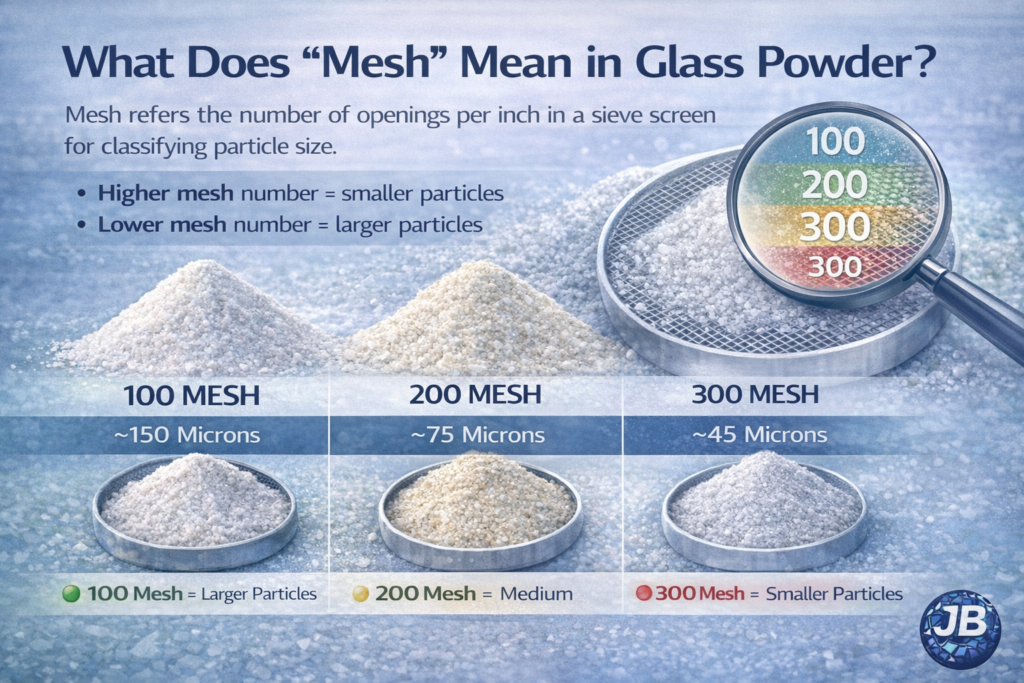
In glass powder classification, mesh refers to the number of openings per linear inch in a sieve screen used to separate particles by size.
Simply put:
- Higher mesh number = smaller particles
- Lower mesh number = larger particles
The mesh system is a standard method used in industrial material processing to ensure consistent particle size distribution.
How Mesh Works
If a material is labelled:
- 100 Mesh – The powder passes through a sieve with 100 openings per inch.
- 200 Mesh – Passes through 200 openings per inch.
- 300 Mesh – Passes through 300 openings per inch.
Since a 300-mesh screen has more openings in the same space, the holes are smaller — meaning only finer particles can pass through.
Reach out to JBGlassCrushers
Mesh to Micron Conversion (Approximate)
| Mesh Size | Approx. Micron Size | Description |
|---|---|---|
| 100 Mesh | ~150 microns | Fine sand-like |
| 200 Mesh | ~75 microns | Very fine powder |
| 300 Mesh | ~45 microns | Ultra-fine powder |
(Note: Exact micron size may vary slightly depending on sieve standard and material shape.)
Why Mesh Size Matters in Glass Powder
Mesh size directly affects:
- Reactivity in cement systems
- Surface area and bonding strength
- Flow behavior in industrial sealing
- Cost (finer grinding requires more energy)
- Surface finish in coatings and ceramics
For example:
- 100 mesh behaves more like a filler or sand replacement.
- 200 mesh offers balanced performance for general industrial use.
- 300 mesh provides high reactivity for high-performance concrete and precision applications.
Mesh vs Micron: What’s the Difference?
- Mesh = Sieve classification method
- Micron (µm) = Exact particle size measurement
Micron measurement is more precise, while mesh is widely used in trade and bulk supply.