
Particle size plays a critical role in determining the performance, cost, and application suitability of glass powder. Whether used in concrete, ceramics, coatings, filtration, or industrial sealing systems, choosing the correct mesh size directly affects strength, reactivity, surface finish, and processing behavior.
In this guide, we explain the differences between 100 mesh, 200 mesh, and 300 mesh glass powder, how mesh relates to micron size, and how to select the right grade for your application.
What Does “Mesh” Mean in Glass Powder?
Mesh refers to the number of openings per linear inch in a sieve screen used to classify particle size.
- Higher mesh number = smaller particles
- Lower mesh number = larger particles
In industrial glass powder production, mesh classification ensures consistent grading for specific applications.
Reach out to JBGlassCrushers
Mesh to Micron Conversion
Here is a practical reference chart:
| Mesh Size | Approx. Micron Size | Particle Description |
|---|---|---|
| 100 Mesh | ~150 microns | Fine sand-like |
| 200 Mesh | ~75 microns | Very fine powder |
| 300 Mesh | ~45 microns | Ultra-fine powder |
Note: Exact micron size may vary slightly depending on production method and classification system.
100 Mesh Glass Powder (~150 Microns)
Characteristics:
- Coarser texture
- Lower surface area
- Moderate reactivity
- More economical to produce
Best Applications:
Construction & Concrete
- Partial sand replacement
- Non-structural blocks
- Paver tiles
Decorative & Terrazzo
- Textured finishes
- Resin and epoxy flooring
Abrasives & Surface Treatment
- Light blasting applications
Performance Insight:
100 mesh glass powder behaves more like a fine aggregate than a reactive pozzolan. It improves texture and reduces material costs but has limited chemical reactivity in cement systems.
200 Mesh Glass Powder (~75 Microns)
Characteristics:
- Balanced particle size
- Increased surface area
- Moderate pozzolanic reactivity
- Versatile industrial-grade
Best Applications:
Cement Replacement (10–20%)
- Improves long-term compressive strength
- Reduces permeability
- Enhances durability
Ceramic & Tile Manufacturing
- Fluxing agent
- Surface smoothness improvement
Industrial Fillers
- Paints and coatings
- Polymer composites
Performance Insight:
200 mesh glass powder begins to show measurable pozzolanic behavior in cementitious systems, reacting with calcium hydroxide to form additional C-S-H gel. This improves density and long-term durability.
300 Mesh Glass Powder (~45 Microns)
Characteristics:
- Ultra-fine powder
- High surface area
- Strong pozzolanic reactivity
- Higher processing cost
Best Applications:
High-Performance Concrete
- Cement replacement up to 20–30%
- Reduced chloride permeability
- Improved sulfate resistance
Industrial Sealing & Bonding
- Better flow and melting behavior
- Uniform bonding
High-Precision Fillers
- Coatings
- Electronics
- Advanced ceramics
Performance Insight:
300 mesh glass powder significantly increases reactivity due to a higher surface area. In concrete systems, it can reduce alkali-silica reaction (ASR) risk when properly designed.
Why Particle Size Matters
Particle size affects:
1. Reactivity
Smaller particles react faster in cement systems.
2. Surface Area
Higher surface area increases bonding potential.
3. Strength Development
Finer glass powder improves long-term strength.
4. Workability
Ultra-fine powder may increase water demand.
5. Cost
Finer grinding requires more energy, increasing the price per kg.
100 vs 200 vs 300 Mesh: Quick Comparison
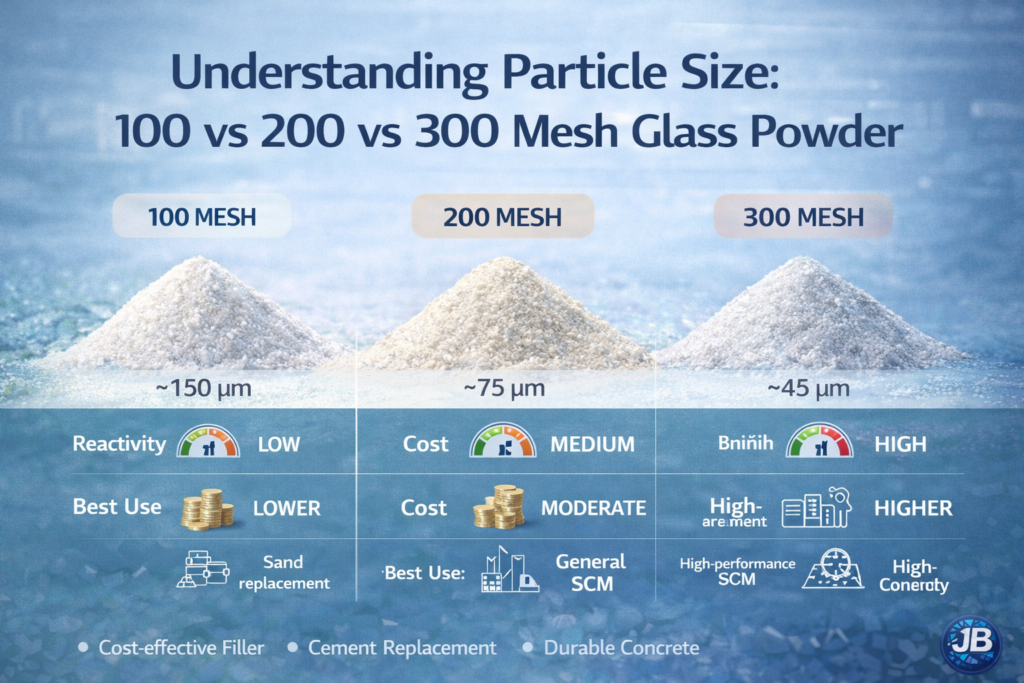
| Factor | 100 Mesh | 200 Mesh | 300 Mesh |
|---|---|---|---|
| Micron Size | ~150 µm | ~75 µm | ~45 µm |
| Reactivity | Low | Medium | High |
| Cost | Lower | Moderate | Higher |
| Best Use | Sand replacement | General SCM | High-performance SCM |
| Surface Finish | Textured | Smooth | Very smooth |
Which Mesh Size Should You Choose?
Choose 100 Mesh If:
- Cost is priority
- Used as filler or sand replacement
- Decorative or non-structural use
Choose 200 Mesh If:
- You need balanced performance
- Used in cement replacement
- Tile and ceramic applications
Choose 300 Mesh If:
- High-strength or durable concrete is required
- Industrial bonding/sealing
- Precision manufacturing
Industrial Trends in India
With increasing demand for sustainable construction materials, finer grades like 200 and 300 mesh glass powder are gaining popularity due to:
- Cement cost reduction
- CO₂ emission reduction
- Government green-building initiatives
- Growing infrastructure projects
Manufacturers now demand custom micron specifications to match performance goals.
Sustainability Impact of Finer Glass Powder
Finer glass powder grades:
- Reduce cement demand
- Lower embodied carbon
- Improve durability and lifespan
- Divert glass waste from landfills
Ultra-fine grades maximise pozzolanic efficiency, improving environmental benefits per kg used.
Quality Considerations When Buying Mesh Glass Powder
When selecting a supplier, check:
- Particle size distribution report
- Chemical composition (SiO₂ content)
- Moisture content
- Contamination limits
- Consistency between batches
Reliable manufacturers provide technical data sheets and customisation options.
Understanding the difference between 100, 200, and 300 mesh glass powder is essential for selecting the right material for your project.
- 100 mesh = cost-effective filler
- 200 mesh = versatile industrial grade
- 300 mesh = high-performance ultra-fine powder
Choosing the correct mesh size ensures optimal performance, durability, and cost efficiency across construction, ceramics, coatings, and industrial applications.