
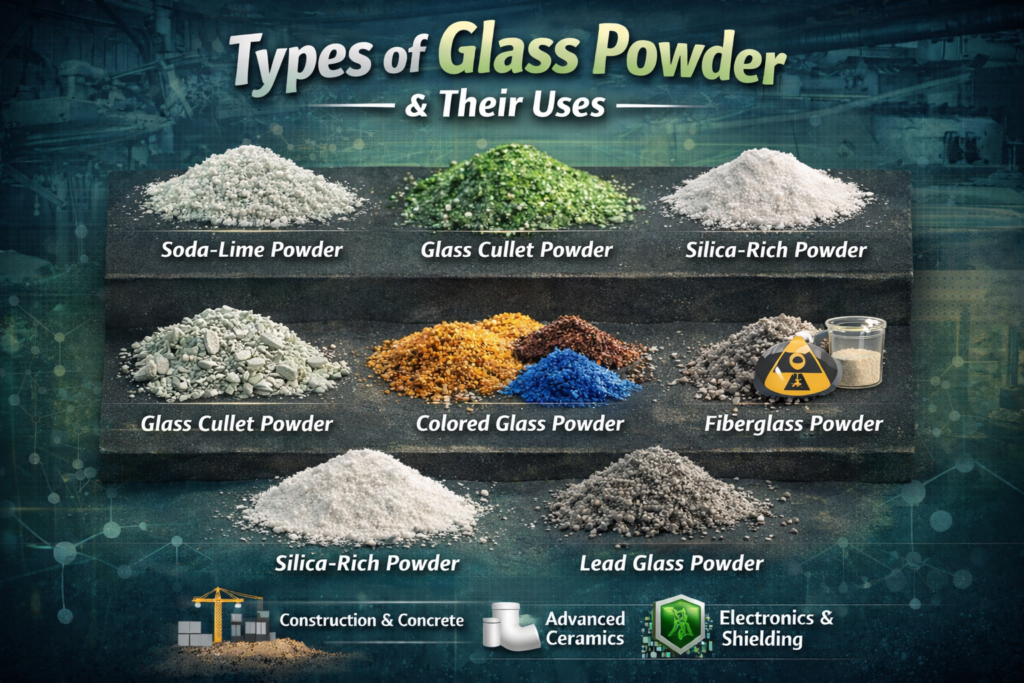
Glass powder is a finely ground form of recycled or virgin glass, processed into a sand-like or flour-like material. Thanks to its strength, chemical stability, and eco-friendly nature, glass powder is now widely used in various applications, including construction, ceramics, paints, plastics, and advanced technology. Different types of glass powder offer distinct properties, making each type suitable for specific applications.
This article explains the main types of glass powder, how they are made, and their real-world uses across industries.
1. Soda-Lime Glass Powder
(Most common type – made from standard packaging & window glass)
Composition
- Silica (SiO₂): 70–74%
- Soda (Na₂O): 12–16%
- Lime (CaO): 6–12%
- Minor oxides (MgO, Al₂O₃, Fe₂O₃)
Key Features
- High silica content
- Chemically stable
- Cost-effective
- Widely available (recycled bottles, jars, windows)
Production
- Recycled container glass
- Ground through ball mills, hammer mills, or jet mills
- Particle sizes range from 50 microns to 1 mm
Physical Characteristics
- High chemical stability
- Good hardness and angularity
- Moderate refractive index (≈1.5–1.6)
Reach out to JBGlassCrushers
Industrial Uses
1. Construction & Concrete
- Partial replacement of cement (10–30%)
- Pozzolanic properties after fine grinding (<75 microns)
- Reduces CO₂ footprint
- Improves workability & impermeability
Research Insight: Micro glass powder contributes to C–S–H gel formation, significantly improving compressive strength. Studies report 15–25% strength gains at 28 days.
2. Paints & Coatings
- Acts as a functional filler
- Improves abrasion resistance and hardness
3. Abrasive Applications
- Eco-friendly alternative to silica sand
- Used in sandblasting, industrial cleaning, paint removal
4. Plastic & Rubber Filler
- Enhances stiffness
- Minimizes shrinkage
- Improves surface finish
Why popular?
Because it is easy to recycle and is compatible with many industrial processes
2. Colored Glass Powder (Green, Brown, Amber, Blue)
Chemical Composition
Similar to soda-lime glass but contains metal oxides:
- Iron oxide (green)
- Chromium oxide (emerald green)
- Sulfur + carbon (amber/brown)
- Cobalt oxide (blue)
Key Features
- Derived from recycled bottles in various colors
- Maintains natural color after crushing
- Free-flowing powder, decorative grade and industrial grade
Surface & Optical Properties
- Stable color retention even after pulverization
- UV-resistant pigments
- Suitable for visual/design applications
Industries & Uses
1. Terrazzo & Epoxy Flooring
- High-demand decorative ingredient
- Adds reflectivity & color depth
2. Countertops & Artificial Quartz
- Used as a sustainable filler
- Replaces granite, marble aggregates
3. Tiles, Mosaics & Ceramic Glazes
- Enhances coloration and texture
4. Landscaping Aggregates
- Used in premium outdoor hardscapes
5. Decorative Concrete
Inlays, exposed aggregate finishes
3. Glass Cullet Powder
(Coarsely crushed glass further ground into fine particles)
Key Features
- High purity
- Angular particles
- Eco-friendly alternative to natural sand
Why Important?
- Large-scale recycling source
- Low processing cost
- Excellent mechanical properties
Industrial Uses
1. Construction – Sand Replacement
With global sand shortages, cullet powder is replacing:
- M-sand
- River sand
- Natural aggregates
Benefits:
- Squared/angular particles improve bonding
- Reduces environmental mining pressure
- Enhances concrete durability
2. Asphalt & Road Construction
- Better skid resistance
- Higher durability
3. Water Filtration Media
- Replaces silica sand
- Higher filtration efficiency
- Lower bacterial growth
4. Fiberglass Manufacturing
- Used as raw feedstock
- Requires clean, contaminant-free cullet
Best for: bulk industrial applications requiring large volumes.
4. Fiberglass Powder
(Made by grinding fibreglass waste or scraps)
Key Features
- High tensile strength
- Lightweight
- Good surface reinforcement capability
Uses
1. Automotive & Marine Composites
- Body panels
- Bumpers
- Boat components
2. Polymer Reinforcement
- Enhances tensile & flexural strength
- Used in resin systems
3. Industrial Fillers
- Putty formulations
- Automotive body repair compounds
Ideal when strength & lightweight characteristics are required.
5. Silica-Rich Glass Powder
(Ultra-fine powder rich in SiO₂)
Properties
- Very high SiO₂ content (>75%)
- Ultra-fine particle size
- Huge surface area
Applications
1. High-Performance Concrete (HPC)
Used in:
- Bridges
- High-rise structures
- Marine constructions
Effects:
- Strength increase (up to 30–40%)
- Less porosity
- Increased chemical durability
- Reduced ASR (Alkali-Silica Reaction)
2. Oil Well Cement
- Controls fluid loss
- Enhances density & strength
3. 3D Printing Construction Materials
- Improves rheology
- Reduces shrinkage
Key Features
- Very fine particle size (micro to nano)
- Excellent pozzolanic properties
- Enhances strength & durability
Uses
- High-performance concrete (HPC)
- Self-compacting concrete
- Oil well drilling cement
- Anti-crack additives
Used in: premium construction materials & engineering applications.
6. Lead Glass Powder
(Not used in common applications – mainly specialised)
Properties
- High lead oxide content (PbO 20–80%)
- Very high density
- Blocks gamma and X-ray radiation
Applications
- Medical radiology rooms
- Nuclear shielding materials
- Scientific equipment
- Optical lenses (precision-grade)
Uses
- X-ray rooms
- Radiation shielding panels
- Scientific instruments
- Optical glass components
Restricted to: controlled industrial and medical environments.
7. Foam Glass Powder
(Produced by crushing foam glass blocks)
Key Features
- Lightweight
- Excellent insulation
- Fire-resistant
- Excellent thermal and acoustic insulation
- Non-absorbent
Applications
- Lightweight insulating concrete
- Fireproof construction materials
- Thermal insulation mortars
- Lightweight filler for geotechnical engineering
Growing demand: in green-building and energy-efficient construction.
8. Ultra-Fine Glass Flour (≤ 20 Micron)
(Highly refined, flour-like powder)
Key Features
- Extremely smooth
- High reactivity
- Suitable for high-performance materials
Uses
- Conductive inks
- Advanced ceramic formulations
- Resin-based high-gloss coatings
- Aerospace-grade composites
- Fine grinding media
Used where smoothness, purity, and precision are required.
Choosing the Right Type of Glass Powder
| Type of Glass Powder | Best For |
|---|---|
| Soda-Lime | Construction, paints, fillers |
| Borosilicate | High-temp & chemical-resistant applications |
| Colored Glass Powder | Décor, terrazzo, tiles |
| Cullet Powder | Concrete, asphalt, filtration |
| Fiberglass Powder | Composite materials |
| Silica-Rich Powder | High-strength concrete |
| Lead Glass | Radiation shielding |
| Foam Glass | Insulation |
| Ultra-Fine Glass Flour | Ceramics, electronics |
Glass powder is rapidly becoming one of the most sustainable, versatile, and cost-effective industrial materials. As industries move toward eco-friendly solutions, recycled glass powder offers significant benefits—reducing landfill waste, lowering carbon emissions, and improving product performance.
Whether used in construction, ceramics, décor, or advanced technologies, choosing the right type of glass powder can dramatically improve durability, sustainability, and overall quality.