Glass Powder Research

Glass Powder as a Performance Filler

Glass Powder as a Performance Filler and Supplementary Material Across Industries

Glass powder, produced by finely grinding recycled soda-lime or borosilicate glass, is emerging as an important industrial filler and supplementary material across multiple sectors. Traditionally treated as waste, finely processed glass now offers functional value because of its hardness, chemical stability, particle packing capability, and, in cementitious systems, pozzolanic behavior. Industries are increasingly exploring glass […]

Glass Powder as a Performance Filler and Supplementary Material Across Industries Read More »

Glass Powder in Polymer Applications

Why Finely Milled Glass Powder Is Gaining Attention in Polymer Manufacturing

Modern polymer industries are continuously searching for materials that improve performance, enhance formulation consistency, and optimize production costs. One material increasingly being explored across polymer systems is finely milled glass powder. With controlled particle sizing, reliable purity, and strong thermal stability, glass powder can function as an effective industrial filler and performance-enhancing material in multiple

Why Finely Milled Glass Powder Is Gaining Attention in Polymer Manufacturing Read More »

Glass Waste to Controlled Raw Material

From Glass Waste to Controlled Raw Material: Why Consistency Matters

In industrial manufacturing, raw material consistency directly impacts product quality, process efficiency, and operational reliability. This is especially true for engineered glass-based materials. What was once considered discarded glass is now being transformed into controlled industrial raw material used across construction, coatings, ceramics, insulation systems, and other manufacturing applications. But simply processing glass is not

From Glass Waste to Controlled Raw Material: Why Consistency Matters Read More »

Electrical Insulation Applications

Glass Powder in Electrical Insulation Applications

High Dielectric Strength Meets Cost-Effective Performance Electrical insulation materials are expected to do more than simply block electrical current. Today’s manufacturers need materials that can withstand heat, resist moisture, maintain long-term stability, and still remain cost-effective in large-scale production. This is where glass powder is becoming an increasingly valuable solution. From cable insulation and transformer

Glass Powder in Electrical Insulation Applications Read More »

Glass Powder Can Lower Your Raw Material Costs

How Glass Powder Can Lower Your Raw Material Costs

Replacing conventional fillers with recycled glass powder can significantly cut industrial raw material costs. Glass powder (often 100% post-consumer recycled) can substitute expensive inputs like cement, quartz, or calcium carbonate. It typically costs far less than high-end virgin materials. Glass powder can also save energy (by reducing clinker use) and logistics (when sourced locally from waste streams).

How Glass Powder Can Lower Your Raw Material Costs Read More »

What Makes Glass Powder ‘Application-Ready’ Understanding Particle Size and Purity

What Makes Glass Powder ‘Application-Ready’? Understanding Particle Size and Purity

Industrial glass powder must be processed to tight particle-size and purity specifications so it performs reliably in downstream applications. “Application-ready” glass powder means uniform, calibrated fineness (with a well-defined particle-size distribution) and minimal contaminants or variable chemistry. Key attributes include a controlled mesh/pore size (often from ~50–1500 µm down to 1 µm), stable soda-lime composition, low moisture

What Makes Glass Powder ‘Application-Ready’? Understanding Particle Size and Purity Read More »

Glass Recycling Process: From Waste to Reusable Resource

Glass is one of the few materials that can be recycled endlessly without losing its quality or purity. This makes it a cornerstone of sustainable waste management and circular manufacturing. However, the journey from discarded bottle to new product involves several carefully controlled stages designed to ensure efficiency, safety, and high-quality output. This guide explains

Glass Recycling Process: From Waste to Reusable Resource Read More »

Industrial-Uses-of-Glass-Powder

Uses of Glass Powder After Grinding: Industrial and Sustainable Applications

Glass waste has become a growing environmental concern worldwide. Millions of tons of glass bottles, containers, and industrial glass waste are discarded every year. Although glass is fully recyclable, a large portion still ends up in landfills. One of the most effective ways to recycle glass is by crushing and grinding it into glass powder.

Uses of Glass Powder After Grinding: Industrial and Sustainable Applications Read More »

Refractory

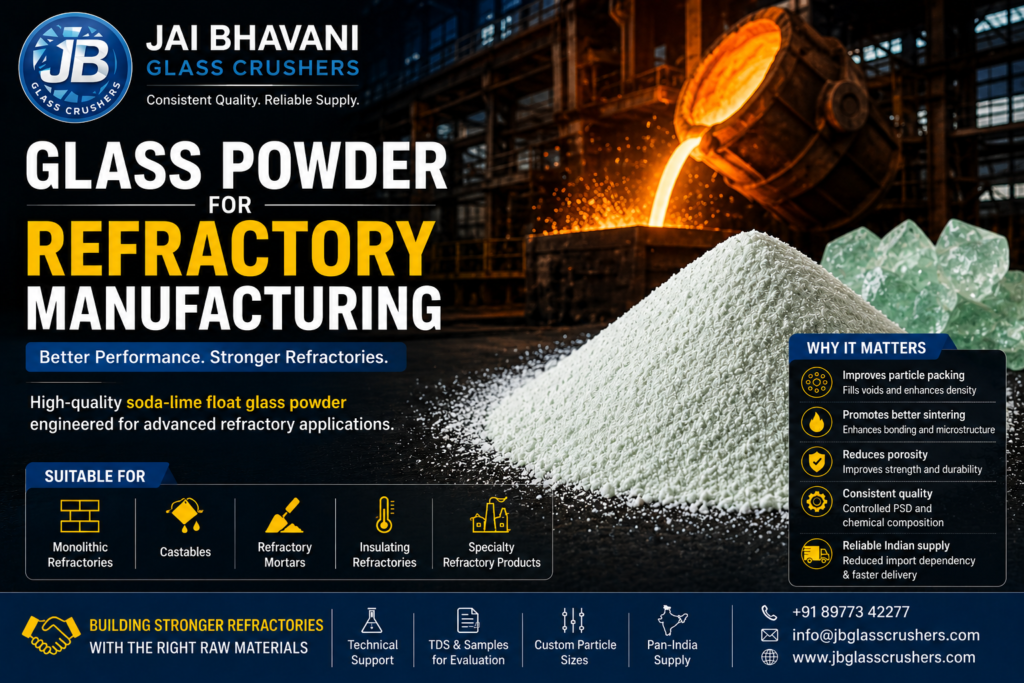
Glass Powder for Refractory Applications: A Sustainable and Cost-Effective Industrial Material

The refractory industry plays a critical role in high-temperature industrial processes, including steel manufacturing, glass production, cement production, and ceramic processing. Refractory materials must withstand extreme heat, chemical corrosion, and mechanical stress. To improve performance and manufacturing efficiency, manufacturers continuously search for reliable raw materials that offer both technical and economic advantages. One such emerging

Glass Powder for Refractory Applications: A Sustainable and Cost-Effective Industrial Material Read More »

17 Micron Glass Powder: A High-Performance Flux for Ceramic Tiles

The ceramic tile industry relies on carefully balanced raw materials to achieve proper melting, vitrification, and surface quality during firing. Among these materials, fluxes play a crucial role because they lower the melting temperature of ceramic bodies and glazes, helping manufacturers reduce energy consumption while improving product strength and finish. One material gaining increasing attention

17 Micron Glass Powder: A High-Performance Flux for Ceramic Tiles Read More »