
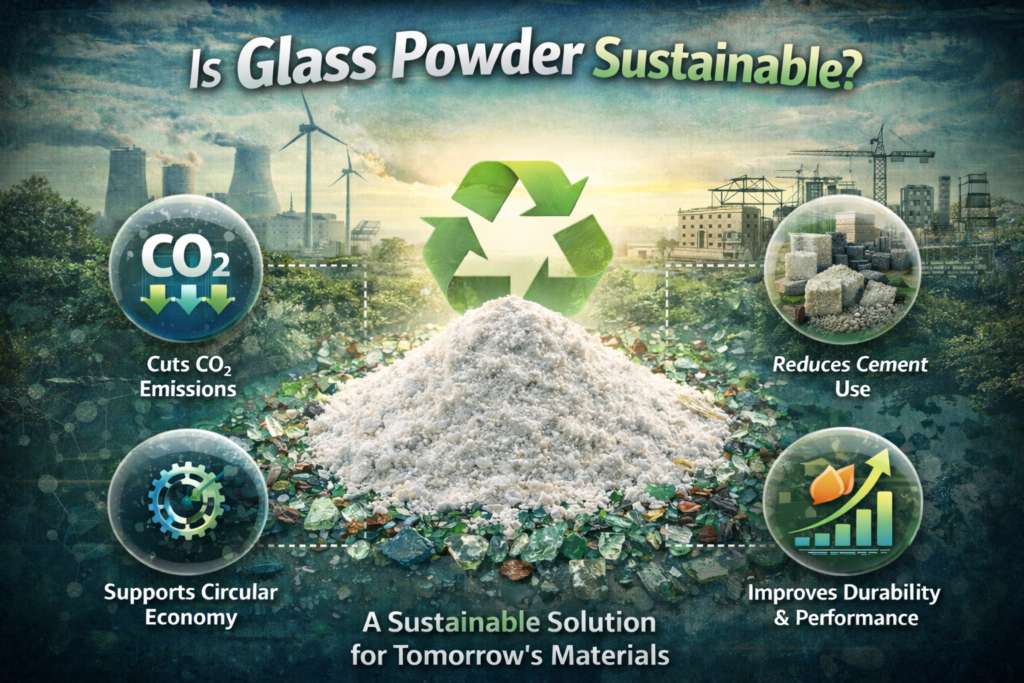
The sustainability of glass powder, especially recycled glass powder derived from post-consumer waste, has become a significant topic in materials science, construction engineering, and environmental research. Sustainability is evaluated not just by recycling rates but also by life-cycle environmental impact, resource efficiency, and functional performance in applications like concrete and composites.
1. Environmental Challenge of Glass Waste
Glass is non-biodegradable, remaining in landfills for hundreds of years if not recycled. Soda-lime glass—which makes up most beverage and container glass—is particularly persistent in the environment when discarded.
Globally, millions of tons of glass waste are generated annually, with a low recycling rate in many regions, contributing to landfill volume and associated environmental hazards.
Thus, any sustainable approach must divert glass waste from landfills and repurpose it into valuable materials.
Reach out to JBGlassCrushers
2. Glass Powder as a Sustainable Material
Reducing Cement Use
The most substantial sustainability benefit comes from using waste glass powder (WGP) as a partial cement replacement in concrete. Cement production is one of the largest industrial sources of CO₂ emissions globally. In contrast, glass powder is a waste-derived material that can reduce the need for cement while maintaining structural performance.
Recent research shows that substituting cement with 10–20% glass powder in concrete can lower carbon emissions and reduce energy consumption during production.
Glass powder’s pozzolanic reactivity where finely ground glass reacts with calcium hydroxide during cement hydration, allows it to form additional calcium silicate hydrate (C-S-H), improving concrete microstructure and strength.
3. Circular Economy & Resource Efficiency
Recycling glass into powder promotes a circular economy by turning a waste stream into a supplementary cementitious material (SCM) that can substitute virgin materials.
Studies show that glass powder not only reduces waste but also enhances the durability and long-term performance of the resulting concrete when used at optimal replacement levels.
Because glass powder can replace natural fine aggregates and part of the cement, it reduces the extraction pressure on sand and increasingly scarce materials.
4. Lower Carbon Footprint & Life Cycle Benefits
Life-cycle assessments (LCA) indicate that incorporating recycled glass powder into concrete can lead to significant net reductions in CO₂ emissions and energy consumption compared with ordinary concrete. Relative to traditional mixes, glass-modified mixes can reduce energy use by ~16% and greenhouse gases by similar margins.
Other environmental studies suggest that using recycled glass in building materials can cut CO₂ emissions by up to ~30% in certain systems, illustrating the broad potential sustainability gains from reusing glass waste
5. Mechanical Performance & Durability
From a technical standpoint, sustainable materials must perform well. Recycled glass powder has been shown to:
- Refine pore structure and reduce permeability in concrete mixtures.
- Maintain or improve compressive strength at moderate replacement levels (below ~30%).
- Increase resistance to sulfate attack, chloride penetration, and prolonged durability under environmental stress.
However, some research notes that very high replacement rates (above ~30%) may influence freeze–thaw resistance or workability—issues that can be addressed through optimised mix design.
6. Broader Sustainability Applications
Beyond concrete, glass powder is also used in:
- Functional fillers in polymers and ceramics reduce reliance on virgin mineral resources.
- Decorative and architectural elements providing eco-friendly aesthetics.
- Alternative construction materials, such as autoclaved aerated concrete, exhibit reduced environmental impact and comparable performance.
These uses extend the sustainability potential of glass powder throughout multiple industries and product categories.
7. Challenges & Opportunities
While glass powder offers significant sustainability benefits, challenges remain:
- Collection & Recycling Infrastructure: To scale, more efficient glass waste segregation systems are needed at municipal and industrial levels.
- Consistency & Processing: Glass must be ground to appropriate fineness to activate pozzolanic behavior effectively, requiring energy-efficient milling technologies.
- Standardisation: Clear standards and guidelines for safe and effective use in construction are still evolving.
These represent opportunities for innovation, policy engagement, and industry collaboration.
Glass powder is sustainable when viewed through the lens of environmental impact reduction, circular economy principles, and material performance. By transforming glass waste into valuable construction and industrial materials, it diverts non-biodegradable waste from landfills, reduces reliance on carbon-intensive materials like cement, and minimises resource extraction.
- Reduces carbon footprint and energy use.
- Supports a circular economy model.
- Enhances concrete durability and performance at optimal use levels.
- Offers diversified industrial applications.
- Requires optimised processing and robust recycling infrastructure.
Glass powder is not just recycled material – it has the potential to be a sustainable building block of future materials science and construction practice.