
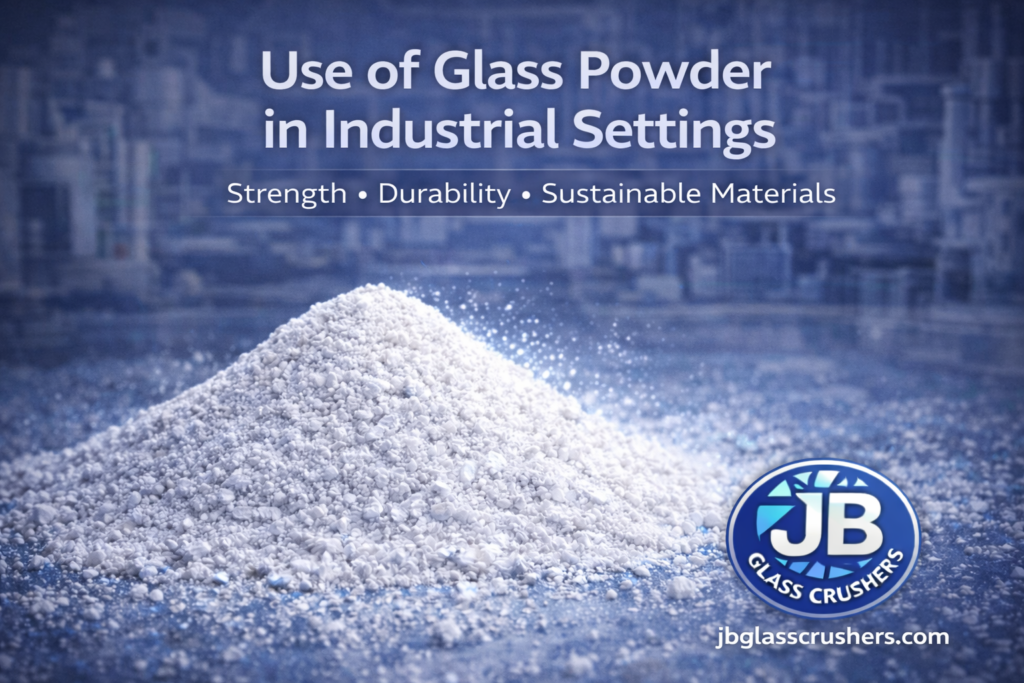
High-Performance Industrial Applications by JB Glass Crushers – Glass powder, finely milled and processed from recycled glass cullet is a highly versatile industrial material. At JB Glass Crushers, we manufacture premium quality glass powder in mesh sizes ranging from 100 mesh to 300 mesh, delivering performance benefits across multiple industrial sectors.
Whether you are developing high-performance coatings, advancing construction materials, or improving finished products, industrial glass powder offers a sustainable and cost-efficient solution.
What is Glass Powder?
Glass powder is produced by crushing and milling recycled glass into fine particles. The mesh size determines the fineness:
- 100 Mesh – General industrial fillers
- 200 Mesh – Smooth finish coatings
- 300 Mesh – Premium, high-performance applications
Unlike conventional mineral fillers, glass powder is chemically inert, non-porous, and environmentally sustainable.
What Is Industrial Glass Powder?
Glass powder is produced by crushing and milling discarded glass into fine particles. The mesh size determines particle diameter, with higher mesh numbers indicating finer powder. JB Glass Crushers supplies lab-tested glass powder with uniform particle distribution to ensure consistent industrial performance.
Reach out to JBGlassCrushers
Advantages of Industrial Glass Powder
Enhanced Mechanical Properties
Finely ground glass particles improve the mechanical strength of composites:
- Increases abrasion resistance
- Enhances structural stability
- Reduces cracking and surface wear
Ideal for heavy-duty industrial applications.
Glass particles improve compressive strength and abrasion resistance when incorporated into:
- Concrete
- Epoxy flooring systems
- Industrial coatings
- Polymer composites
Studies show finely ground glass can act as a supplementary performance enhancer in cementitious systems by improving particle packing density.
Improved Surface & Finish
Glass powder acts as a fine filler that improves the surface quality of products:
- Smooth, uniform finishes in coatings and paints
- Better texture and gloss control
- Reduces surface defects and pinholes
It is especially valuable in industrial coatings and decorative floor systems.
In paint and coating applications, glass powder:
- Improves leveling
- Reduces shrinkage cracks
- Enhances surface uniformity
- Improves gloss control
For coating manufacturers, 200–300 mesh glass powder provides superior dispersion compared to coarse fillers.
Enhanced Chemical & Environmental Resistance
Incorporating glass powder into industrial systems results in:
- Higher resistance to moisture and chemicals
- Reduced corrosion effects
- Improved longevity under harsh conditions
This makes it suitable for protective surfaces in factories, warehouses, and chemical plants.
Glass is naturally inert. When used in industrial systems, it enhances:
- Resistance to moisture
- Reduced corrosion penetration
- Improved durability in chemical environments
This makes it ideal for:
- Factory floors
- Warehouses
- Chemical processing plants
- Marine-exposed coatings
Cost-Effective & Sustainable
Glass powder is a value-added replacement for traditional mineral fillers such as silica and talc, offering:
- Reduces landfill waste
- Minimises mining of natural minerals
- Supports circular economy practices
- Helps meet green building standards
Using recycled glass contributes to a reduced carbon footprint in material production.
Key Industrial Applications
1. Coatings & Paints
Glass powder enhances industrial coatings used in:
- Factory floors
- Protective paints
- Powder coatings
- High-performance wall coatings
Benefits: smoother finish, better adhesion, and durability.
2. Construction Materials
Used to improve:
- Concrete mixes
- Precast architectural products
- Terrazzo and decorative flooring
- Tile adhesives and grouts
Benefits: higher strength, reduced cracking, and improved workability.
3. Industrial Flooring Systems
Perfect for:
- Epoxy flooring
- Self-leveling industrial floor coatings
- Heavy traffic & warehousing floors
Glass powder produces a tough, smooth, long-lasting surface with excellent chemical resistance.
4. Composites & Polymer Systems
Glass powder enhances polymer matrices by:
- Improving thermal and mechanical stability
- Providing dimension stability
- Enhancing surface finish for composites
Technical Advantages of Glass Powder
- Uniform particle size distribution
- Low oil absorption
- High hardness
- Non-reactive & stable
- Excellent compatibility with epoxy, acrylic & PU systems
Available in:
- Clear Glass Powder
- Color Glass Powder
High quality available in tons for bulk industrial supply.
Available Mesh Sizes
At JB Glass Crushers, we offer industrial glass powder in multiple grades:
| Mesh Size | Typical Use Cases |
|---|---|
| 100 Mesh | General industrial fillers, concrete admixtures |
| 200 Mesh | Coatings & paints requiring smoother finish |
| 300 Mesh & finer | Coatings & paints requiring a smoother finish |
All mesh sizes are lab-tested for particle size uniformity and performance consistency.
Why Choose JB Glass Crushers
Industrial Grade Quality – Lab tested, uniform particle size
Bulk Supply Across PAN India – Reliable delivery in tons
Clear & Color Glass Powder – Tailored to your application
Eco-Friendly Material – Made from recycled glass cullet
Frequently Asked Questions
Is glass powder safe for industrial use?
Yes. When properly processed and milled, it is safe and stable for use in coatings, concrete, and flooring systems.
What mesh size is best for epoxy flooring?
200 mesh and 300 mesh are preferred for smooth finishes and high durability.
Can glass powder replace silica in coatings?
In many formulations, it can partially replace silica depending on performance requirements.
Glass powder has become a high-value industrial raw material due to its strength enhancement, surface improvement, chemical resistance, and sustainability benefits. As industries move toward greener and more cost-efficient manufacturing processes, glass powder continues to gain demand.
JB Glass Crushers is committed to delivering industrial-grade glass powder solutions tailored to modern manufacturing needs.