
Flux materials are essential in ceramic tile manufacturing because they control melting, vitrification, and the final properties of ceramic bodies and glazes. Traditionally, feldspar minerals have been the primary flux used in ceramic formulations. However, the growing availability of recycled glass powder has introduced an alternative flux that offers both technical and environmental advantages.
Understanding how these two materials function in ceramic bodies helps manufacturers select the most efficient and sustainable flux for their production processes.
Role of Flux in Ceramic Tile Manufacturing
Ceramic tiles are typically made from mixtures of clay, quartz (silica), and flux materials. When these materials are fired in kilns at temperatures between 1000 °C and 1250 °C, fluxes melt and form a liquid phase that fills pores and bonds particles together.
This process, known as vitrification, determines several important properties of ceramic tiles, including:
- Mechanical strength
- Water absorption
- Surface finish
- Dimensional stability
Flux materials, therefore, play a crucial role in determining both manufacturing efficiency and final product quality.
What Is Feldspar?
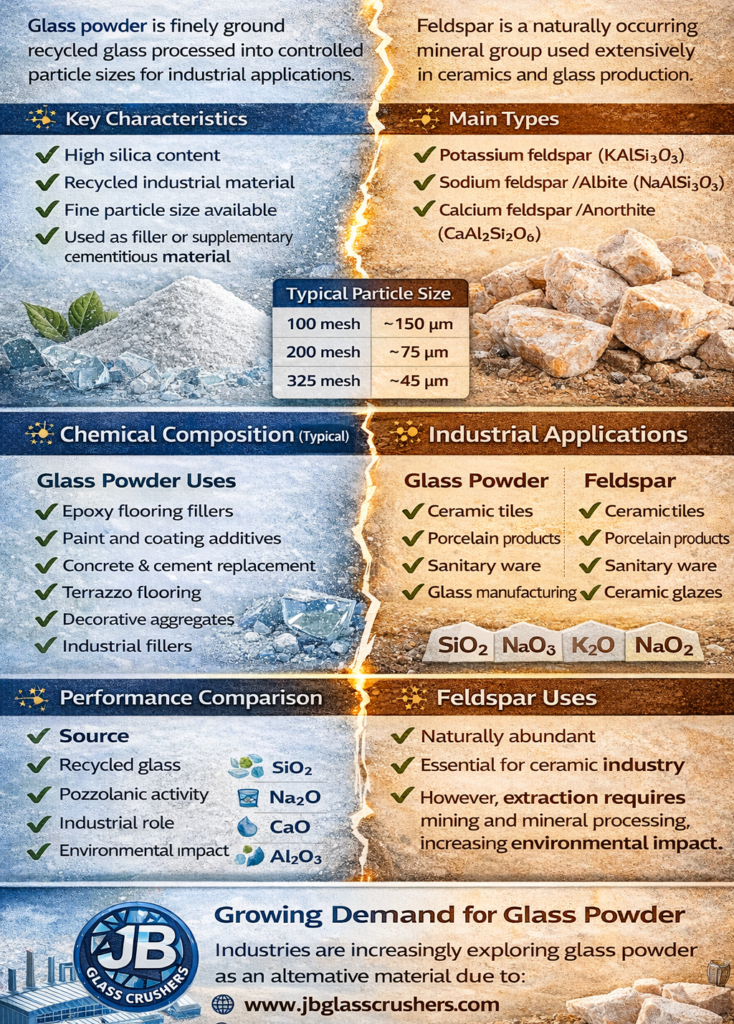
Feldspar is a naturally occurring mineral widely used in ceramics because of its ability to act as a flux during firing. The two most common feldspars used in ceramic bodies are:
- Potassium feldspar (K₂O·Al₂O₃·6SiO₂)
- Sodium feldspar (Na₂O·Al₂O₃·6SiO₂)
When heated, feldspar begins to melt and form a glassy phase that helps bind ceramic particles together. Because of this property, feldspar has been a standard raw material in tile and porcelain production for decades.
However, feldspar mining, processing, and transportation can increase material costs, and the supply of high-quality feldspar varies by region.
What Is Glass Powder?
Glass powder is produced by crushing and grinding recycled glass into fine particles. Most recycled glass originates from soda-lime glass, which contains silica, sodium oxide, and calcium oxide.
These compounds are similar to those found in ceramic flux materials. Because glass has already been melted during its original manufacturing process, it tends to soften and melt more easily during ceramic firing.
When ground into fine particles, glass powder can behave similarly to traditional ceramic frits or feldspar fluxes.
Chemical Composition Comparison
Although both materials act as fluxes, their compositions differ in important ways.
Feldspar:
- High silica content
- Contains alumina (Al₂O₃)
- Fluxing oxides, mainly sodium or potassium
Soda-Lime Glass Powder:
- Silica (SiO₂) as the structural component
- Sodium oxide (Na₂O) as a strong flux
- Calcium oxide (CaO) as a stabiliser
- Small amounts of magnesium and other oxides
Because glass powder contains sodium oxide and calcium oxide, it often melts more readily than feldspar during firing.
Melting Behavior and Flux Efficiency
One of the main differences between glass powder and feldspar is their melting behavior.
Feldspar typically begins melting at temperatures above 1100 °C and gradually forms a viscous liquid phase during firing. Glass powder, on the other hand, softens at lower temperatures because it has already been processed into a glassy structure.
This characteristic can provide several advantages:
- Faster formation of the liquid phase during firing
- Improved bonding between ceramic particles
- Potential reduction in kiln temperature
Lower firing temperatures can significantly reduce energy consumption in large ceramic kilns.
Impact on Ceramic Tile Properties
Strength and Densification
Both feldspar and glass powder promote densification by forming a liquid phase during firing. However, glass powder often melts more quickly, which can help improve particle bonding and reduce porosity.
Water Absorption
The formation of a glassy phase helps seal pores in ceramic bodies. When properly used, glass powder can produce tiles with low water absorption, similar to those produced using feldspar.
Surface Quality
In glaze systems, glass powder can contribute to smoother surfaces and improved gloss because of its glassy nature.
Cost Considerations
Feldspar is a mined mineral, and its price can vary depending on location, mining conditions, and transportation costs. In contrast, recycled glass powder is produced from waste glass, making it a potentially more economical raw material in regions where glass recycling infrastructure exists.
Using recycled glass powder may therefore help manufacturers reduce raw material costs while maintaining performance.
Environmental Sustainability
One of the most significant advantages of glass powder is its environmental impact.
Millions of tons of waste glass are generated each year, and a large portion ends up in landfills. Processing this waste into fine glass powder provides a way to reuse the material in industrial applications.
Incorporating recycled glass powder into ceramic tiles offers several environmental benefits:
- Reduction of landfill waste
- Lower demand for mined minerals
- Reduced energy consumption during firing
- Support for circular economy practices
These advantages align with global efforts to make construction materials more sustainable.
Limitations and Considerations
Despite its advantages, glass powder must be carefully controlled when used in ceramic formulations.
Factors that manufacturers usually evaluate include:
- Chemical composition consistency
- Particle size distribution
- Iron content, which may affect color
- Compatibility with existing ceramic body formulations
For highly white ceramics or sanitary ware, low-iron materials may still be preferred.
Which Flux Is Better?
Both feldspar and glass powder can function effectively as flux materials in ceramic tile production. The choice often depends on manufacturing goals and raw material availability.
Feldspar remains a reliable and widely used flux because of its consistent composition and long history in ceramic production.
Glass powder, however, offers several advantages:
- Lower melting temperature
- Faster vitrification
- Potential cost savings
- Environmental sustainability
For many ceramic tile manufacturers, glass powder can partially replace feldspar in body formulations, providing both technical and economic benefits.
Conclusion
Flux materials play a critical role in determining the performance and efficiency of ceramic tile manufacturing. While feldspar has traditionally been the dominant flux used in ceramics, finely ground soda-lime glass powder is emerging as a valuable alternative.
Its ability to melt easily, promote vitrification, and support sustainable manufacturing makes glass powder an attractive option for modern ceramic production. As recycling technologies improve and industries seek greener raw materials, glass powder is likely to become an increasingly important flux material in the ceramic tile industry.