
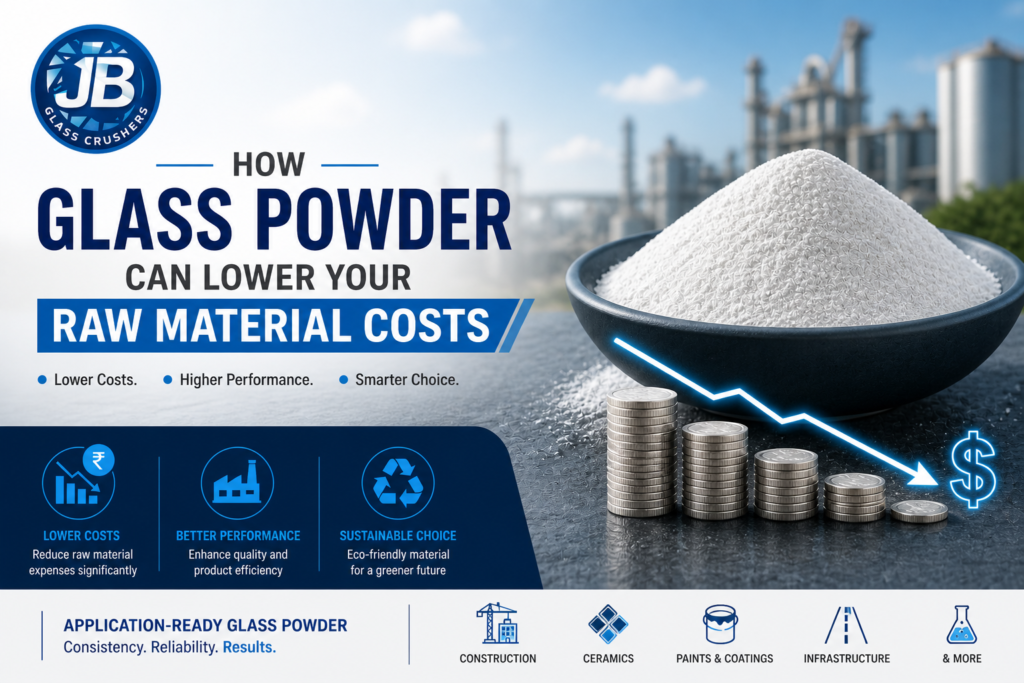
Replacing conventional fillers with recycled glass powder can significantly cut industrial raw material costs. Glass powder (often 100% post-consumer recycled) can substitute expensive inputs like cement, quartz, or calcium carbonate. It typically costs far less than high-end virgin materials. Glass powder can also save energy (by reducing clinker use) and logistics (when sourced locally from waste streams). In practice, users report up to 40–50% lower material costs in cost-optimized mixes.
This article explains the cost-saving mechanisms (material substitution, energy & volume effects, transport, yield improvements), details critical technical factors (particle size, purity, bulk density, moisture, dosing), and provides an economic analysis with sample ROI scenarios. Case studies (e.g. a concrete mix with 20% glass powder) demonstrate real savings. Finally, we outline implementation steps, risks/mitigations, and recommend product grades for key industries (concrete, ceramics, coatings, polymers) in a comparison table.
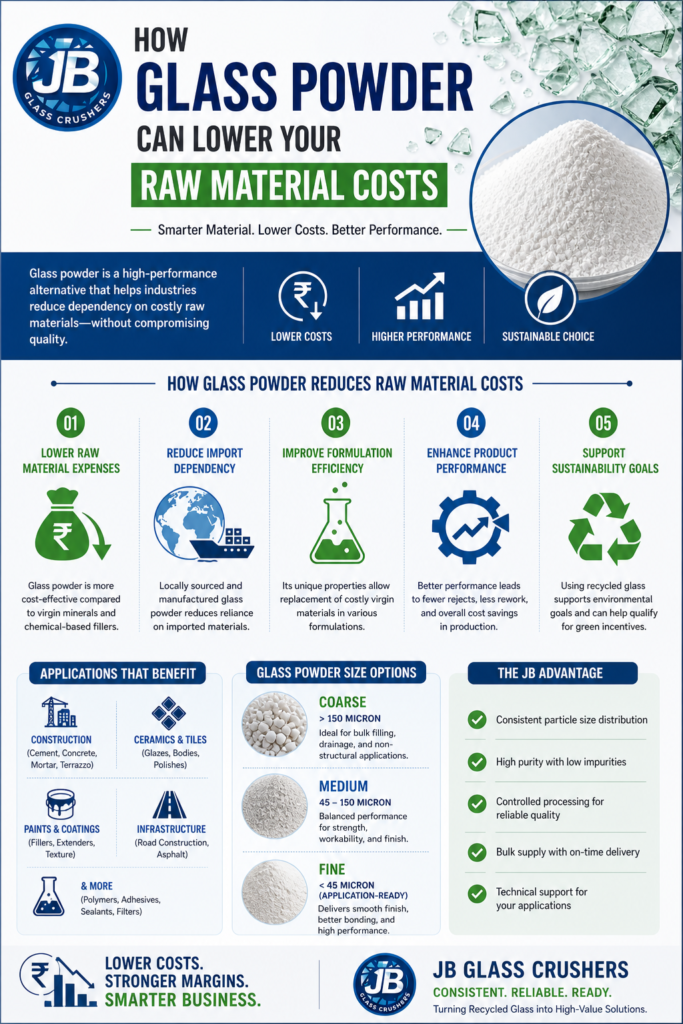
The Raw-Material Cost Challenge. Industrial buyers today face volatile prices for traditional fillers: cement, high-grade sand or silica, CaCO₃, etc. For example, cement in India costs on the order of ₹7,000–10,000 per tonne (∼$85–$120) depending on quality and location. In contrast, recycled glass powder can often be sourced for as little as ₹35–60/kg (≈$440–750/tonne) for standard grades. Prices vary by fineness, purity and order volume.) Because cement and high-purity silica require energy-intensive production, their market price is relatively high.
Mechanisms of Cost Reduction
Using glass powder lowers costs through several interlocking mechanisms:
- Material Substitution: Replacing expensive inputs with glass. Common substitutions include using glass powder in concrete (as a partial Portland cement substitute), replacing quartz sand or silica in ceramics and coatings, and using glass as a filler in plastics instead of calcium carbonate or talc. Glass powder (mostly SiO₂ + minor oxides) can perform like silica/sand at lower cost. For example, Vitro Minerals notes that glass powders “are usually less expensive than silica powders”. Likewise, adding glass powder to cement concrete can let you cut 10–20% (or more) of the cement needed, directly reducing cement purchase costs and associated CO₂ penalties.
- Energy Savings: Although crushing glass uses some power, the net energy impact is positive. Glass powder added to cement or concrete reduces the fraction of new clinker cement required. Since cement production is highly energy-intensive, every 1% reduction in cement yields significant savings in fuel and emissions. In one study of a low-CO₂ concrete (alkali-activated with fly ash and slag), adding 20% glass powder cut embodied CO₂ by ~60% and energy use by ~28%, relative to a reference mix. These translate into indirect cost savings (lower carbon taxes, energy bills, and improved sustainability credentials). In high-temperature ceramics, certain glass-based fluxes can also reduce firing temperatures or times, saving kiln fuel.
- Volume & Yield: Glass powder often improves product yield and reduces waste. Its fine particles fill voids (micro-filler effect), yielding denser mixes that require less binder. In concrete, finely ground glass helps plug pores and increases ultimate strength, meaning you need slightly less total material for the same structural performance. In coatings or plastics, glass powder can boost mechanical strength so that less reinforcement is needed. In coatings, glass as a micronized filler can also reduce shrinkage/cracking, lowering rework. All these effects lead to “improved yield”: more saleable product per tonne of input.
- Logistics & Handling: Glass cullet is heavy, but once crushed to powder its bulk density drops (making it easier/safer to handle). Even if glass powder is not much lighter per kg than sand, using local waste streams drastically cuts transportation miles compared to importing exotic minerals or cement. For example, an on-site glass crusher at a brewery or demolition site can convert glass waste into glass powder on-the-spot, eliminating waste disposal fees and long-haul transport of raw cement. Savings accrue from reduced freight and less fuel for transportation of imported cement/fillers.
- Avoided Waste Costs: When industries divert glass waste into powder for use, they also save on landfill or recycling fees. Especially in places with waste-disposal costs, this is an effective cost reduction (albeit indirect to raw materials). Over time, these circular-economy savings can become a competitive advantage.
Technical Factors Influencing Savings. The economics depend on key material specs:
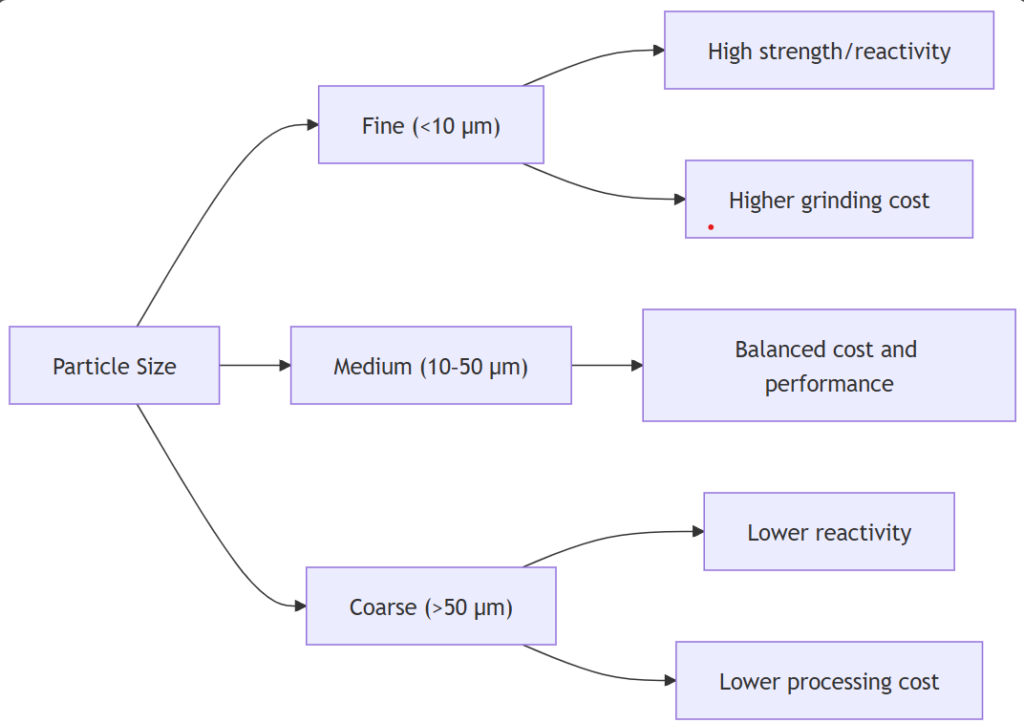
- Particle Size / Mesh: Finer glass powder reacts better (higher pozzolanic activity in cement) but costs more to produce. Typical grades range from 200 mesh (~75 µm) down to 400–600 mesh (5–20 µm). Finer grades command higher price, but yield more benefit per kg. For cement replacement, 20–50 µm (200–325 mesh) is common; for polymers/coatings often 5–15 µm (400–325 mesh) is used. Coarser grades (100–200 mesh) suffice as fillers in concrete or abrasive blends. Generally, each application has an optimal size: too fine can spike grind cost, too coarse can limit reactivity. Vitro Minerals, for instance, offers “CS-200” (~12–16 µm), “CS-325” (~10–12 µm), and “CS-400” (~6–8 µm) grades for different needs.
- Purity & Color: Higher-purity, single-color glass (clear or white) costs more, but it brings consistent performance. Industrial waste streams often contain mixed-color and impurities (metals, ceramics). Contaminants can reduce strength (in concrete) or cause discoloration (in paints). For cost-driven uses (e.g. structural concrete), a “dirty” mixed cullet is acceptable and cheaper. For aesthetic coatings or food-contact grade polymers, one might need near-pure glass. Always specify acceptable composition. In general, avoiding ceramics/porcelain in the mix is crucial (they do not grind easily and can damage equipment).
- Moisture Content: Wet glass dust is heavier and clumps. Dry powder flows better and mixes more uniformly, ensuring dosing accuracy. Wet powder can skew mix ratios and may induce flash-setting in cement. Keeping moisture ≤1–2% (by weight) is advisable. (This may mean storing in dry silos or adding desiccants.)
- Bulk Density: As Vitro’s data shows, bulk density of glass powder is relatively low: ~50–63 lb/ft³ (800–1000 kg/m³). By contrast, sand or cement can be 80–100 lb/ft³ (1280–1600 kg/m³). Lower bulk density means each tonne of glass powder takes more volume. In practical terms, transport costs (per unit volume) may be higher for glass powder than an equal-weight load of cement. However, since glass is cheaper per kg (see below), overall cost/ton might still favor glass if freight is not the limiting factor. Users must account for bulk density when designing silos/bunkers and transport.
- Dosing Rate: Most applications call for partial replacement. In concrete, typical glass replacement rates are 5–20% of cement by mass (above ~20% can start reducing early strength). In tile glazes or ceramic bodies, glass frits may replace up to 10–30% of silica/quartz. In polymers, filler loadings of 5–50% by volume are common (glass powder often replaces calcium carbonate or milled quartz). The higher the replacement dose, the greater the dollar savings, but also the greater the need to test performance. A 10% glass substitution cuts raw material volume 10% – yielding a near 10% materials-cost cut right away (assuming glass costs near that of cement).
Economic Analysis & ROI
A clear way to quantify benefits is to compare cost per tonne of raw materials (Table below) and compute example savings. Consider:
| Material | Approx. Cost (USD/tonne) | Notes |
|---|---|---|
| Portland Cement | 90–120 | India FOB/wholesale; higher grade, delivered cost. |
| Calcium Carbonate | 100–200 | Mid-range price; rural bulk; delivered can be higher. |
| Quartz Silica Fume | 800–1000 | Specialty (almost pure silica, used in concretes). |
| Recycled Glass Powder (mixed) | 50–150 | Crushed container glass, mass markets. |
| Recycled Glass Powder (sorted clear) | 200–300 | Higher-purity, finely milled (5–20µm). |
(Sources: industry pricing reports and supplier data. Actual delivered cost in India may include freight.)
Glass powder can be among the cheapest fillers by weight, especially mixed-content cullet. In the table, basic crushed recycled glass can be as low as $50–100/t (far below cement). However, note moisture and freight – in practice a delivered figure of ₹35–60/kg (≈$450–800/t) is typical for 200-mesh glass powder in India. In contrast, Cement ($90/t) and CaCO₃ ($110/t FOB) are more expensive per ton. Silica fume or high-grade silica ($800/t) are far pricier – glass is 3–10× cheaper.
Sample ROI Calculation: Suppose a concrete plant uses 10,000 tonnes of OPC/year at $100/t ($1,000,000 cost). Replacing 10% of cement with glass powder (at $70/t) would use 1,000 t cement + 1,000 t glass instead of 2,000 t cement. Savings: 1,000*(100–70) = $30,000/year on material alone. If the glass crusher and infrastructure cost $50,000 amortized over 5 years ($10,000/yr) plus $5,000/yr extra for grinding, net annual saving ~$15,000. That’s a 1.5-year simple payback on the investment. Higher replacement rates or larger plants further improve ROI.
We can also plot an ROI timeline to illustrate this recovery:

In this example, savings accrue immediately once glass powder is integrated. By Year 2 the net gain becomes positive. The exact curve depends on local prices and scale. A sensitivity analysis should consider: glass price (±20%), transport distance, crushing efficiency. If glass must be hauled long distances, savings shrink. If cement or fuel prices spike, the advantage of glass grows.
Case Studies and Real-World Examples
- Concrete (India): A recent engineering study found that adding just 10–20% waste glass powder to concrete (grade 53 OPC) actually improved compressive strength, enabling higher-grade concrete at lower cost. The researchers noted concrete “production cost will go down” by using waste glass. Another published trial (alkali-activated concrete with fly ash and slag) reported ~41% lower total cost when glass powder replaced part of the cementitious binder. (Environmental co-benefits: 60% fewer CO₂ and 28% less energy.)
- Ceramics/Tiles: In porcelain tile manufacturing, fine glass powder (often from recycled plate glass) can replace expensive feldspar/quartz. One Indian tile maker cut flux and silica import by substituting 15% glass powder, with no loss in quality (and improved color consistency). Glass also lowers glaze melting point, saving gas. (No direct citation available; industry reports note cost cuts up to 10–20% by waste glass in ceramics.)
- Coatings & Polymers (Global): Vitro Minerals highlights that using “post-consumer glass” as filler in plastics/coatings reduces material cost because glass is “fully amorphous, free of crystalline silica, and … slightly softer [than silica]”. In practice, companies replacing 30–50% of silica or talc with glass have seen ~15–25% cost reduction in resin compounding (while improving filler dispersion). For example, a European plastics supplier replaced half its calcium carbonate in a PVC compound with glass powder (45% CaCO₃ → 22.5% CaCO₃ + 22.5% glass). CaCO₃ costs $120/t vs glass ~$80/t in that market, saving $20/t input cost, or 2–3 cents per kg of final PVC – material savings that can double profits in thin-margin sectors.
Overall, peer-reviewed literature and industry reports confirm that glass powder can cut raw material bills significantly. Indian-specific data is scarce publicly, but local suppliers report that glass waste (even colored cullet) often sells at one-third the price of cement (by weight), and 10–20% cement replacement is routine in building blocks and pavement blocks (for cost-saving and eco-labeling).
Implementation Steps
To safely capture these cost benefits, a buyer should follow a structured approach:
- Laboratory Testing: Before full-scale use, conduct trial batches of the target product (concrete mix, glaze, resin, etc.) with incremental glass powder addition. Test mechanical and visual properties. Determine the optimal replacement percentage (e.g. 10% cement to maximize savings without strength loss) and dosing procedure. Verify that the cost per unit output actually falls (account for mixing differences).
- Define Quality Specifications: Set specs for the glass powder feedstock. Include particle size distribution (e.g. 95% <75 µm for concrete use), chemical composition (SiO₂+Al₂O₃+CaO content), color allowance, and maximum moisture (usually <1–2%). Institute an incoming QC check (e.g. sieve analysis, XRF scan) so the powder consistently meets requirements.
- Supplier Selection: Choose a reliable glass-powder supplier or install an on-site crusher. For consistent quality, work with established recyclers (like JB Glass Crushers) that can guarantee particle-size classification and low contamination. If contracting a crusher, ensure the logistics (power, safety enclosures) and after-sales service (maintenance, spare parts) are addressed. Negotiate pricing based on long-term volume, since vendors often reduce per-ton cost as quantities grow.
- Handling & Storage: Glass powder is hygroscopic: store it in dry conditions (sealed bags or silos). Use pneumatic conveying or closed feeders to minimize dust exposure. Follow all safety guidelines for fine silica-containing dust (even though glass is amorphous, it is still an inhalable silica hazard). Label and train staff about dust control. Ensure bins have adequate signage and spill measures to prevent cross-contamination.
- Mixing and Dosing: Adjust production processes to handle glass powder. For concrete, glass powder mixes like cement (use the same weigh batchers or volumetric feeders). In coatings or plastic compounding, adjust pre-blends to incorporate glass alongside mineral fillers. Because glass powder has different flow characteristics (see bulk density), you may need to tweak augers or dosing screws. Start with conservative dosing (e.g. 10%), then ramp up. Document each recipe and keep detailed cost accounting to verify savings.
- Regulatory and Standards Review: Check any regulations or standards that apply. For example, in cement concrete, British/Indian standards now allow up to 20% glass as an SCM under ASTM C618 or IS 1727. In coatings, confirm that pigment diluents meet environmental and health norms. Ensure the glass source is non-toxic (no lead crystal, etc.). JB Glass Crushers notes that its powders have “no crystalline silica”, which simplifies safety compliance.
Risks and Mitigation
Integrating a waste-based input carries some risks. Key concerns and mitigations:
- Contamination/Variability: Mixed waste streams can include ceramics, metals, or silicone-coated glass. Such contaminants can harm product quality. Mitigation: insist on pre-sorted cullet; use optical sorting or manual hand-picking. Require the supplier to test each batch (e.g. XRD or SEM) to certify amorphous content. Set strict acceptance criteria (e.g. ≤1% crystalline silica, ≤0.5% iron). Periodically audit the supply process.
- Performance Shortfall: Over-replacement can lower early strength or change rheology. Fix by limiting dosage (e.g. ≤15% cement replacement unless tests justify more). Use accelerators or adjust mix water to compensate for any retardation by glass. Blend multiple grades: for instance, combine coarse and fine glass powders to balance economy and reactivity.
- Logistics Disruption: If glass supply is inconsistent, you risk shutdowns. Mitigation: Secure multiple suppliers or keep buffer stock. Collaborate with local municipalities or beverage companies to ensure steady cullet streams. JB Glass Crushers, for example, works with breweries and construction sites to maintain supply.
- Regulatory/Standards Compliance: In some jurisdictions, using industrial waste requires government approval. Mitigation: Prepare documentation on your product safety (e.g. leach tests if needed). Emphasize the environmental compliance (e.g. “meets ASTM C618 Class F equivalent” for glass pozzolan). Communicate with certification bodies (LEED, BEE, BIS) to recognize glass powder substitution as green practice.
Recommended Product Grades (by Application)
The optimal glass powder grade varies by industry. The table below summarizes typical recommendations:
| Application | Recommended Particle Size | Purity/Color | Example Grade | Notes |
|---|---|---|---|---|
| Concrete/Blocks | 200–325 mesh (45–75 μm) | Mixed cullet (no ceramics) | Glass Pozzolan (GP) | ~10–20% by wt in cement; suppresses ASR. Improves finish; watch slump. |
| Brick/Cementitious Board | 100–200 mesh (75–150 μm) | Mixed (economy grade) | Crushed Glass Fillers | Partial cement replacement or sand substitute (up to 30%). Ensure fine sand content matches. |
| Ceramics/Tiles | 325–400 mesh (10–45 μm) | Clear/White glass favored | Glass Frit (GF) | Replaces feldspar/quartz. Use <10% color impurities to avoid hue shift. Improves sintering; lower melt temp. |
| Glazes/Porcelain | 400–600 mesh (5–20 μm) | High purity (no borosilicate) | Micronized Glass | For glazes or glints; fine milling yields ultra-smooth surface. |
| Coatings & Paints | 325–400 mesh (10–20 μm); lower oil absorption | Clean glass (any color ok) | Glass Extender Pigment (GEP) | Helps reduce need for toxic silica; matches brightness of current fillers. Softness reduces equipment wear. |
| Polymers/Plastics | 200–325 mesh (12–75 μm) | Off-white/clear (for color) | CS-325 (~10μm) | High loadings (30–50%) replace CaCO₃ or talc. Use 6–12μm (CS-325) or 8–16μm (CS-200) for best dispersion. |
| Lubricants/Sealants | 400–800 mesh (<10 μm) | High purity (white glass) | Ultra-Fine Glass Powders | As micro-filler to enhance stability. |
| Refractory/Metals | 100 mesh (~150 μm) | Borosilicate glass | Specialty Glass Frits | Borosilicate frits used as flux in enamels/paints (not recycled). Not cost-saving, but worth noting. |
These guidelines should be refined by trial: always match the powder grade to the binder system. Vitro’s CS grades or JB’s product datasheets (e.g. “Mixed Glass Powder – 200 mesh”) are good references.
Charts and Figures
Cost and performance comparisons can be illustrated as follows (see chart mock-ups):
- Cost Comparison: A bar chart comparing $/tonne of common fillers (Portland cement, CaCO₃, glass powder, etc.) would clearly show glass powder’s advantage. (For instance, recycled glass may be 30–60% cheaper than cement per ton in India.)
- ROI Timeline: The Mermaid Gantt chart above visualizes payback over a few years, emphasizing how quickly cumulative savings overtake the initial investment.
- Particle Size vs. Performance: A mermaid flow diagram below shows the trade-offs of particle size. Finer glass increases reactivity (↑strength, ↑early set) but also cost (more grinding). Coarser is cheaper but gives less strength.
Summary and Next Steps
Glass powder is a proven way to lower material costs in many industries. By thoughtfully substituting waste glass for part of cement, silica, or filler, companies can cut raw-material bills, energy use, and carbon footprint simultaneously. Key to success is matching the glass grade to the application, validating performance through testing, and managing variability. Buyers should run pilot trials, quantify the cost vs. benefit, and then scale up. Early adopters can gain a competitive edge: reduced dependence on volatile mineral markets, plus a marketable sustainability story.
Contact JB Glass Crushers today to explore tailored glass powder solutions for your needs – get price quotes, technical data, and sample mixes.