
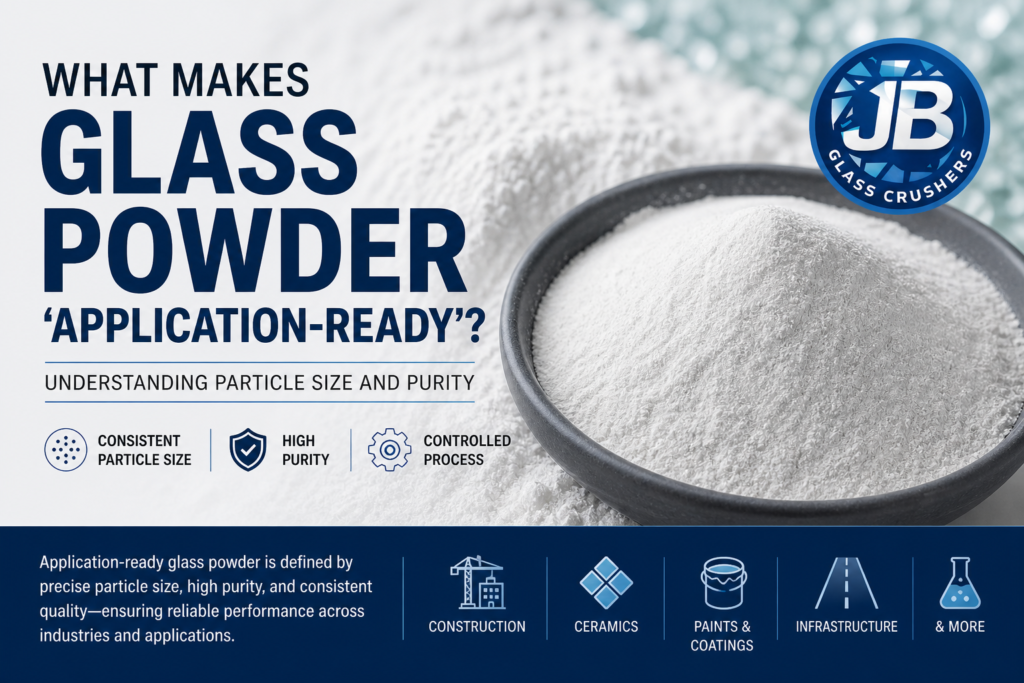
Industrial glass powder must be processed to tight particle-size and purity specifications so it performs reliably in downstream applications. “Application-ready” glass powder means uniform, calibrated fineness (with a well-defined particle-size distribution) and minimal contaminants or variable chemistry. Key attributes include a controlled mesh/pore size (often from ~50–1500 µm down to 1 µm), stable soda-lime composition, low moisture and impurities. This report reviews the defining properties of quality glass powder, typical industrial grades (mesh sizes and uses), how particle size affects performance in concrete, ceramics, coatings, plastics and other sectors, plus QA/test methods and processing steps. We also cover handling/packaging best practices and business benefits. Contact JB Glass Crushers for custom grades, samples or technical data.
What Is “Application-Ready” Glass Powder?
Application-ready glass powder is finely ground glass processed to meet precise industrial specifications (particle-size, purity, chemistry, moisture, etc.) so it can be used directly in manufacturing. It is an engineered raw material with uniform PSD (particle size distribution) and consistent composition. For example, JB Glass Crushers defines it as powder with controlled particle size and low contamination, for clients needing strict consistency. In practice this means glass powder that meets agreed mesh/μm ranges, has stable soda‑lime chemistry (e.g. ~70–75% SiO₂, ~12–15% Na₂O, ~9% CaO), very low moisture, and minimal non‑glass inclusions. Such consistency ensures reliable, repeatable results in concrete, coatings, ceramics and other processes (enabling predictable strength, color, reactivity, etc.).
Key Quality Attributes of Glass Powder
Glass powder quality hinges on its particle-size characteristics and purity. Important attributes include:
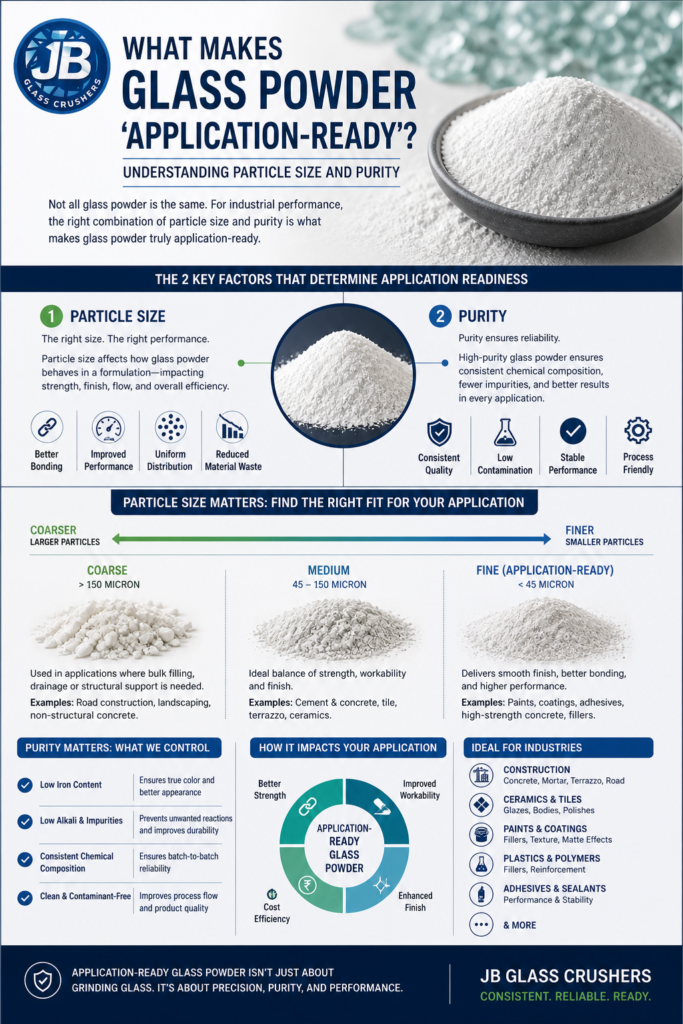
- Particle Size Distribution (PSD) and Mesh Size: Glass powder is specified by sieve mesh or μm. Typical industrial grades range from coarse (e.g. ~100 mesh ≈150 µm) to fine (300–400 mesh, ~50–40 µm). The PSD curve (cumulative % passing vs size) must be tight: for example, a “100 mesh” grade might have D50 around 100–120 µm, whereas a “200 mesh” grade has D50 ~60–75 µm. Figure: three glass powder samples illustrate how fineness increases (from right to left). Uniform PSD means most particles lie within the target range; this uniformity is critical for consistent reactivity and flow in applications. Coarse particles (>300 µm) or fines (<1 µm) outside spec are typically screened out.
- Purity and Chemistry: High-grade glass powder is typically soda-lime glass with a stable composition. A typical soda-lime glass batch is ~70–75% SiO₂, 12–15% Na₂O (soda), 9% CaO (lime) and minor Al₂O₃, MgO, K₂O. Analyses (e.g. XRF) confirm these oxides and trace elements (Fe₂O₃ is ideally very low). Minimal contaminants are crucial – any foreign material (metals, plastics, organics) is removed by processing and screening. JB Glass Crushers notes that controlled processing yields “uniform particle size distribution, stable soda-lime composition, and minimal impurities”. Typical specifications require glass powder to be essentially inert (unaffected by water), with hardness similar to silica, and free of paper/plastic shards or organic residues.
- Moisture and Flowability: Low moisture (<1–2% by weight) is essential so the powder flows freely and doesn’t cake. Controlled drying and storage (in dry bins or sealed bags) ensure moisture targets. Low moisture also extends shelf life and prevents lump formation. Flowability (resistance to bridging in silos) depends on particle shape and surface. Glass powder is usually angular (since crushing produces irregular grains), which tends to improve mechanical interlock but can reduce flow. Sometimes additives or air classification are used to improve flow.
- Other Physical Properties: Bulk density and specific gravity are typical values for logistics and mix design. Soda-lime glass powder has specific gravity ~2.4–2.6 g/cc (depending on composition). Bulk (pack) density varies with mesh (finer powder packs denser). Particle shape (angular vs rounded) affects packing and reactivity – angular glass particles have more surface area. Glass powder is inherently hard and inert (Mohs ~6–7, insoluble), providing abrasion resistance when used as filler.
- Colour and Iron Content: For many uses the powder is clear/white or light green (soda-lime glass has slight green tint from Fe). High-end grades require low iron content (<0.1–0.2%) to avoid coloration in paints or ceramics, and to maximize brightness. Colour-sorted powders (clear, green, mixed) are available, but all have controlled metallic oxide levels.
- LoI (Organic Content): A low Loss-on-Ignition (LOI) value (<0.5–1%) indicates negligible carbon or organics. LOI is measured by weight loss on heating (e.g. 1000 °C) and ensures the powder is essentially pure glass.
Typical Grades and Specifications
| Grade (mesh) | Approx. Size Range (µm) | Example Applications |
|---|---|---|
| 100–150 | ~150–100 | Primers, anti-skid coatings |
| 150–200 | ~100–75 | Epoxy & industrial coatings |
| 200–300 | ~75–50 | Ceramic glazes, high-clarity paints |
| 300–400 | ~50–38 | Fine fillers for plastics, adhesives |
These ranges are illustrative: custom grades (e.g. 50–70 mesh or 325 mesh) are also common. For instance, a finer “300 mesh” (~50 µm) glass powder yields smoother finishes in ceramics or paint, while a coarser “100 mesh” (~150 µm) can impart texture or replace sand. JB Glass Crushers produces all these industrial grades with tight control.
Impact of Particle Size on Applications
Particle size strongly affects how glass powder behaves in each use-case. In general, finer glass reacts or binds more readily, while coarser particles impart bulk or texture. Key examples by sector:
- Concrete / Cement: When used as a supplementary cementitious material (SCM), very fine glass powder (often <45 µm) can participate in pozzolanic reactions with Ca(OH)₂, improving strength and durability. Studies show that glass powder with a PSD centered around 50–60 µm optimally enhances tensile strength in concrete. Coarser glass sand (150–300 µm) is often used as aggregate replacement. Fine powder helps reduce alkali–silica reaction if ground below a critical size. In practice, glass powder grades for cement replacement are usually 200–325 mesh (~75–44 µm).
- Ceramics / Tiles: Glass powder is used in glazes and bodies. Finer grades (150–300 mesh) give smooth surface finish and sinter uniformly. Low-iron clear glass powder avoids color defects. Controlled fineness ensures consistent firing; irregular (angular) particles can improve green strength of pressed tiles. JB Glass Crushers notes that controlled fineness and low impurities improve the surface finish and strength of ceramic tiles.
- Paints & Coatings: Medium-fine glass powder (typically 150–200 mesh) is used as a functional filler. It enhances abrasion resistance, matte finish, and weathering properties. Because glass is inert, it can improve chemical resistance in coatings. For example, 200–300 mesh provides finer dispersion (smoother finish) in high-quality paints, while 100–150 mesh might be used for anti-skid road markings. Fine glass powder (to 325 mesh) also helps in high-performance industrial primers, where uniform particle size prevents clogging and ensures gloss.
- Plastics / Polymers: Glass powders (typically 200–300 mesh) are added to plastics or rubber to increase rigidity and thermal stability. Smaller particles disperse better; coarser particles (>100 mesh) may degrade surface finish. Uniform fillers reduce stress concentrations. In composites (e.g. epoxy), fine glass powder improves process control and can lower cost. The angular glass particles interlock in polymer matrices, boosting mechanical strength without moisture pickup.
- Abrasives & Sandblasting: Coarser crushed glass (
80–100 mesh, 180–150 µm) is widely used as a blasting abrasive (it’s hard and sharp). Particle size dictates aggressiveness: coarse glass abrasives cut faster, finer ones polish more gently. Coarse 30–50 mesh (>350 µm) is used for heavy-duty stripping, while 100–200 mesh is common for general blasting. For precision abrasives, monodisperse glass beads or 400+ mesh glass powders (<38 µm) can be used to polish or matte surfaces. - Road Construction / Aggregates: Finely ground glass (100–200 mesh) can substitute mineral filler or sand in asphalt and concrete, improving durability. Special reflective glass powders (clear beads, ~200–400 mesh) are used in road marking paints to enhance night visibility (they refract headlights). Aggregate-size glass cullet (several mm) is also used in pavement layers, but that is beyond “powder” range.
Each application has an optimal PSD. Generally, finer glass powder increases reactivity and smoothness (e.g. in cement or coatings), while coarser powder or cullet provides bulk and texture (e.g. anti-skid coatings, abrasives). JB Glass Crushers works with clients to recommend specific mesh grades for each industry need.
Quality Testing & Specification Control
Robust QA methods ensure the powder meets specs. Key tests and methods include:
- Particle Size Analysis: Dry sieving and laser diffraction are used. Industrial labs often perform sieve analysis (e.g. using ASTM/ISO sieves down to 325 mesh) to verify mesh spec. Laser diffraction (ISO 13320) yields a full PSD curve (D10/D50/D90). Specifications may require, for example, 90% passing a certain mesh. (E.g. 90% <150 µm for 100 mesh grade.) Tight tolerances (<±10 µm) are common.
- Chemical Composition (XRF): X-ray Fluorescence (XRF) spectrometry is standard to assay glass powder oxides. It measures SiO₂, CaO, Na₂O, Al₂O₃, and trace elements. For soda-lime glass, an acceptable composition might be ~70% SiO₂, 12–15% Na₂O, 9–12% CaO, with <0.5% Fe₂O₃. Stable composition (within ±1–2% of target oxides) is crucial for consistent performance. XRF ensures the glass chemistry is within customer specs and detects any heavy-metal impurities.
- Contamination Screening: Powder samples are visually examined (microscope) for foreign particles (plastic, metal, paper). Magnetic separators can verify removal of any ferrous debris. JB Glass Crushers emphasizes that “advanced processing minimizes contamination (paper, plastic, organic impurities)”. Acceptable limits depend on the client; typically contamination must be 0% by visual count, and sensors ensure any detected trash is removed.
- Loss-on-Ignition (LOI): LOI tests for volatile organics or carbonates. A typical method is heating ~1 g of powder at ~1000 °C and measuring weight loss. An LOI below about 0.5–1% indicates very low organic content, confirming purity. This ensures the glass hasn’t absorbed oils or moisture, which could affect processing.
- Moisture Content: Measured by drying a sample (e.g. 2 h at 105 °C). For most glass powders, moisture must be kept very low – typically <1%. High moisture (>2%) can cause clumping or feeding issues. Specifications often set max moisture by weight (e.g. ≤0.5%).
- Bulk Density: Though not a purity test, bulk density (mass/volume) is measured to ensure consistency batch-to-batch. It is useful for mix design in applications. For example, a specification might require 1.0–1.3 g/cc (loose fill) for a given mesh.
A sample specification table might look like:
| Test | Method / Standard | Target / Limit |
|---|---|---|
| Particle Size | Laser diffraction or sieving (ASTM D6913 / ISO 13320) | e.g. ≥95% <150 µm for 100 mesh grade |
| Chemical Composition | XRF spectrometry (ASTM C114, ISO) | SiO₂ ~70%, Na₂O 12–15%, CaO ~9–12%, Fe₂O₃ <0.1% |
| Fe / Metallic Impurities | Magnetic / optical inspection | Nil detected |
| Loss on Ignition | 2h @1000 °C (ASTM E1131) | <0.5–1% |
| Moisture Content | 2h @105 °C (ASTM D2216) | <1% by weight |
| Bulk Density | Tapped/untapped density test | Within ±5% of spec (application-dependent) |
These tests are routinely done on each production batch. JB Glass Crushers, for instance, uses sieving and laser PSD checks plus XRF to “ensure uniform particle size distribution [and] minimal impurities”. Meeting these QA thresholds is what makes the powder truly application-ready.
What Is “Application-Ready” Glass Powder?
Application-ready glass powder is finely ground glass processed to meet precise industrial specifications (particle-size, purity, chemistry, moisture, etc.) so it can be used directly in manufacturing. It is an engineered raw material with uniform PSD (particle size distribution) and consistent composition. For example, JB Glass Crushers defines it as powder with controlled particle size and low contamination, for clients needing strict consistency. In practice this means glass powder that meets agreed mesh/μm ranges, has stable soda‑lime chemistry (e.g. ~70–75% SiO₂, ~12–15% Na₂O, ~9% CaO), very low moisture, and minimal non‑glass inclusions. Such consistency ensures reliable, repeatable results in concrete, coatings, ceramics and other processes (enabling predictable strength, color, reactivity, etc.).
Key Quality Attributes of Glass Powder
Glass powder quality hinges on its particle-size characteristics and purity. Important attributes include:
- Particle Size Distribution (PSD) and Mesh Size: Glass powder is specified by sieve mesh or μm. Typical industrial grades range from coarse (e.g. ~100 mesh ≈150 µm) to fine (300–400 mesh, ~50–40 µm). The PSD curve (cumulative % passing vs size) must be tight: for example, a “100 mesh” grade might have D50 around 100–120 µm, whereas a “200 mesh” grade has D50 ~60–75 µm. Figure: three glass powder samples illustrate how fineness increases (from right to left). Uniform PSD means most particles lie within the target range; this uniformity is critical for consistent reactivity and flow in applications. Coarse particles (>300 µm) or fines (<1 µm) outside spec are typically screened out.
- Purity and Chemistry: High-grade glass powder is typically soda-lime glass with a stable composition. A typical soda-lime glass batch is ~70–75% SiO₂, 12–15% Na₂O (soda), 9% CaO (lime) and minor Al₂O₃, MgO, K₂O. Analyses (e.g. XRF) confirm these oxides and trace elements (Fe₂O₃ is ideally very low). Minimal contaminants are crucial – any foreign material (metals, plastics, organics) is removed by processing and screening. JB Glass Crushers notes that controlled processing yields “uniform particle size distribution, stable soda-lime composition, and minimal impurities”. Typical specifications require glass powder to be essentially inert (unaffected by water), with hardness similar to silica, and free of paper/plastic shards or organic residues.
- Moisture and Flowability: Low moisture (<1–2% by weight) is essential so the powder flows freely and doesn’t cake. Controlled drying and storage (in dry bins or sealed bags) ensure moisture targets. Low moisture also extends shelf life and prevents lump formation. Flowability (resistance to bridging in silos) depends on particle shape and surface. Glass powder is usually angular (since crushing produces irregular grains), which tends to improve mechanical interlock but can reduce flow. Sometimes additives or air classification are used to improve flow.
- Other Physical Properties: Bulk density and specific gravity are typical values for logistics and mix design. Soda-lime glass powder has specific gravity ~2.4–2.6 g/cc (depending on composition). Bulk (pack) density varies with mesh (finer powder packs denser). Particle shape (angular vs rounded) affects packing and reactivity – angular glass particles have more surface area. Glass powder is inherently hard and inert (Mohs ~6–7, insoluble), providing abrasion resistance when used as filler.
- Colour and Iron Content: For many uses the powder is clear/white or light green (soda-lime glass has slight green tint from Fe). High-end grades require low iron content (<0.1–0.2%) to avoid coloration in paints or ceramics, and to maximize brightness. Colour-sorted powders (clear, green, mixed) are available, but all have controlled metallic oxide levels.
- LoI (Organic Content): A low Loss-on-Ignition (LOI) value (<0.5–1%) indicates negligible carbon or organics. LOI is measured by weight loss on heating (e.g. 1000 °C) and ensures the powder is essentially pure glass.
Typical Grades and Specifications
| Grade (mesh) | Approx. Size Range (µm) | Example Applications |
|---|---|---|
| 100–150 | ~150–100 | Primers, anti-skid coatings |
| 150–200 | ~100–75 | Epoxy & industrial coatings |
| 200–300 | ~75–50 | Ceramic glazes, high-clarity paints |
| 300–400 | ~50–38 | Fine fillers for plastics, adhesives |
These ranges are illustrative: custom grades (e.g. 50–70 mesh or 325 mesh) are also common. For instance, a finer “300 mesh” (~50 µm) glass powder yields smoother finishes in ceramics or paint, while a coarser “100 mesh” (~150 µm) can impart texture or replace sand. JB Glass Crushers produces all these industrial grades with tight control.
Impact of Particle Size on Applications
Particle size strongly affects how glass powder behaves in each use-case. In general, finer glass reacts or binds more readily, while coarser particles impart bulk or texture. Key examples by sector:
- Concrete / Cement: When used as a supplementary cementitious material (SCM), very fine glass powder (often <45 µm) can participate in pozzolanic reactions with Ca(OH)₂, improving strength and durability. Studies show that glass powder with a PSD centered around 50–60 µm optimally enhances tensile strength in concrete. Coarser glass sand (150–300 µm) is often used as aggregate replacement. Fine powder helps reduce alkali–silica reaction if ground below a critical size. In practice, glass powder grades for cement replacement are usually 200–325 mesh (~75–44 µm).
- Ceramics / Tiles: Glass powder is used in glazes and bodies. Finer grades (150–300 mesh) give smooth surface finish and sinter uniformly. Low-iron clear glass powder avoids color defects. Controlled fineness ensures consistent firing; irregular (angular) particles can improve green strength of pressed tiles. JB Glass Crushers notes that controlled fineness and low impurities improve the surface finish and strength of ceramic tiles.
- Paints & Coatings: Medium-fine glass powder (typically 150–200 mesh) is used as a functional filler. It enhances abrasion resistance, matte finish, and weathering properties. Because glass is inert, it can improve chemical resistance in coatings. For example, 200–300 mesh provides finer dispersion (smoother finish) in high-quality paints, while 100–150 mesh might be used for anti-skid road markings. Fine glass powder (to 325 mesh) also helps in high-performance industrial primers, where uniform particle size prevents clogging and ensures gloss.
- Plastics / Polymers: Glass powders (typically 200–300 mesh) are added to plastics or rubber to increase rigidity and thermal stability. Smaller particles disperse better; coarser particles (>100 mesh) may degrade surface finish. Uniform fillers reduce stress concentrations. In composites (e.g. epoxy), fine glass powder improves process control and can lower cost. The angular glass particles interlock in polymer matrices, boosting mechanical strength without moisture pickup.
- Abrasives & Sandblasting: Coarser crushed glass (
80–100 mesh, 180–150 µm) is widely used as a blasting abrasive (it’s hard and sharp). Particle size dictates aggressiveness: coarse glass abrasives cut faster, finer ones polish more gently. Coarse 30–50 mesh (>350 µm) is used for heavy-duty stripping, while 100–200 mesh is common for general blasting. For precision abrasives, monodisperse glass beads or 400+ mesh glass powders (<38 µm) can be used to polish or matte surfaces. - Road Construction / Aggregates: Finely ground glass (100–200 mesh) can substitute mineral filler or sand in asphalt and concrete, improving durability. Special reflective glass powders (clear beads, ~200–400 mesh) are used in road marking paints to enhance night visibility (they refract headlights). Aggregate-size glass cullet (several mm) is also used in pavement layers, but that is beyond “powder” range.
Each application has an optimal PSD. Generally, finer glass powder increases reactivity and smoothness (e.g. in cement or coatings), while coarser powder or cullet provides bulk and texture (e.g. anti-skid coatings, abrasives). JB Glass Crushers works with clients to recommend specific mesh grades for each industry need.
Quality Testing & Specification Control
Robust QA methods ensure the powder meets specs. Key tests and methods include:
- Particle Size Analysis: Dry sieving and laser diffraction are used. Industrial labs often perform sieve analysis (e.g. using ASTM/ISO sieves down to 325 mesh) to verify mesh spec. Laser diffraction (ISO 13320) yields a full PSD curve (D10/D50/D90). Specifications may require, for example, 90% passing a certain mesh. (E.g. 90% <150 µm for 100 mesh grade.) Tight tolerances (<±10 µm) are common.
- Chemical Composition (XRF): X-ray Fluorescence (XRF) spectrometry is standard to assay glass powder oxides. It measures SiO₂, CaO, Na₂O, Al₂O₃, and trace elements. For soda-lime glass, an acceptable composition might be ~70% SiO₂, 12–15% Na₂O, 9–12% CaO, with <0.5% Fe₂O₃. Stable composition (within ±1–2% of target oxides) is crucial for consistent performance. XRF ensures the glass chemistry is within customer specs and detects any heavy-metal impurities.
- Contamination Screening: Powder samples are visually examined (microscope) for foreign particles (plastic, metal, paper). Magnetic separators can verify removal of any ferrous debris. JB Glass Crushers emphasizes that “advanced processing minimizes contamination (paper, plastic, organic impurities)”. Acceptable limits depend on the client; typically contamination must be 0% by visual count, and sensors ensure any detected trash is removed.
- Loss-on-Ignition (LOI): LOI tests for volatile organics or carbonates. A typical method is heating ~1 g of powder at ~1000 °C and measuring weight loss. An LOI below about 0.5–1% indicates very low organic content, confirming purity. This ensures the glass hasn’t absorbed oils or moisture, which could affect processing.
- Moisture Content: Measured by drying a sample (e.g. 2 h at 105 °C). For most glass powders, moisture must be kept very low – typically <1%. High moisture (>2%) can cause clumping or feeding issues. Specifications often set max moisture by weight (e.g. ≤0.5%).
- Bulk Density: Though not a purity test, bulk density (mass/volume) is measured to ensure consistency batch-to-batch. It is useful for mix design in applications. For example, a specification might require 1.0–1.3 g/cc (loose fill) for a given mesh.
A sample specification table might look like:
| Test | Method / Standard | Target / Limit |
|---|---|---|
| Particle Size | Laser diffraction or sieving (ASTM D6913 / ISO 13320) | e.g. ≥95% <150 µm for 100 mesh grade |
| Chemical Composition | XRF spectrometry (ASTM C114, ISO) | SiO₂ ~70%, Na₂O 12–15%, CaO ~9–12%, Fe₂O₃ <0.1% |
| Fe / Metallic Impurities | Magnetic / optical inspection | Nil detected |
| Loss on Ignition | 2h @1000 °C (ASTM E1131) | <0.5–1% |
| Moisture Content | 2h @105 °C (ASTM D2216) | <1% by weight |
| Bulk Density | Tapped/untapped density test | Within ±5% of spec (application-dependent) |
These tests are routinely done on each production batch. JB Glass Crushers, for instance, uses sieving and laser PSD checks plus XRF to “ensure uniform particle size distribution [and] minimal impurities”. Meeting these QA thresholds is what makes the powder truly application-ready.