
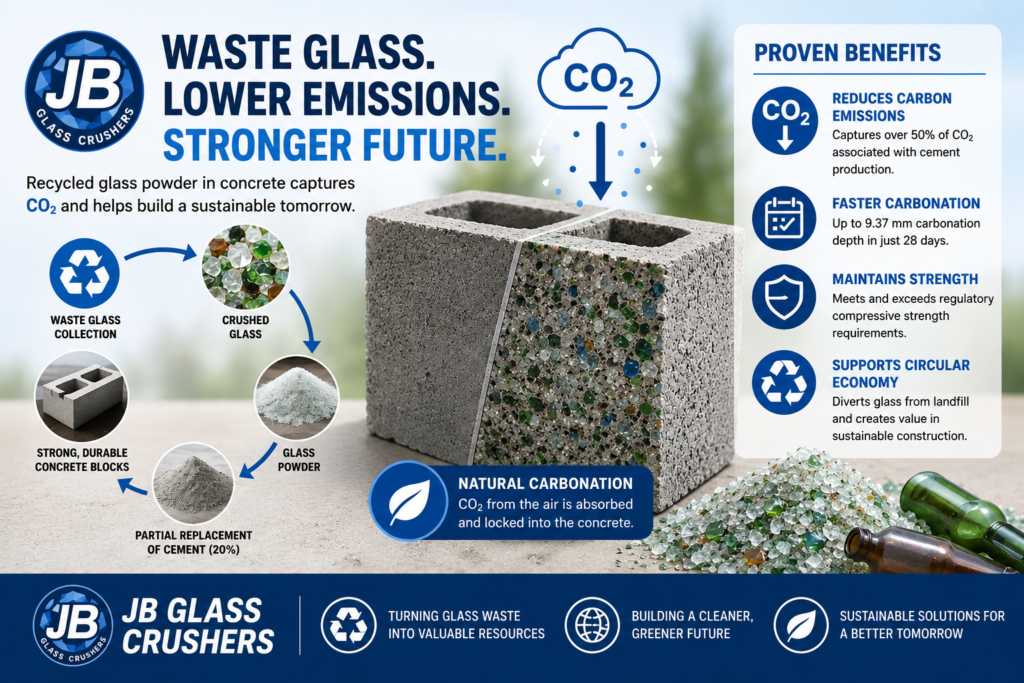
As the construction industry faces increasing pressure to reduce carbon emissions, researchers are uncovering new ways to transform waste materials into climate-friendly building solutions. One promising innovation is the use of glass powder as a partial replacement for cement in concrete.
Recent research has demonstrated that incorporating glass powder into concrete masonry products not only reduces the demand for carbon-intensive cement but also enhances the material’s ability to capture and store carbon dioxide from the atmosphere.
Why Cement’s Carbon Footprint Matters
Cement production is responsible for approximately 7–8% of global carbon dioxide emissions. Manufacturing Portland cement requires high-temperature kilns and releases significant amounts of CO₂ during both fuel combustion and the chemical conversion of limestone.
Reducing cement consumption is therefore one of the most effective ways to lower the environmental impact of concrete construction.
This is where glass powder offers an exciting opportunity.
Turning Waste Glass into a Valuable Construction Material
Millions of glass bottles and containers are discarded every year, with a large percentage still ending up in landfill. By crushing and processing waste glass into fine powder, this material can be used as a supplementary cementitious material in concrete production.
Researchers evaluated concrete mixtures containing 20% glass powder as a replacement for Portland cement and compared their performance with conventional concrete used in masonry block manufacturing.
The results were encouraging.
Capturing Carbon Through Natural Carbonation
One of the most significant findings was the ability of glass-modified concrete to absorb carbon dioxide through a natural process known as carbonation.
During carbonation, CO₂ from the atmosphere reacts with compounds within the concrete, forming stable calcium carbonate minerals that permanently store carbon.
The study found that concrete containing glass powder achieved:
- Faster carbonation rates
- Greater carbonation depth
- Significant long-term carbon storage potential
- Comparable mechanical performance to conventional concrete
After just 28 days, the glass powder concrete reached carbonation depths of more than 9 mm, demonstrating an accelerated ability to capture atmospheric carbon dioxide.
Lower Emissions Without Sacrificing Strength
A common concern when replacing cement is whether structural performance will be affected.
The research showed that concrete containing 20% glass powder maintained compressive strength well above industry requirements. In fact, all test samples exceeded the minimum standards for masonry block production.
This means manufacturers can reduce cement usage while continuing to produce durable, high-performance products.
For builders, developers, and concrete producers, this represents a practical pathway toward lower-carbon construction without compromising quality.
Supporting Circular Economy Goals
Using glass powder creates environmental benefits on multiple levels:
Diverts Glass from Landfill
Waste glass is transformed into a valuable industrial resource instead of becoming landfill waste.
Reduces Cement Consumption
Replacing a portion of cement directly lowers embodied carbon emissions.
Enhances Carbon Capture
Glass-modified concrete can absorb and permanently store carbon dioxide during its service life.
Creates Sustainable Building Products
The resulting concrete maintains the performance required for real-world construction applications.
Together, these benefits support circular economy initiatives that prioritise resource efficiency and waste reduction.
What This Means for the Glass Recycling Industry
The growing interest in alternative construction materials is creating new markets for glass products. As research continues to demonstrate the technical and environmental advantages of glass powder, demand for high-quality glass feedstock is expected to increase.
This highlights the importance of efficient glass crushing and processing systems capable of producing consistent particle sizes suitable for advanced manufacturing applications.
JB Glass Crushers: Helping Build a Low-Carbon Future
At JB Glass Crushers, we believe that every bottle has value beyond its first use. Our glass crushing solutions help businesses, councils, hospitality venues, and recycling facilities convert waste glass into reusable resources that support sustainable industries.
Innovations such as glass-enhanced concrete demonstrate how glass can contribute to reducing carbon emissions, supporting circular economy goals, and creating stronger environmental outcomes.
As demand grows for sustainable building materials, glass is proving to be much more than waste—it is becoming an essential ingredient in the construction materials of the future.
Discover the Potential of Glass
Contact JB Glass Crushers today to learn how our glass processing solutions can help your organisation reduce waste, lower disposal costs, and unlock new opportunities in sustainable construction and manufacturing.