
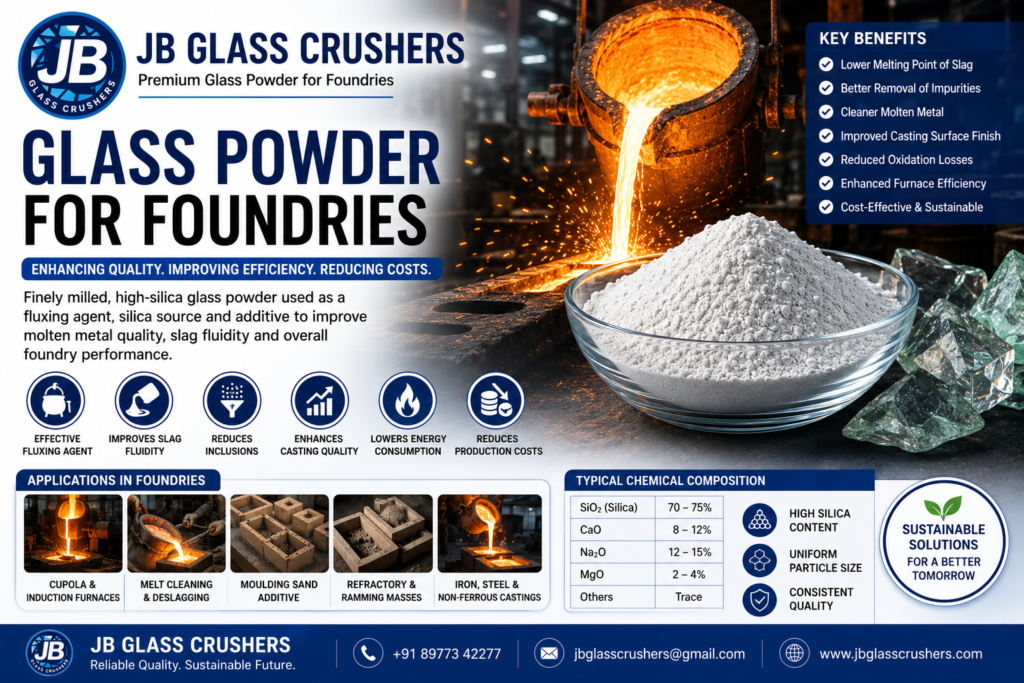
How Finely Milled Glass Powder is Creating Value in Modern Foundries
The foundry industry is continuously seeking ways to improve casting quality, reduce production costs, enhance energy efficiency, and optimize raw material utilization. One material gaining increasing attention is finely milled glass powder, a silica-rich product derived from high-quality clear float glass. Due to its unique chemical composition and melting behavior, glass powder is proving to be an effective additive in foundry operations, particularly as a fluxing agent and silica source.
What is Glass Powder?
Glass powder is produced by crushing and micronizing clean float glass into fine particles of controlled mesh size. High-quality glass powder typically contains:
| Component | Typical Content |
|---|---|
| SiO₂ (Silica) | 70–75% |
| CaO | 8–12% |
| Na₂O | 12–15% |
| MgO | 2–4% |
| Others | Trace |
The high silica content combined with alkali oxides makes glass powder highly reactive at elevated temperatures.
Role of Glass Powder in Foundry Applications
1. Fluxing Agent in Metal Melting
Glass powder lowers the melting point of slag and assists in the formation of a fluid slag layer.
Benefits:
- Faster slag formation
- Improved slag fluidity
- Better removal of non-metallic inclusions
- Reduced oxidation losses
- Lower furnace energy consumption
- Cleaner molten metal
Many foundries utilize glass powder in cupola, induction, and furnace melting operations to improve melt cleanliness and process efficiency.
2. Binder and Additive in Moulding Sand Systems
Finely milled glass particles can improve particle packing within sand mixtures.
Advantages:
- Better surface finish of castings
- Improved mould strength
- Reduced permeability variations
- Enhanced dimensional accuracy
This makes glass powder a valuable supplementary material in certain moulding and core-making applications.
3. Refractory and Ramming Mass Applications
Glass powder is increasingly incorporated into refractory products and monolithic formulations.
Key Benefits:
- Enhanced particle packing density
- Improved sintering characteristics
- Better bonding between particles
- Reduced porosity
- Improved thermal stability
These properties help improve refractory life and overall furnace performance.
Why Glass Powder Works as a Flux
Unlike pure silica sand, glass powder contains naturally occurring alkali oxides that soften and melt at lower temperatures.
This provides:
Lower Fusion Temperature
Glass begins softening earlier than conventional silica materials.
Improved Wetting Action
Molten glass promotes better interaction between slag-forming constituents.
Enhanced Slag Mobility
A more fluid slag layer improves impurity removal and furnace efficiency.
Operational Benefits for Foundries
Improved Casting Quality
Glass powder assists in reducing:
- Oxide inclusions
- Surface defects
- Slag entrapment
- Blowholes related to contamination
Resulting in cleaner castings and reduced rejection rates.
Reduced Production Costs
Foundries can achieve savings through:
- Lower energy consumption
- Reduced flux consumption
- Improved metal recovery
- Fewer casting defects
- Reduced rework and scrap
Enhanced Furnace Efficiency
A more fluid slag system improves heat transfer and furnace productivity while reducing downtime for cleaning operations.
Applications Across Foundry Segments
Iron Foundries
- Grey Iron
- Ductile Iron
- SG Iron
Steel Foundries
- Carbon Steel
- Alloy Steel
- Stainless Steel
Non-Ferrous Foundries
- Aluminium
- Brass
- Bronze
- Copper Alloys
Refractory Manufacturers
- Castables
- Ramming Masses
- Gunning Mixes
- Mortars
Recommended Characteristics for Foundry-Grade Glass Powder
For optimum performance, foundries should select glass powder with:
- High silica content
- Low moisture
- Uniform particle size distribution
- Consistent chemical composition
- Controlled mesh size
- Free-flowing characteristics
Why Choose JB Glass Crushers?
JB Glass Crushers manufactures premium-quality finely milled glass powder from carefully selected clear float glass.
Key Features:
- High silica content
- Consistent particle size distribution
- Custom mesh sizes available
- Smooth, free-flowing powder
- Reliable bulk supply capability
- Suitable for foundry, refractory, ceramic, and construction industries
Applications Served:
- Foundries
- Refractories
- Steel Plants
- Ceramic Manufacturing
- Construction Materials
- Industrial Mineral Processing
Conclusion
As foundries continue to focus on quality improvement, process optimization, and cost efficiency, finely milled glass powder offers a practical and high-performance solution. Its ability to function as an effective fluxing agent, silica source, and refractory additive makes it a valuable material for modern metal casting operations.
For foundries seeking cleaner melts, improved casting quality, and enhanced furnace efficiency, JB Glass Crushers’ Glass Powder provides a reliable and cost-effective option backed by consistent quality and technical performance.
Contact JB Glass Crushers
📧 jbglasscrushers@gmail.com
📞 +91 89773 42277
🌐 www.jbglasscrushers.com