
Road markings are one of the most important passive safety systems on highways, urban roads, airports, and industrial facilities. During the day, painted lane lines provide clear visual guidance. At night, however, ordinary paint alone reflects very little light, making lane markings difficult to see under vehicle headlights.
To overcome this limitation, glass beads are incorporated into thermoplastic and liquid road marking paints. These transparent spherical particles create retroreflectivity the ability to return light back toward its source making lane markings highly visible during nighttime driving and adverse weather conditions.
Why Retroreflectivity Matters
Standard road marking paint scatters light in multiple directions. As a result, only a small portion of the light from vehicle headlights reaches the driver’s eyes, causing road markings to appear dim.
Glass beads function as thousands of microscopic optical lenses embedded within the paint layer. Their spherical geometry enables them to capture incoming light, redirect it internally, and return it toward the driver.
This optical property is known as retroreflection and is the primary reason modern highways remain visible after sunset.
How Glass Beads Create Retroreflectivity
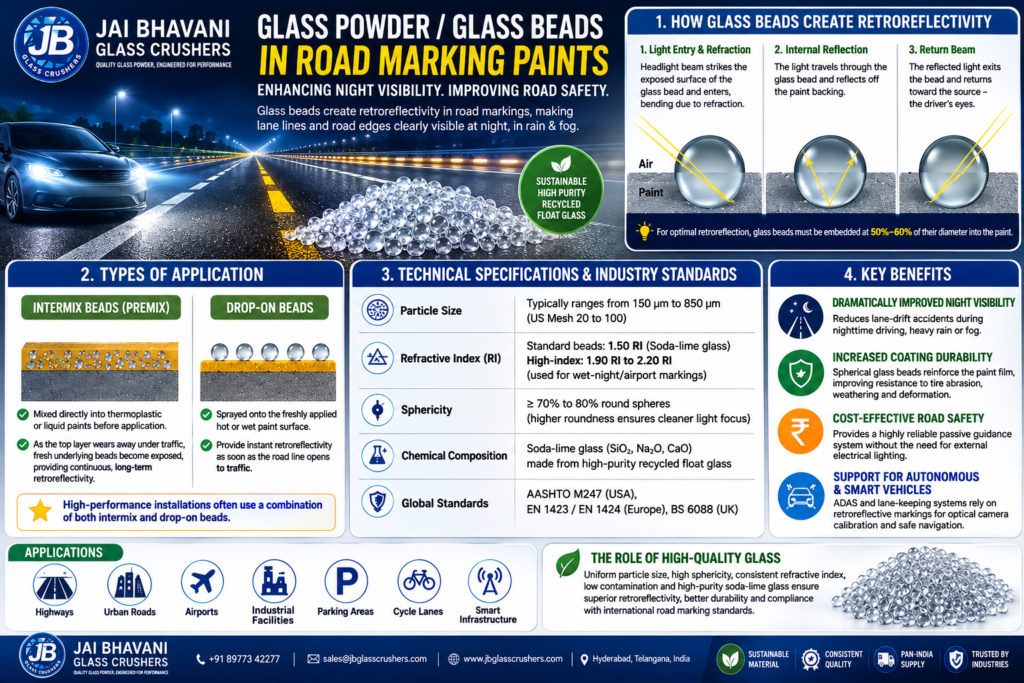
The retroreflective process occurs in three stages:
1. Light Entry and Refraction
Light emitted from a vehicle’s headlights strikes the exposed portion of the spherical glass bead.
As the light enters the bead, it is refracted (bent) because of the difference between the refractive index of air and glass.
2. Internal Reflection
The refracted light travels through the glass sphere toward the rear portion of the bead, which is embedded inside the road marking paint.
The paint layer behind the bead acts as a reflective backing, causing the light to change direction.
3. Return to the Driver
The reflected light exits through the front of the glass bead and travels back toward the source of illumination—the driver’s headlights and eyes.
This unique optical mechanism allows road markings to appear bright even at long viewing distances.
Importance of Proper Embedment
For maximum performance, glass beads should be embedded approximately 50–60% of their diameter into the paint binder.
If embedded too deeply:
- Light cannot properly enter the bead.
- Retroreflectivity decreases significantly.
If embedded too shallowly:
- Beads detach quickly under vehicle traffic.
- Road markings lose reflectivity prematurely.
Proper embedment provides both optical efficiency and long-term durability.
Methods of Incorporating Glass Beads
Glass beads are generally used in two application methods.
1. Intermix (Premix) Beads
Intermix beads are blended directly into thermoplastic or liquid road marking paint before application.
As the paint gradually wears under traffic, fresh beads become exposed, providing continuous retroreflectivity throughout the service life of the marking.
Advantages
- Long-term reflectivity
- Improved wear resistance
- Extended pavement marking life
2. Drop-On Beads
Drop-on beads are applied immediately after the paint is sprayed or extruded while the coating is still hot or wet.
These beads provide instant nighttime visibility as soon as the marking is opened to traffic.
Advantages
- Immediate retroreflectivity
- Excellent initial brightness
- Widely used on highways and city roads
Best Practice
High-performance road marking systems commonly combine intermix beads with drop-on beads.
This combination provides:
- Immediate night visibility
- Continuous long-term retroreflection
- Improved durability under heavy traffic
Technical Specifications
| Parameter | Typical Specification |
|---|---|
| Particle Size | 150–850 µm (US Mesh 20–100) |
| Refractive Index | Standard: 1.50 RI (Soda-Lime Glass) |
| Premium Beads | 1.90–2.20 RI for wet-night and airport markings |
| Sphericity | ≥70–80% spherical particles |
| Chemical Composition | Soda-Lime Glass (SiO₂, Na₂O, CaO) |
| Raw Material | High-purity float glass |
| Standards | AASHTO M247, EN 1423, EN 1424, BS 6088 |
Benefits of Glass Beads in Road Marking Paints
Superior Night Visibility
Retroreflective glass beads significantly improve the visibility of:
- Lane markings
- Edge lines
- Pedestrian crossings
- Directional arrows
- Stop bars
This enhances driver guidance during:
- Night driving
- Rain
- Fog
- Low-light conditions
Improved Road Safety
Clearly visible pavement markings help reduce:
- Lane departure accidents
- Head-on collisions
- Driver fatigue
- Navigation errors in poor visibility
Enhanced Durability
Glass beads reinforce the road marking system by:
- Improving resistance to tire abrasion
- Maintaining reflectivity over time
- Extending the service life of pavement markings
Cost-Effective Safety Solution
Unlike electrically illuminated guidance systems, retroreflective road markings require no external power source while providing reliable visual guidance throughout their service life.
Supporting ADAS and Autonomous Vehicles
Modern vehicles equipped with:
- Lane Departure Warning (LDW)
- Lane Keeping Assist (LKA)
- Adaptive Cruise Control (ACC)
- Autonomous Driving Systems
depend on highly visible lane markings for camera recognition and lane tracking.
Consistent retroreflectivity improves the performance of these vision-based systems, particularly during nighttime operation.
Applications
Glass beads are widely used in:
- Highways
- Urban roads
- Expressways
- Airports
- Industrial facilities
- Parking areas
- Bicycle lanes
- Smart transportation infrastructure
The Role of High-Quality Glass
The performance of road marking beads depends on:
- Uniform particle size
- High sphericity
- Consistent refractive index
- Low contamination
- High-purity soda-lime glass
These characteristics ensure reliable retroreflectivity, better durability, and compliance with international road marking standards.
Conclusion
Glass beads are an essential component of modern road marking systems, transforming ordinary paint into a high-performance, retroreflective safety solution. Whether applied as intermix beads for long-term durability or drop-on beads for immediate nighttime visibility, they play a critical role in improving driver guidance, reducing accidents, and supporting next-generation transportation systems.
As demand grows for safer roads and smarter infrastructure, high-quality soda-lime glass beads manufactured to international standards will continue to be a cornerstone of durable, high-visibility road marking technologies.