
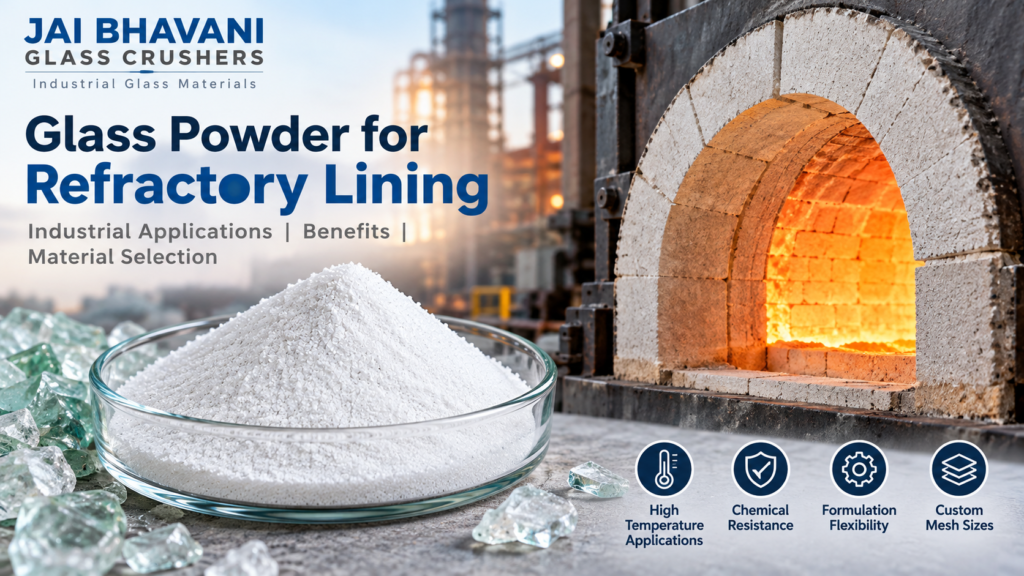
Glass powder is an industrial material that may be used in selected refractory formulations, high-temperature protective coatings and kiln-related processes, depending on its chemical composition and thermal behaviour. Its potential applications include acting as a silica-bearing raw material, a fluxing component or a constituent of specialized mixtures designed for particular operating conditions.
For refractory manufacturers, foundries, steel plants and industrial furnace operators, the key consideration is not simply the availability of glass powder. It is whether the material’s chemistry, particle-size distribution and behaviour at elevated temperatures are compatible with the intended refractory system.
What Is Glass Powder for Refractory Applications?
Glass powder is produced by grinding glass into controlled particle sizes. Industrial-grade material can be manufactured in different mesh grades to meet the requirements of specific industrial processes.
Most conventional soda-lime glass contains silica (SiO₂), along with sodium oxide (Na₂O), calcium oxide (CaO) and other minor constituents. The actual composition varies with the source of the glass.
In refractory applications, these constituents matter because they influence high-temperature reactions, viscosity, softening behaviour and interactions with other raw materials.
Glass powder should therefore be evaluated as a composition-dependent material rather than treated as interchangeable with high-purity silica flour or conventional refractory raw materials.
How Can Glass Powder Be Used in Refractory Lining Applications?
1. Kiln and Furnace-Related Processes
Industrial kilns and furnaces use refractory linings to protect equipment from elevated temperatures, chemical attack and mechanical wear. These linings may consist of refractory bricks, castables, ramming mixes or other specially formulated materials.
Glass powder may be considered as a constituent in selected formulations where its thermal behaviour and chemical composition are suitable. However, its use must be established through formulation testing and cannot be assumed suitable for every kiln or furnace.
The operating temperature, furnace atmosphere, contact materials and thermal cycling conditions all influence whether a particular glass-containing formulation is appropriate.
2. Refractory Crusting and Protective Mixtures
Some industrial processes involve deposits, crust formation or protective layers associated with high-temperature operations. In such cases, the intended function of a glass-containing mixture must be clearly defined.
Depending on its composition, glass powder may contribute to liquid-phase formation, particle bonding or the development of a glassy phase during heating.
However, these effects can be beneficial in one formulation and undesirable in another. Excessive liquid formation, penetration into refractory pores or reactions with the underlying lining may weaken the refractory or accelerate degradation.
Consequently, glass powder intended for a kiln crusting process should be assessed against the actual process requirements, rather than selected solely on the basis of silica content or mesh size.
3. Glass-Containing Refractory Binders and Coatings
Glass-forming materials and glass powders are used in certain specialized high-temperature coating and ceramic systems. Their purpose may include promoting bonding, assisting densification or developing a protective layer under specified conditions.
Research on glass-containing ceramifiable composites demonstrates that glass dust can act as a fluxing component and influence the formation and strength of ceramic residues during heating. However, those results apply to the tested composite formulations and do not independently establish suitability for a conventional furnace lining.
4. Silica-Bearing Raw Material in Selected Formulations
Silica is an important constituent of many refractory systems. Ground glass can provide silica, but ordinary soda-lime glass also introduces alkali and alkaline-earth constituents.
These additional oxides can change the high-temperature behaviour of a refractory mixture. In some systems, they may promote liquid-phase formation at lower temperatures; in others, they may reduce refractoriness or adversely affect chemical resistance.
For this reason, glass powder should not automatically replace high-purity silica flour, quartz or another established refractory raw material without a technical evaluation.
Potential Benefits of Industrial Glass Powder
The potential benefits depend on the formulation and application.
- Controlled particle size: Specified mesh grades can help manufacturers formulate mixtures with defined particle-size distributions.
- Potential fluxing action: Glass constituents may promote liquid-phase formation or bonding in selected ceramic and high-temperature systems.
- Formulation flexibility: Glass powder can be evaluated as an additional component in specialized mixtures.
- Industrial material utilization: Using suitable glass-derived raw materials can support resource efficiency where the application and quality requirements are met.
- Customizable supply: Industrial suppliers may provide different grades and material specifications to suit testing requirements.
These are potential formulation advantages, not guaranteed performance benefits for every refractory application.
Why Chemical Composition Matters
Before selecting glass powder for a refractory-related process, buyers should evaluate the complete chemical analysis.
| Parameter | Why it matters |
|---|---|
| Silicon dioxide (SiO₂) | Indicates the silica contribution to the formulation |
| Sodium oxide (Na₂O) | Can influence softening, viscosity and high-temperature reactions |
| Calcium oxide (CaO) | May affect phase formation and interactions with other oxides |
| Aluminium oxide (Al₂O₃) | Relevant to the overall oxide balance and refractory formulation |
| Iron oxide (Fe₂O₃) | May affect colour, chemistry and high-temperature behaviour |
| Other metallic oxides | May influence compatibility with the process and final material |
| Moisture content | Important for storage, dosing and formulation consistency |
| Particle-size distribution | Influences mixing, packing, reaction kinetics and material handling |
The required limits for these parameters must be defined by the end user. A formulation requiring very low sodium, lithium, potassium or total metallic impurities may need a different feedstock from a process that deliberately uses glass as a fluxing constituent.
Does Glass Powder Improve Refractory Performance?
Not automatically. Refractory performance depends on the complete formulation, including the refractory aggregates, matrix, binder, additives and processing conditions.
Research on refractory materials emphasizes the importance of corrosion resistance, thermal stability, mechanical integrity and suitability for the operating environment. Studies of glass-furnace refractories also demonstrate that interactions between molten glass and refractory materials can lead to corrosion and contamination.
Adding glass powder without appropriate testing could reduce the service life of a lining or introduce unwanted chemical reactions. Its use should therefore be supported by laboratory trials and, where appropriate, controlled industrial testing.
How to Select Glass Powder for a Refractory Application
Industrial buyers should evaluate the following factors before placing a bulk order.
1. Define the process. Identify whether the material is intended for a refractory castable, ramming mix, coating, kiln crusting process or another application.
2. Establish chemical limits. Specify acceptable levels of silica, sodium, potassium, lithium, iron and other relevant oxides or metallic impurities.
3. Specify the particle size. Define the required mesh grade or micron range, including any limits on oversize and fine particles.
4. Evaluate high-temperature behaviour. Determine the relevant softening, melting, reaction and compatibility characteristics of the glass-containing formulation.
5. Test the complete formulation. Evaluate relevant properties such as refractoriness, dimensional stability, bonding, corrosion resistance and thermal cycling performance.
6. Conduct a controlled trial. Compare the candidate formulation with the established process or reference material before moving to commercial-scale supply.
Frequently Asked Questions
Can glass powder be used in refractory lining?
Glass powder may be incorporated into certain specialized refractory-related formulations, but its suitability depends on its composition, temperature exposure and intended function. It should not be considered a universal substitute for refractory materials.
Which mesh size is suitable for refractory applications?
There is no single universally suitable mesh size. The required particle size depends on the formulation, mixing process, application method and desired material properties. Buyers should establish the specification through formulation development and testing.
Is high silica content sufficient for refractory use?
No. Silica content alone does not establish suitability. Alkali content, other oxides, particle-size distribution and high-temperature behaviour must also be considered.
Can glass powder be used for kiln crusting?
It may be considered for certain kiln-related formulations, but the exact process, operating temperature, required chemical purity and interaction with the existing lining must be assessed before use.
What information should a buyer provide when requesting a sample?
The buyer should specify the application, operating temperature, chemical composition limits, required mesh size, sample quantity and any known restrictions on sodium, lithium, potassium or total metallic impurities.
Conclusion
Glass powder has potential in selected refractory-related formulations, kiln processes and high-temperature ceramic systems. Its suitability depends on the intended function, chemical composition, particle size and performance of the complete formulation.
For industrial buyers, the most reliable approach is to define the application and chemical requirements first, then evaluate the material through technical analysis and controlled trials.
Jai Bhavani Glass Crushers manufactures industrial glass powder in specified particle-size grades for industrial applications. Buyers can contact the company to discuss available grades, request technical specifications and determine whether a particular material is suitable for their process.
For specialized refractory applications, final selection should be based on verified material specifications and the end user’s technical approval.