
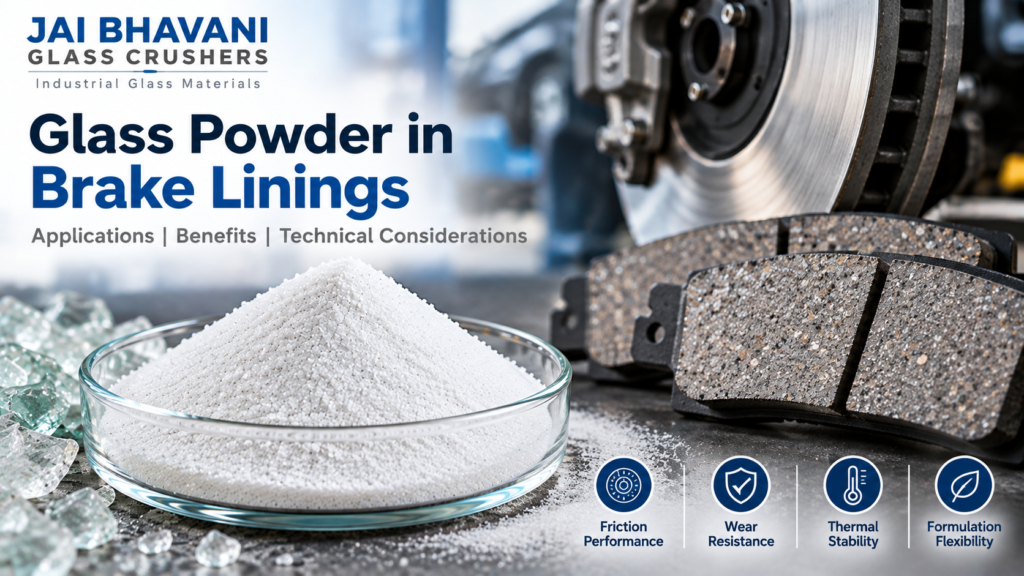
Glass powder is an emerging material of interest in the development of automotive brake friction materials. Researchers have investigated its use in selected brake-lining formulations to understand how it influences friction coefficient, wear resistance, hardness and friction stability under different operating conditions.
For brake-lining manufacturers, glass powder may offer an additional option for formulation development. However, its performance depends on the glass composition, particle-size distribution, loading level, binder system and manufacturing process.
Jai Bhavani Glass Crushers supplies industrial glass powder in specified particle-size grades. Manufacturers evaluating glass powder for friction materials should assess the material against their formulation requirements and validate its performance through appropriate laboratory testing.
What Is Glass Powder Used in Brake Linings?
Brake linings are friction materials that convert the kinetic energy of a moving vehicle into heat through friction between the lining and the rotating brake disc or drum.
A typical brake friction material contains several functional components:
- Binders: Hold the formulation together and provide structural integrity.
- Reinforcing materials: Improve mechanical strength and support the friction structure.
- Abrasives: Influence friction generation and surface interaction.
- Lubricants and friction modifiers: Help control friction, wear and temperature-related behaviour.
- Fillers: Adjust density, processing characteristics, cost and other material properties.
Glass powder may be evaluated as a functional filler or friction-modifying constituent in certain formulations. Its role is not identical to that of glass fibres, which are used as reinforcing materials, or silica flour, which has different composition and physical characteristics.
The suitability of glass powder depends on how it interacts with the other ingredients and how the resulting friction material performs during braking.
What Does Scientific Research Say About Glass Powder in Brake Linings?
The researchers produced bronze-based brake-lining samples containing 0%, 2%, 4%, 6% and 8% glass powder by weight. They used hot pressing to manufacture the samples and evaluated their tribological properties using a Chase-type friction tester. The study also examined hardness, density and worn-surface microstructure.
The researchers reported several findings:
- The addition of glass powder increased the hardness of the tested samples while reducing their density.
- The formulation containing 6% glass powder produced the highest measured cold and hot friction coefficients among the tested formulations.
- The formulation containing 8% glass powder exhibited the most stable friction behaviour and the lowest wear loss among the formulations studied.
- Friction coefficients decreased as the test temperature increased, highlighting the importance of evaluating temperature-related performance.
These findings demonstrate that glass powder can influence brake-lining properties and that its effects depend on the proportion used in the formulation.
Important limitation: The study investigated a particular bronze-based friction material. Its results do not establish 6% or 8% as universally optimal concentrations for commercial automotive brake pads or other lining systems.
Potential Benefits of Glass Powder in Brake Friction Materials
1. Potential improvement in wear behaviour
Wear resistance is an important consideration in brake-lining development because excessive material loss can reduce component life and increase maintenance requirements.
In the 2023 study, the bronze-based formulation containing 8% glass powder showed the lowest wear loss among the tested samples. The researchers associated this behaviour with the development of compacted wear-debris structures, known as secondary plateaus, on the friction surface.
These structures can influence the contact between the lining and the brake disc.
The result is encouraging for further research, but the same effect must be demonstrated in the specific formulation under consideration.
2. Influence on friction coefficient
The coefficient of friction determines how effectively the brake material generates braking force under specified conditions.
The study found that glass powder content affected both cold and hot friction coefficients. The highest values occurred at an intermediate addition level rather than at the highest concentration.
This illustrates why manufacturers should evaluate multiple formulations rather than assume that increasing glass powder content will continuously improve braking performance.
3. Potential changes in hardness and density
The researchers observed increased hardness and reduced density in the glass-powder-containing samples.
Such changes may be relevant when developing friction materials with particular mechanical and weight requirements. However, hardness alone does not establish good brake performance. It must be considered alongside wear, compressibility, bonding strength, thermal stability and the risk of damaging the opposing disc.
4. Opportunities for material formulation development
Glass powder may offer another ingredient for manufacturers seeking to optimize the balance between friction stability, wear, density and processing requirements.
The potential commercial value depends on consistent raw-material quality, compatibility with the formulation and demonstrated performance in the final product.
Why Particle Size and Chemical Composition Matter
Glass powder is not a single, standardized material. Its properties depend on the source glass, grinding process and resulting particle-size distribution.
For brake-lining manufacturers, the following characteristics should be evaluated before selecting a supplier.
| Property | Relevance to brake-lining development |
|---|---|
| Particle-size distribution | Influences dispersion, particle contact and wear-surface formation |
| Silica content | Helps characterize the glass chemistry |
| Sodium and calcium oxides | Can influence thermal and chemical behaviour |
| Aluminium and iron oxides | Affect the overall composition and potential interactions |
| Moisture content | Important for storage, dosing and processing consistency |
| Contamination | May introduce unwanted variation in the final formulation |
| Batch consistency | Helps maintain repeatable manufacturing and test results |
A nominal mesh designation alone is not sufficient to characterize the material. Particle-size distribution, including fine and coarse fractions, should be measured where required by the manufacturer’s specification.
Likewise, high silica content does not automatically make a glass powder suitable for friction materials. The complete chemical composition and its interaction with the other ingredients must be considered.
How to Evaluate Glass Powder for Brake-Lining Manufacturing
Manufacturers considering glass powder should use a controlled evaluation process.
Step 1: Define the formulation requirements. Identify whether the material will be used in a resin-bonded, non-asbestos organic or metal-based friction formulation.
Step 2: Establish the raw-material specification. Define the required particle-size distribution, chemical composition, moisture limits and contamination requirements.
Step 3: Prepare controlled trial formulations. Compare a baseline formulation with candidate formulations containing different glass powder proportions. Addition levels should be selected by the formulation engineer rather than copied directly from a single research study.
Step 4: Evaluate friction and wear. Conduct appropriate friction-material tests under controlled loads, speeds and temperature conditions. Assess cold and hot friction, fade, recovery and wear.
Step 5: Assess noise and mechanical performance. Evaluate brake noise, vibration, compressibility, hardness, bonding and interaction with the brake disc as appropriate.
Step 6: Validate the finished product. Complete the applicable performance, durability and regulatory validation before any commercial or vehicle-safety application.
Brake components are safety-critical products. Laboratory screening alone is not sufficient to establish roadworthiness or production suitability.
Is Glass Powder Suitable for All Types of Brake Linings?
No. Brake friction materials differ significantly in composition and manufacturing method.
The findings from bronze-based sintered friction materials cannot automatically be transferred to resin-bonded brake pads, commercial-vehicle linings, railway brake materials or other friction systems.
Glass powder must be evaluated for each intended formulation. Its particle characteristics, softening behaviour and interactions with the binder and other ingredients can affect friction, wear and temperature stability.
Glass fibres also behave differently from glass powder. Research on glass-fibre-reinforced friction materials has reported changes in friction, wear and vibration depending on fibre type and dispersion. These findings reinforce the need to distinguish between glass powder and glass-fibre applications.
Frequently Asked Questions
Can glass powder be used in brake pads?
Research has investigated glass powder in selected brake-lining formulations, including bronze-based materials. Whether it is suitable for a specific brake pad depends on the formulation, particle size, chemistry and validated friction and wear performance.
What percentage of glass powder is used in brake linings?
There is no universally established percentage for all brake-lining formulations. A published study investigated additions ranging from 0% to 8% by weight in a particular bronze-based material. These experimental values should not be treated as a commercial formulation recommendation.
Does glass powder improve brake-lining wear resistance?
It improved wear behaviour in the specific bronze-based formulations studied in the 2023 publication. Performance in other materials must be established through testing.
Which mesh size is suitable for brake-lining applications?
The appropriate particle size depends on the manufacturer’s formulation and process. Buyers should specify the required particle-size distribution rather than select a mesh grade based on general assumptions.
What should a manufacturer request from a glass powder supplier?
The manufacturer should request a technical data sheet, chemical composition, particle-size distribution, moisture information and details of quality-control procedures. Samples can then be assessed against the manufacturer’s internal specifications.
Conclusion
Glass powder is a research-supported candidate material for selected brake friction formulations. A 2023 study demonstrated that its addition influenced friction coefficients, hardness, density and wear behaviour in bronze-based brake-lining samples.
The findings provide a basis for further formulation research, but they do not establish universal performance benefits or a single recommended addition level.
For brake-lining manufacturers, the next step is to define the raw-material specification, evaluate suitable samples and validate the complete formulation under the required braking conditions.
Jai Bhavani Glass Crushers supplies industrial glass powder in specified particle-size grades. Manufacturers interested in evaluating glass powder for friction-material development can contact the company to discuss available grades, technical specifications and sample requirements.
Final material selection should be based on the manufacturer’s technical evaluation and validation of the finished brake component.