
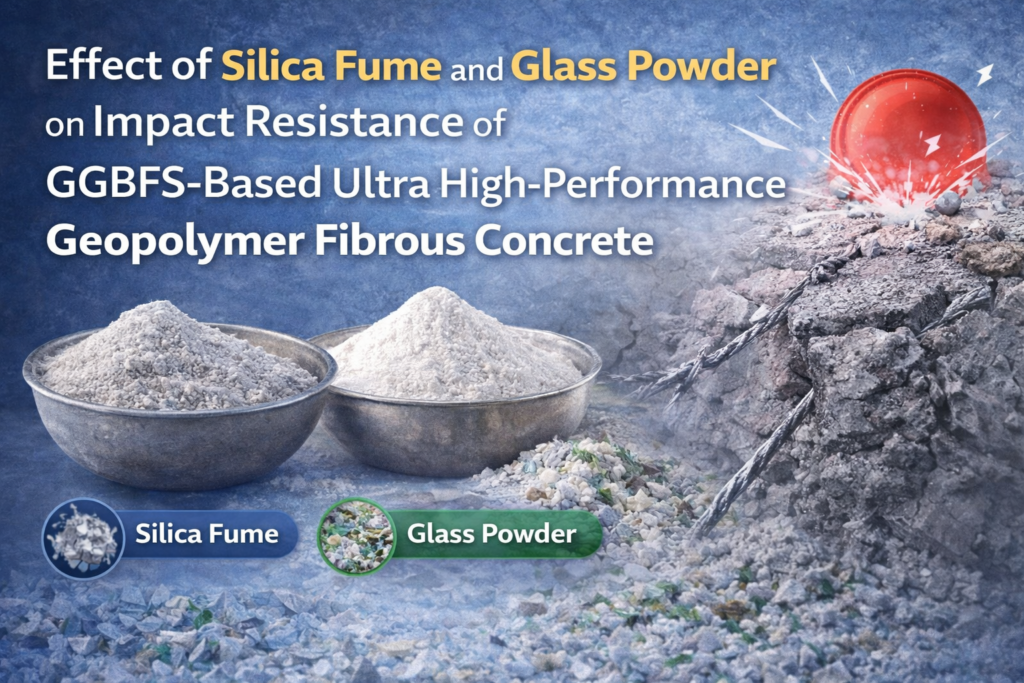
The construction industry is increasingly adopting sustainable materials to reduce environmental impact while improving structural performance. One promising development is ultra-high-performance geopolymer concrete (UHPGC) made using industrial by-products such as ground granulated blast furnace slag (GGBFS). Unlike traditional Portland cement-based concrete, geopolymer concrete relies on alkaline activation of aluminosilicate materials, significantly reducing carbon emissions.
Recent studies have focused on incorporating silica fume and recycled glass powder into GGBFS-based geopolymer concrete to enhance mechanical and durability properties. These materials can improve particle packing density, microstructure refinement, and bonding within the concrete matrix. When combined with fiber reinforcement, the resulting material demonstrates improved impact resistance and toughness, making it suitable for high-performance structural applications.
Materials Used in the Study
Ground Granulated Blast Furnace Slag (GGBFS)
GGBFS is a by-product of the iron and steel industry and is widely used in geopolymer concrete due to its high calcium and silica content. It contributes to the formation of calcium–alumino–silicate hydrate (C–A–S–H) gel, which enhances strength development in geopolymer systems.
Silica Fume
Silica fume is an extremely fine pozzolanic material obtained from the production of silicon metal or ferrosilicon alloys. Due to its high silica content and very fine particle size, silica fume significantly improves the microstructure of concrete.
Key benefits include:
- Improved compressive strength
- Reduced permeability
- Enhanced bond strength between aggregates and matrix
- Increased durability
Recycled Glass Powder
Glass powder is produced by grinding recycled glass cullets into fine particles. It contains high levels of amorphous silica, making it highly reactive in geopolymer and cementitious systems.
Glass powder contributes to:
- Pozzolanic reaction with alkaline activators
- Improved particle packing density
- Reduced voids in the concrete matrix
- Sustainable recycling of waste glass
Role of Fibers in Ultra-High-Performance Geopolymer Concrete
The addition of fibers significantly improves the ductility and energy absorption capacity of concrete. In geopolymer fibrous concrete, fibers help control crack propagation and enhance resistance against impact loading.
Common fibers used include:
- Steel fibers
- Polypropylene fibers
- Basalt fibers
- Glass fibers
These fibers bridge microcracks within the concrete matrix and prevent sudden brittle failure, improving overall structural performance.
Impact Resistance of Geopolymer Fibrous Concrete
Impact resistance refers to the ability of concrete to absorb energy and withstand sudden loads such as collisions, explosions, or falling objects. Traditional concrete often exhibits brittle behavior under impact loading. However, geopolymer fibrous concrete modified with silica fume and glass powder shows significant improvements in impact performance.
The improvement occurs due to several factors:
- Refined microstructure resulting from silica fume particles filling microscopic voids.
- Pozzolanic reaction between glass powder and alkaline activators that strengthens the matrix.
- Fiber bridging effect, which distributes stress and prevents crack propagation.
Together, these mechanisms increase the energy absorption capacity of the concrete.
Microstructural Improvements
When silica fume and glass powder are incorporated into GGBFS-based geopolymer concrete, they contribute to the formation of a denser microstructure.
Effects observed include:
- Reduced pore size distribution
- Increased matrix compactness
- Improved interfacial transition zone (ITZ) between aggregates and binder
- Higher bond strength between fibers and geopolymer matrix
These microstructural improvements directly influence the mechanical properties of the concrete, including compressive strength, flexural strength, and impact resistance.
Advantages of Using Glass Powder in Geopolymer Concrete
The incorporation of recycled glass powder offers several benefits:
Sustainability
Using glass powder helps recycle waste glass and reduces landfill disposal.
Improved Mechanical Performance
Glass powder contributes reactive silica that enhances geopolymerization and matrix strength.
Cost Reduction
Glass powder can partially replace expensive materials such as silica fume or other fine mineral additives.
Environmental Benefits
Replacing cement with geopolymer binders and recycled glass significantly reduces carbon emissions.
Applications of Ultra High-Performance Geopolymer Fibrous Concrete
Due to its superior strength and impact resistance, this material can be used in demanding structural applications such as:
- Industrial floors
- Protective structures
- Bridge decks
- Pavements and transportation infrastructure
- Blast-resistant structures
- Offshore and marine constructions
These applications require materials capable of absorbing high-impact loads while maintaining structural integrity.
Future Research Directions
While the use of silica fume and glass powder in geopolymer fibrous concrete has shown promising results, further research is required to optimise mix proportions and curing conditions. Future studies may focus on:
- Long-term durability performance
- Large-scale structural applications
- Optimisation of fiber content
- Life-cycle environmental assessment
These investigations will help accelerate the adoption of geopolymer concrete in sustainable infrastructure development.
Conclusion
The incorporation of silica fume and recycled glass powder in GGBFS-based ultra-high-performance geopolymer fibrous concrete significantly enhances impact resistance and mechanical performance. Silica fume improves the microstructure by filling voids and strengthening the matrix, while glass powder contributes reactive silica that supports geopolymerization and densification.
Combined with fiber reinforcement, these materials produce a high-performance concrete capable of absorbing greater impact energy while maintaining structural integrity. In addition to performance improvements, the use of recycled glass powder also promotes environmental sustainability and circular economy practices within the construction industry.
As the demand for eco-friendly and high-performance construction materials continues to grow, geopolymer fibrous concrete incorporating silica fume and glass powder is expected to play a significant role in the future of sustainable infrastructure.