
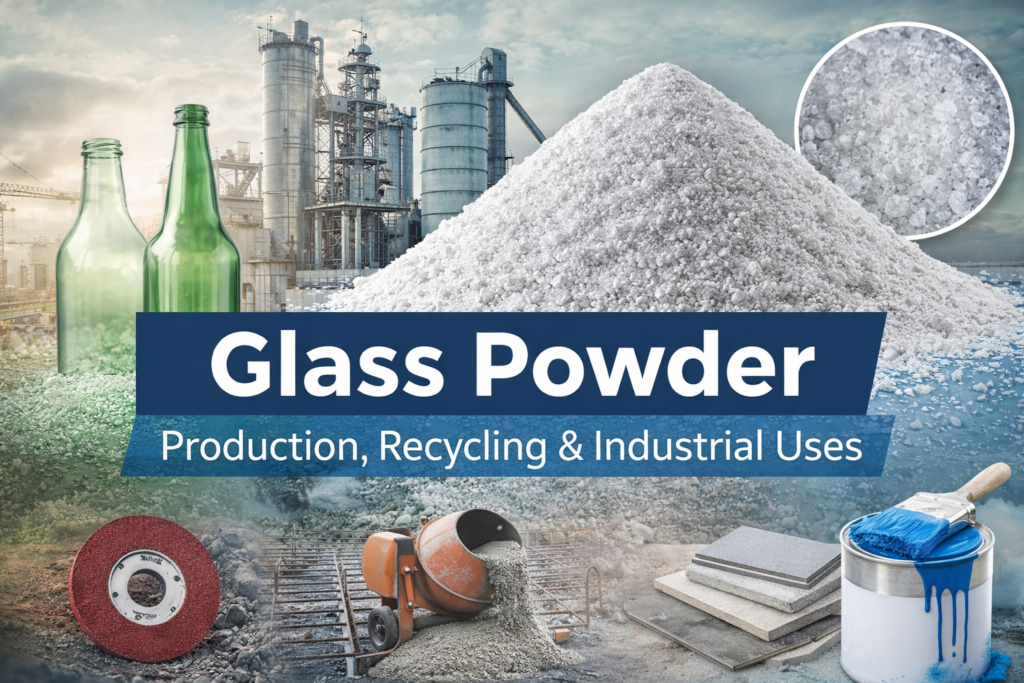
Glass waste has become a growing environmental concern worldwide. Millions of tons of glass bottles, containers, and industrial glass waste are discarded every year. Although glass is fully recyclable, a large portion still ends up in landfills. One of the most effective ways to recycle glass is by crushing and grinding it into glass powder.
Glass powder is a finely processed material made from recycled glass that can be used in many industrial and construction applications. With its high silica content, durability, and chemical stability, glass powder is now widely used in cement, ceramics, abrasives, coatings, infrastructure projects, and decorative products.
For industries looking for sustainable materials, glass powder offers a perfect combination of performance, cost efficiency, and environmental benefits.
What is Glass Powder?
Glass powder is produced by crushing waste glass and grinding it into fine particles. The particle size can vary depending on the grinding process and application requirements.
Typically, glass powder can be classified into several particle sizes, such as:
- Coarse powder: 100–300 microns
- Fine powder: 50–100 microns
- Ultra-fine powder: below 50 microns
The primary component of glass powder is silica (SiO₂), which provides excellent hardness, chemical resistance, and durability. Because of these properties, finely ground glass powder can act as a pozzolanic material, filler material, abrasive agent, or reinforcing additive in many manufacturing processes.
Recycling glass into powder also reduces environmental waste and converts discarded glass into valuable industrial raw material.
Manufacturing Process of Glass Powder
The production of glass powder involves several steps to convert waste glass into fine powder suitable for industrial use.
1. Collection and Sorting
The process begins with collecting glass waste from sources such as:
- Beverage bottles
- Window glass
- Industrial glass scrap
- Automotive glass
The collected glass is sorted to remove impurities such as plastic, metal, labels, and other contaminants.
2. Cleaning and Preparation
After sorting, the glass is washed and cleaned to ensure it is free from dirt, oil, and foreign materials. Clean glass ensures higher purity in the final powder product.
3. Crushing
The cleaned glass is fed into glass crushers where it is broken down into small fragments. Crushing reduces the size of the glass pieces and prepares them for grinding.
4. Grinding
The crushed glass is further processed in grinding machines to produce fine powder. Different grinding technologies can produce various particle sizes depending on the industrial requirement.
5. Sieving and Classification
After grinding, the powder is sieved to obtain uniform particle sizes. This classification ensures consistent quality and performance for different industrial applications.
Properties of Glass Powder
Glass powder has several unique properties that make it suitable for multiple industries.
High Silica Content
Glass powder mainly contains silica, which gives it excellent hardness and chemical stability.
Chemical Resistance
It is resistant to most chemicals and environmental conditions, making it suitable for long-lasting industrial applications.
Durability
Glass powder enhances the durability and strength of materials when used as a filler or additive.
Fine Particle Structure
Fine particles allow glass powder to fill microscopic voids in materials such as cement and coatings, improving density and performance.
Eco-Friendly Material
Using recycled glass powder helps reduce landfill waste and promotes sustainable manufacturing.
Industrial Uses of Glass Powder
Glass powder has become an important raw material in several industries. Below are some of the most common applications.
1. Glass Powder in Cement and Concrete
One of the most significant uses of glass powder is in cement and concrete production.
Finely ground glass powder can partially replace cement in concrete mixtures. When added to cement, the silica in glass powder reacts with calcium hydroxide, forming additional binding compounds that increase strength.
Benefits include:
- Improved compressive strength
- Reduced permeability in concrete
- Increased durability
- Reduced cement consumption
- Lower carbon footprint in construction
Glass powder is increasingly used in green building projects, road construction, and infrastructure development.
2. Ceramic and Tile Manufacturing
Glass powder is commonly used in ceramic and tile production. It acts as a flux material that helps improve the strength and finish of ceramic products.
Applications include:
- Ceramic tiles
- Sanitary ware
- Decorative pottery
- Porcelain products
Glass powder helps ceramics achieve smoother surfaces and stronger bonding during high-temperature firing.
3. Abrasive Blasting Material
Another major application of glass powder is in abrasive blasting and surface preparation.
Finely crushed glass particles are used to remove rust, paint, coatings, and surface contaminants from metal and industrial equipment.
Compared to traditional sand blasting, glass powder abrasives offer several advantages:
- Less hazardous than silica sand
- Environmentally safer
- Effective cleaning performance
- Recyclable blasting media
Industries such as shipbuilding, automotive manufacturing, and metal fabrication frequently use glass powder for surface treatment.
4. Filler Material in Paints and Coatings
Glass powder is widely used as a filler material in paints, coatings, and adhesives.
Because of its hardness and chemical resistance, it improves the durability and performance of coatings.
Benefits of coatings include:
- Increased scratch resistance
- Improved surface finish
- Enhanced durability
- Better chemical resistance
Glass powder fillers are commonly used in industrial paints, protective coatings, and specialised chemical coatings.
5. Glass Powder in Plastics and Polymers
In plastic manufacturing, glass powder is used as a reinforcing filler to improve mechanical properties.
When mixed with polymers, glass powder can increase:
- Structural strength
- Heat resistance
- Dimensional stability
This makes it useful in producing automotive parts, industrial plastic components, and composite materials.
6. Road Construction and Infrastructure
Glass powder is also used in road construction and infrastructure projects.
It can be mixed with soil, asphalt, or concrete to enhance strength and stability. This helps create durable road surfaces and strong foundation layers.
Using recycled glass powder in infrastructure also contributes to sustainable construction practices by reducing the use of natural raw materials.
7. Decorative and Artistic Applications
Glass powder is widely used in artistic and decorative applications.
Artists and designers use colored glass powder to create:
- Decorative glass panels
- Mosaic art
- Glass sculptures
- Decorative tiles
When heated in kilns, glass powder melts and fuses into vibrant designs and textures.
Environmental Benefits of Glass Powder Recycling
Recycling glass into powder offers several environmental advantages.
Reduces Landfill Waste
Glass takes thousands of years to decompose. Recycling it into powder prevents large quantities of waste from accumulating in landfills.
Conserves Natural Resources
Using recycled glass powder reduces the need for natural raw materials like sand and limestone.
Reduces Carbon Emissions
Replacing cement with glass powder can significantly reduce carbon dioxide emissions associated with cement production.
Supports Circular Economy
Glass powder recycling promotes sustainable manufacturing by converting waste materials into valuable industrial resources.
Why Industries Prefer Glass Powder
Industries increasingly choose glass powder because it offers multiple advantages:
These benefits make glass powder a valuable material in modern industrial production.
- Cost-effective alternative to raw materials
- High durability and chemical resistance
- Improves the strength and performance of materials
- Eco-friendly and sustainable
- Wide range of industrial applications
Conclusion
Glass powder has emerged as a versatile and sustainable industrial material. Produced by crushing and grinding recycled glass, it offers valuable applications in construction, ceramics, abrasives, coatings, plastics, and infrastructure projects.
As industries continue to focus on sustainability and waste reduction, glass powder recycling will play a critical role in transforming waste glass into high-value industrial products.
Companies like Jai Bhavani Glass Crushers are helping lead this transformation by converting discarded glass into high-quality glass powder for industrial use.
By adopting recycled glass powder, industries can reduce environmental impact while improving material performance and supporting sustainable development.