
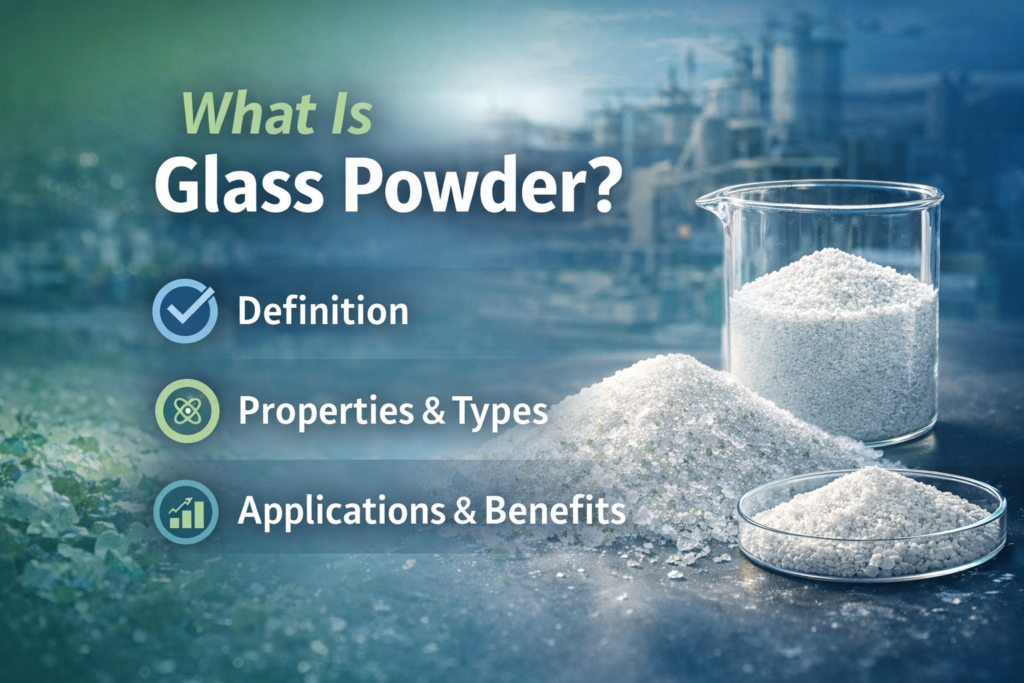
Glass powder is a finely ground material produced by crushing and milling waste or raw glass into controlled particle sizes. It is widely used as an industrial filler and functional additive across various industries, including construction, ceramics, coatings, paints, and epoxy flooring manufacturing. With growing emphasis on sustainability, glass powder has become an important recycled raw material for modern industrial processes.
Also known as glass frit or glass flux, glass powder is produced by rapidly quenching molten glass and milling it into ultra-fine particles. Typical median particle sizes range from 30 microns down to 0.1 microns, with customised sizes and particle distributions available to meet specific application needs.
The properties of glass powder depend primarily on the chemical composition of the glass, as well as particle size, shape, and morphology. By selecting or engineering specific glass compositions, speciality glass powders can be designed to meet a wide range of functional and performance requirements.
Reach out to JBGlassCrushers
Key Functions of Glass Powder
Sealing, Joining, and Insulation
Glass powder is widely used as a non-ageing, temperature-resistant inorganic bonding material. It provides reliable sealing, joining, and soldering across metals, ceramics, and glass components. Its gas-tight nature and excellent electrical insulation properties make it ideal for insulating electrical conductors, sealing assemblies, and passivating or protecting semiconductor surfaces.
Filler, Additive, and Functional Material
As an inorganic filler or additive, glass powder enhances composite materials by improving thermal stability, strength, durability, optical properties, and chemical resistance. Certain glass powders can be functionalized or engineered to act as active materials, including porous, bioactive, UV-absorbing, HF-adsorbing, or ion-releasing particles.
How Is Glass Powder Made
Glass powder is manufactured by:
- Collecting and sorting waste glass (clear, green, brown, or mixed)
- Removing contaminants such as metals, plastics, and organic matter
- Crushing the glass into smaller particles
- Grinding and screening to achieve specific micron or mesh sizes
The final product is a clean, consistent powder suitable for industrial use.
Key Properties of Glass Powder
- High silica content – provides strength and chemical resistance
- Angular particle shape – improves bonding and abrasion resistance
- Low moisture content – ensures better mixing and flow
- Hard filler nature – enhances durability in coatings and construction
- Insoluble in water – stable in wet and dry environments
These properties make glass powder a reliable alternative to traditional mineral fillers.
Advantages of Glass Powder
Compared to organic, polymer, or silicone-based materials, glass powders offer several key benefits:
- High temperature resistance
- Non-ageing and chemically stable behavior
- Excellent insulation properties
- Superior mechanical and thermal performance
Glass powder is increasingly recognised across construction, coatings, plastics, electronics, and advanced manufacturing sectors due to these advantages.
Industrial Applications of Glass Powder
Construction and Building Materials
Glass powder acts as a pozzolanic material in concrete, reacting with lime to enhance strength, durability, and chemical resistance.
Using glass powder as a partial cement replacement also helps reduce CO₂ emissions.
Paints and Coatings
Its fine particle size and reflective properties make glass powder an effective filler that improves abrasion resistance, surface finish, and gloss.
Plastics and Composites
In plastics, glass powder increases rigidity, strength, and dimensional stability, while also reducing material costs and enabling property customisation.
Abrasives and Surface Treatment
Due to its hardness, glass powder is used in abrasive blasting and surface preparation processes.
Ceramics and Glass Manufacturing
Glass powder is added to ceramic and glass formulations to modify melting behavior, color, and mechanical properties.
Environmental and Economic Benefits
Environmental Protection
- Recycles waste glass and reduces landfill disposal
- Lowers energy consumption compared to producing new raw materials
- Helps reduce greenhouse gas emissions
Improved Material Performance
- Enhances compressive strength, corrosion resistance, and thermal insulation
- Improves product lifespan and durability
Cost Efficiency
- Provides a cost-effective alternative to virgin raw materials
- Reduces production and energy costs across industries
Is Glass Powder Safe?
When manufactured and handled correctly, glass powder is safe for industrial use. Like any fine powder material, proper handling measures, such as dust control and protective equipment, are recommended during processing and application.
Sustainability and the Future of Glass Powder
Glass powder is one of today’s most sustainable industrial materials. By converting waste glass into high-value products, it supports the circular economy, reduces carbon emissions, and helps industries meet sustainability goals.
Future Growth Areas
- Eco-friendly 3D-printed construction materials
- Nano glass powders for electronics and advanced coatings
- Green concrete and zero-waste manufacturing
With ongoing innovation and growing environmental awareness, glass powder is set to play an even greater role in sustainable industrial development.
Benefits of Using Recycled Glass Powder
- Reduces landfill waste
- Lowers raw material costs
- Supports sustainable manufacturing
- Consistent and predictable performance
- Available in multiple grades and mesh sizes
Glass Powder Mesh Sizes
Glass powder is commonly supplied in:
- 100–150 mesh – primers, anti-skid coatings
- 150–200 mesh – epoxy & industrial coatings
- 200–300 mesh – ceramics, high-clarity coatings
Custom mesh sizes can be developed based on application needs.
Conclusion
Glass powder is a versatile, eco-friendly, and high-performance industrial material. Its wide range of applications, combined with sustainability benefits, makes it an increasingly preferred choice for manufacturers across multiple industries.
At JB Glass Crushers, we specialise in producing clean, industrial-grade glass powder with consistent quality and bulk supply capability to meet demanding industrial requirements.