
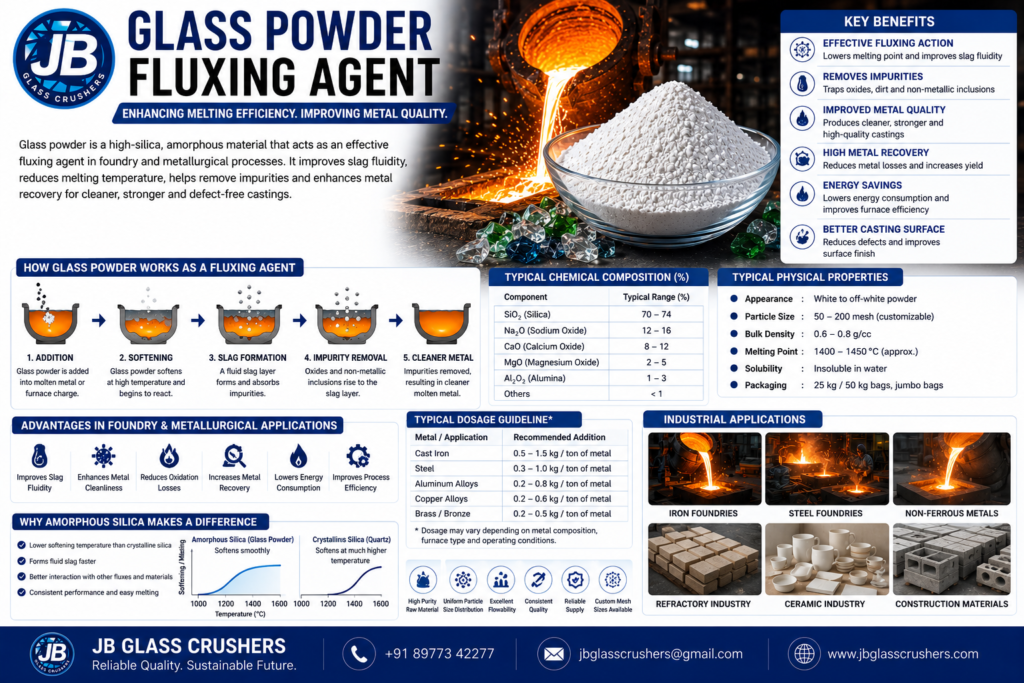
Fluxing agents play a critical role in modern metallurgical, foundry, and refractory operations. They facilitate impurity removal, improve slag fluidity, reduce energy consumption, and enhance overall process efficiency. Among various fluxing materials available today, finely milled glass powder has emerged as an effective silica-based fluxing agent due to its unique chemical composition, low softening temperature, and excellent melting behavior.
Manufactured from high-quality float glass and processed into controlled particle sizes, glass powder offers a cost-effective and technically efficient solution for foundries, steel plants, non-ferrous metal industries, and refractory manufacturers seeking improved furnace performance and superior product quality.
Understanding Fluxing Agents
A flux is a material added to a molten system to promote chemical reactions, facilitate impurity removal, and improve the physical characteristics of slag or melt phases.
The primary functions of a fluxing agent include:
- Lowering melting temperatures
- Reducing slag viscosity
- Promoting impurity separation
- Enhancing metal recovery
- Improving heat transfer
- Minimizing oxidation losses
- Producing cleaner molten metal
Effective fluxes help optimize furnace operations while reducing energy requirements and improving final product quality.
Why Glass Powder Functions as an Effective Flux
Amorphous Silica Structure
Unlike crystalline quartz, float glass contains amorphous silica. This non-crystalline structure softens and reacts more readily at elevated temperatures.
The amorphous nature of glass powder provides:
- Faster thermal activation
- Enhanced slag formation
- Improved melting behavior
- Better interaction with furnace charge materials
As temperatures increase, glass powder gradually softens and contributes to the formation of a fluid slag phase that assists in impurity capture and removal.
Chemical Composition Supporting Fluxing Performance
Typical soda-lime float glass contains:
| Component | Typical Range |
|---|---|
| SiO₂ | 70–74% |
| Na₂O | 12–16% |
| CaO | 8–12% |
| MgO | 2–5% |
| Al₂O₃ | 1–3% |
Each component contributes to fluxing efficiency.
Silica (SiO₂)
Provides slag-forming characteristics and assists in impurity encapsulation.
Sodium Oxide (Na₂O)
Acts as a powerful fluxing constituent by reducing melting temperatures and improving slag fluidity.
Calcium Oxide (CaO)
Supports slag stability and enhances impurity absorption.
Magnesium Oxide (MgO)
Improves thermal performance and chemical stability.
Role of Glass Powder in Slag Formation
During melting operations, impurities such as:
- Oxides
- Sulfides
- Non-metallic inclusions
- Dirt
- Furnace contaminants
must be separated from molten metal.
Glass powder assists by forming a fluid slag layer capable of:
- Capturing impurities
- Suspending inclusions
- Promoting impurity flotation
- Facilitating slag removal
The resulting cleaner melt improves casting quality and process consistency.
Improved Slag Fluidity
One of the most important characteristics of an effective flux is its ability to lower slag viscosity.
Glass powder contributes to:
Faster Slag Flow
A more fluid slag moves easily across the melt surface, allowing efficient impurity collection.
Easier Slag Removal
Operators can remove slag more effectively, reducing processing delays.
Better Furnace Productivity
Improved slag behavior minimizes interruptions and promotes continuous operations.
Energy Savings Through Fluxing Action
Glass powder softens at temperatures lower than many traditional silica-containing materials.
Benefits include:
- Reduced furnace energy consumption
- Faster charge melting
- Improved heat transfer
- Lower operating costs
Even small improvements in melting efficiency can generate substantial cost savings in high-volume foundry operations.
Metal Recovery Enhancement
In foundries and metal processing plants, valuable metal can become trapped within slag.
Glass powder improves:
- Slag-metal separation
- Metal recovery rates
- Furnace yield
- Production efficiency
This translates directly into improved profitability and reduced raw material waste.
Applications in Iron and Steel Foundries
Glass powder is increasingly evaluated for:
Cast Iron Production
- Improved slag control
- Better melt cleanliness
- Enhanced casting quality
Steel Foundries
- Reduced inclusions
- Cleaner molten steel
- Improved surface finish
- Better mechanical properties
The uniform chemistry of finely milled glass powder helps maintain consistent furnace performance across multiple production cycles.
Applications in Non-Ferrous Metal Industries
For aluminum, copper, brass, and bronze melting operations, glass powder can assist in:
- Oxide removal
- Slag conditioning
- Melt protection
- Metal purification
The controlled particle size ensures rapid melting and efficient interaction with molten metal systems.
Benefits in Refractory Manufacturing
Glass powder serves as a fluxing aid during refractory production.
Advantages include:
Enhanced Sintering
Glass phases promote particle bonding at elevated temperatures.
Improved Densification
Better packing and fusion create stronger refractory products.
Controlled Thermal Behavior
Glass powder contributes to stable firing characteristics.
Improved Product Quality
Manufacturers achieve better consistency and mechanical performance.
Importance of Particle Size Distribution
The effectiveness of glass powder as a flux depends significantly on particle size.
Uniform particle size distribution offers:
- Faster dissolution
- Predictable melting behavior
- Improved blending
- Consistent furnace performance
Finely milled powders maximize surface area and improve reaction efficiency throughout the melting process.
Environmental Advantages
Glass powder supports industrial sustainability by enabling productive use of glass materials while reducing dependence on virgin fluxing minerals.
Benefits include:
- Resource conservation
- Reduced landfill burden
- Improved material utilization
- Lower environmental footprint
T ,,,,,,,,,,,,,,,,,,,,,,,,,,,,,,,,,,,,,,,,,,,,,,,,,,,,,,,,,,,,,,,,,,,,,,,,,,,,,,,,,,,,,,,,,,,,,,,,,,,,,,,,,,,,,,,,,,,,,,,,,,,,,,,,,,,,,,,hese advantages align with modern manufacturing goals focused on sustainability and circular economy practices.
Why Choose JB Glass Crushers Glass Powder
JB Glass Crushers manufactures premium silica-rich glass powder specifically designed for demanding industrial applications.
Key Features
- High silica content
- Uniform particle size distribution
- Excellent flowability
- Consistent chemical composition
- Low moisture content
- Custom mesh sizes available
- Reliable industrial-scale supply
Industrial Applications
- Foundry Flux
- Refractory Manufacturing
- Steel Processing
- Iron Casting
- Non-Ferrous Metal Industries
- Ceramic Production
- Construction Materials
Future Outlook
As industries seek greater efficiency, lower emissions, and improved product quality, finely milled glass powder is expected to play an increasingly important role as a multifunctional fluxing material.
Its combination of silica-rich chemistry, controlled particle size, low softening temperature, and excellent slag-forming behavior positions glass powder as a valuable solution for modern metallurgical and refractory applications.
Conclusion
Glass powder has evolved beyond its traditional perception as a secondary material and is now recognized as a highly effective fluxing agent. Its ability to improve slag fluidity, enhance metal cleanliness, reduce energy consumption, and increase metal recovery makes it a valuable tool for foundries, steel plants, and refractory manufacturers.
With premium-quality silica-rich glass powder from JB Glass Crushers, industries can achieve cleaner melts, improved productivity, and more consistent manufacturing performance while supporting sustainable industrial practices.