
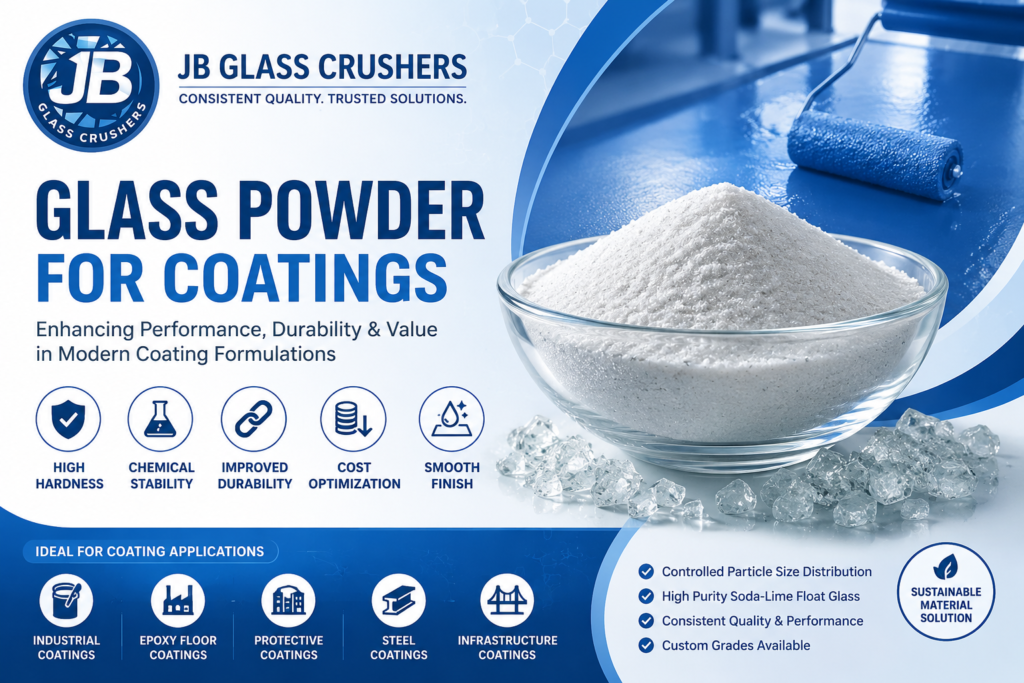
Glass powder is gaining attention as a functional mineral/glass-based filler for coatings, paints, epoxy systems and protective finishes. Its high silica content, hardness, chemical stability and ability to be produced in controlled particle sizes make it a material worth evaluating in industrial coating formulations.
For coating manufacturers, the key question is not simply whether glass powder can be added to a coating, but which glass powder grade, particle size and loading level provides the required balance of cost, dispersion, surface finish and performance.
What Is Glass Powder?
Glass powder is finely ground glass processed into a controlled particle-size distribution.
For industrial coatings, the source glass and processing quality are important. A consistent soda-lime float-glass powder, for example, can provide a silica-rich inorganic filler with controlled particle size.
The particle size can have a significant influence on processing and final properties. Research on glass-powder/epoxy composites has shown that particle size, distribution, concentration and surface treatment can affect composite properties.
Why Use Glass Powder in Coatings?
Glass powder can serve as a functional filler rather than simply an inexpensive extender.
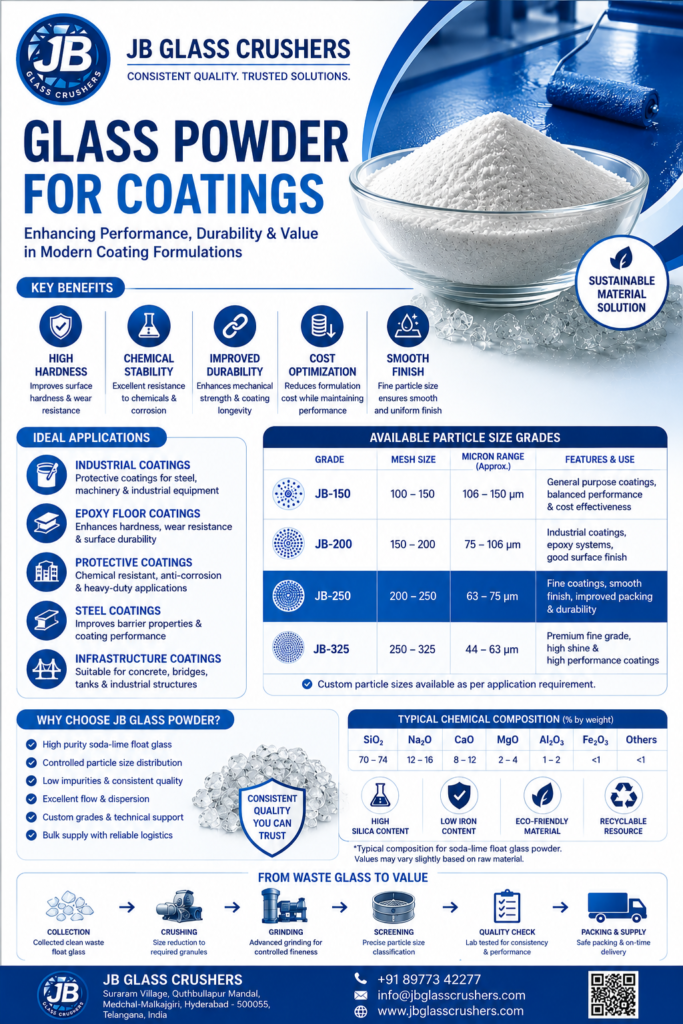
Potential benefits include:
1. High silica content
Soda-lime glass is predominantly silica-based. A silica-rich filler can contribute hardness and rigidity to polymer coating systems.
Studies using glass powder in epoxy composites have reported increases in hardness compared with unfilled epoxy.
2. Improved hardness and wear resistance
Glass is a hard inorganic material. When appropriately dispersed in a resin system, fine glass particles can contribute to a harder composite surface.
This can be particularly interesting for:
- Industrial floor coatings
- Epoxy coatings
- Protective coatings
- Machinery coatings
- Heavy-duty surfaces
- Abrasion-resistant systems
The actual improvement depends on particle size, loading, dispersion and resin chemistry, so it should be established through formulation trials.
3. Potential cost optimization
One reason coating manufacturers investigate mineral and glass fillers is to optimize formulation cost without compromising required performance.
Glass powder can potentially replace a portion of more expensive fillers in suitable formulations.
However, cost should always be evaluated on a performance-adjusted basis, rather than simply comparing ₹/kg.
4. Improved dimensional stability
Inorganic fillers can reduce the amount of resin required and modify shrinkage and dimensional behaviour.
Glass-filled epoxy systems have been investigated for mechanical and thermal-property improvements.
5. Chemical and thermal performance
Glass is chemically stable compared with many organic fillers. Properly selected glass powder can therefore be attractive for protective coating systems where durability is important.
Research on glass-powder-reinforced epoxy systems has reported improvements in mechanical and thermal properties, particularly when the glass powder was appropriately surface-treated.
Glass Powder in Epoxy Coatings
Epoxy is one of the most interesting applications for fine glass powder.
A coating formulation may contain:
Epoxy resin + hardener + pigments + glass powder + other fillers + additives
The glass powder can function as part of the inorganic filler package.
Potential applications include:
- Epoxy floor coatings
- Industrial flooring
- Protective coatings
- Chemical-resistant flooring
- Machinery coatings
- Concrete protection
- Heavy-duty industrial surfaces
Research has specifically demonstrated the use of glass powder as a filler in epoxy-resin composites. One study found that glass-powder/epoxy composites exhibited higher hardness than pure epoxy, while also investigating mechanical and electrical properties.
Particle Size Matters
Particle size is one of the most important specifications when supplying glass powder for coatings.
A coating manufacturer may be interested in:
- 100–150 mesh
- 150–200 mesh
- 200–300 mesh
- 300–325 mesh
- Micronized grades
But mesh alone does not fully describe a powder.
For a serious coating application, the customer should ideally evaluate the particle-size distribution (PSD), including parameters such as D10, D50 and D90.
Why?
Fine particles generally provide better packing and can produce a smoother coating surface, but extremely fine powders can also increase surface area and therefore influence:
- Resin demand
- Viscosity
- Dispersion
- Wetting
- Agglomeration
- Processing
Research on glass-powder processing has demonstrated that particle size affects both powder flowability and thermal behaviour.
Therefore:
Finer does not automatically mean better.
The optimum grade depends on the coating system.
Surface Treatment Can Make a Difference
One particularly important consideration is compatibility between glass particles and the resin.
Glass is an inorganic surface, while epoxy and other coating binders are organic polymer systems.
Poor interfacial compatibility can lead to:
- Poor wetting
- Agglomeration
- Weak particle-resin adhesion
- Increased viscosity
- Reduced mechanical performance
Surface treatment can improve this interface.
Research on glass powder/epoxy composites found that surface treatment of the glass powder improved mechanical and thermal properties.
For certain applications, a silane coupling treatment can improve interaction between the glass surface and epoxy resin. Patent literature on epoxy powder coatings also describes silane-treated glass powder for improving wettability and adhesion and reducing water penetration at the glass/resin interface.
This means there can be two commercial product opportunities:
Standard glass powder
- economical filler for suitable coating systems
Surface-treated glass powder
- higher-performance grade for applications requiring improved resin compatibility
Glass Powder vs Conventional Fillers
Glass powder should not be considered a universal replacement for every coating filler.
| Property | Glass Powder | Conventional Mineral Filler |
|---|---|---|
| Silica content | Typically high | Depends on mineral |
| Hardness | High | Depends on mineral |
| Particle size | Customizable | Available in multiple grades |
| Density | Relatively high | Depends on filler |
| Resin compatibility | May require optimization | Depends on surface chemistry |
| Cost | Potentially competitive | Varies significantly |
| Surface treatment | Possible | Common for some fillers |
| Application | Epoxy, protective & industrial coatings | Broad range |
The right choice depends on the formulation.
Glass Powder for Industrial Floor Coatings
Industrial flooring is a particularly interesting application.
A typical epoxy floor system may require:
- Resin
- Hardener
- Pigment
- Reinforcing/filler materials
- Anti-slip components
- Flow/leveling additives
Glass powder can potentially contribute to the inorganic filler component.
Potential advantages include:
Hardness → Wear resistance → Surface durability → Filler loading → Cost optimization
But the final flooring performance needs to be validated through actual application testing.
Glass Powder for Protective Coatings
Protective coatings are another potential application.
Glass powder can be evaluated in systems designed for:
- Steel structures
- Machinery
- Industrial equipment
- Concrete
- Chemical environments
- Infrastructure
- Tanks and industrial surfaces
The value proposition is particularly strong where the customer wants a hard, durable inorganic filler rather than simply a low-cost extender.
Important: Don’t Use Ordinary Glass Powder Blindly
Not every glass powder is appropriate for every coating.
A coating manufacturer should evaluate:
Chemical composition
Important parameters may include:
- SiO₂
- Na₂O
- CaO
- MgO
- Al₂O₃
- Fe₂O₃
- Other trace oxides
Physical properties
- Particle-size distribution
- Moisture
- Bulk density
- Colour
- Whiteness
- Specific gravity
Application properties
- Dispersion
- Resin compatibility
- Viscosity
- Surface finish
- Cure behaviour
- Adhesion
- Abrasion resistance
- Chemical resistance
How Much Glass Powder Should Be Added?
There is no universal loading percentage.
The optimum loading depends on:
- Resin type
- Hardener
- Particle size
- Surface treatment
- Existing filler package
- Desired viscosity
- Application method
- Required mechanical properties
Published research demonstrates that glass-powder loading influences the properties of the resulting epoxy composite, so formulation trials are necessary rather than assuming a single universal dosage.
For commercial development, it is better to test several loading levels and compare:
0% → low loading → medium loading → high loading
against the customer’s existing formulation.
What Coating Manufacturers Should Test
A proper trial should compare the glass-powder formulation with the existing formulation.
Wet coating
Test:
- Viscosity
- Dispersion
- Settling
- Pot life
- Application behaviour
Cured coating
Test:
- Adhesion
- Hardness
- Abrasion resistance
- Impact resistance
- Flexibility
- Chemical resistance
- Water resistance
- Gloss
- Surface appearance
For epoxy systems, bubble formation and wetting are also important practical considerations.
What Grade Should You Offer for Coatings?
For JB Glass Crushers, I would position your product portfolio approximately like this:
Fine Grade
200–250 mesh
Good starting point for:
- Industrial coatings
- Epoxy
- Construction coatings
- General fillers
Ultrafine Grade
250–325 mesh
Better suited for applications where the customer wants:
- Finer particle distribution
- Better packing
- Smoother surface
- Higher filler fineness
Glass Powder vs Glass Bubbles
These should not be confused.
Solid glass powder is primarily a dense inorganic filler.
Hollow glass microspheres/bubbles are lightweight functional fillers used for density reduction, rheology and other specialized effects. For example, 3M describes glass bubbles for coatings as lightweight fillers that can reduce formulation weight and viscosity and contribute to properties such as scratch resistance and solar reflectivity.
Glass powder is a solid glass-based functional filler
Key Benefits of Glass Powder in Coatings
Potential benefits include:
- High silica-based inorganic filler
- Hardness contribution
- Potential wear/abrasion resistance improvement
- Filler loading and resin optimization
- Potential formulation cost reduction
- Dimensional stability
- Suitable for selected epoxy and protective coating systems
- Controlled particle-size grades
- Possibility of surface treatment for improved resin compatibility
Research supports the potential of glass powder as a filler in epoxy systems, but performance depends strongly on particle characteristics, formulation and surface treatment.
Conclusion
Glass powder can be more than a simple low-cost filler in coatings.
Its high silica-based inorganic composition, hardness and ability to be produced in controlled particle sizes make it an interesting material for epoxy, industrial flooring, protective coatings and other specialized coating systems.
However, successful use depends on matching the glass chemistry, particle-size distribution, surface characteristics and loading level to the coating formulation.