
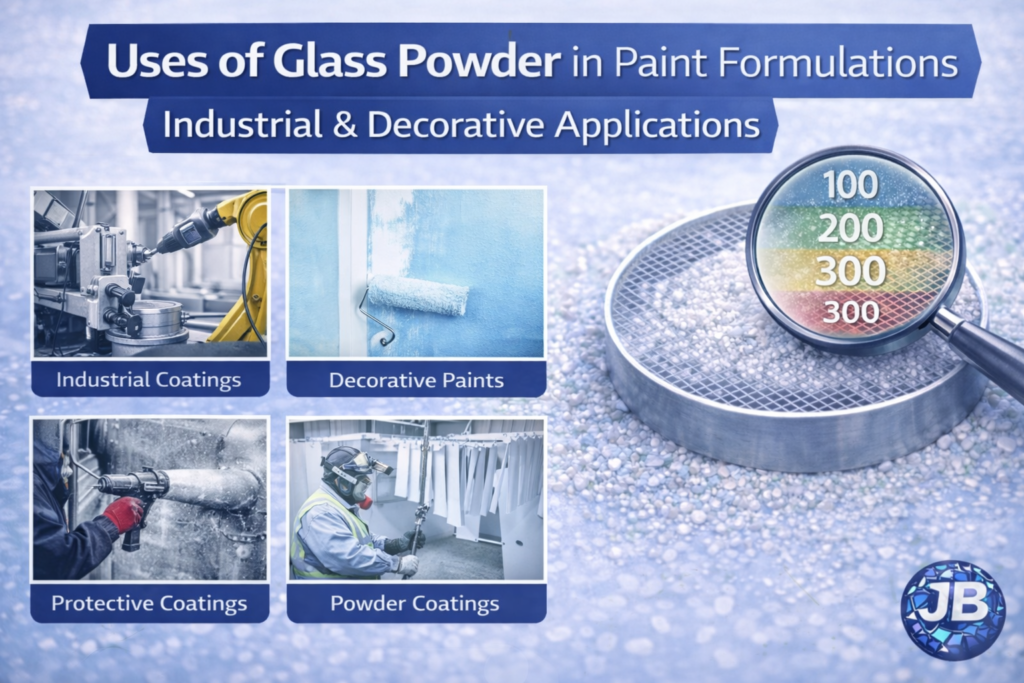
Glass powder is increasingly being used in modern paint and coating formulations due to its durability, chemical stability, and eco-friendly properties. Finely processed recycled glass powder acts as a functional filler that enhances performance while supporting sustainable manufacturing practices.
With industries shifting toward cost-effective and environmentally responsible raw materials, glass powder has emerged as a reliable alternative to conventional mineral fillers.
What Is Glass Powder in Paint Applications?
Glass powder is produced by crushing and milling waste glass into ultra-fine particles, typically ranging from 100 to 300 mesh or finer. In paint formulations, it functions as:
- A performance-enhancing filler
- A reinforcement additive
- A surface-modifying agent
- A cost-optimisation material
Its smooth, inert, and chemically stable nature makes it suitable for both water-based and solvent-based coating systems.
Reach out to JBGlassCrushers
Benefits of Using Glass Powder in Paint Formulations
1. Improved Durability
Glass powder enhances scratch resistance, abrasion resistance, and overall coating strength. This makes it ideal for industrial and protective coatings.
2. Enhanced Surface Smoothness
Fine particle size improves flow characteristics and surface finish, resulting in smoother coatings with improved gloss control.
3. Chemical Resistance
Glass is chemically inert, which improves resistance to corrosion, moisture, and harsh environmental conditions.
4. Cost-Effective Filler Alternative
Glass powder can partially replace traditional fillers such as silica, calcium carbonate, and talc, reducing formulation costs.
5. Eco-Friendly & Sustainable
Manufactured from recycled glass, it reduces landfill waste and supports green building initiatives.
Applications in the Paint Industry
Glass powder is used across multiple coating categories:
Industrial Coatings
- Machinery coatings
- Structural steel coatings
- Factory floor paints
Decorative Paints
- Interior and exterior wall paints
- Texture paints
- Premium smooth finish coatings
Protective Coatings
- Anti-corrosion systems
- Marine coatings
- Chemical-resistant coatings
Powder Coatings
Ultra-fine glass powder improves mechanical strength and surface performance in powder-based systems.
Recommended Mesh Sizes for Paint Formulations
Depending on application requirements:
- 100 Mesh – General filler applications
- 200 Mesh – Improved smoothness & better dispersion
- 300 Mesh & finer – Premium coatings requiring a superior finish
Finer grades improve dispersion, opacity control, and film uniformity.
Advantages & Benefits of Glass Powder in Paint Formulations
Glass powder is not just a filler; it is a functional performance enhancer in modern paint and coating systems. Below are the key technical and commercial advantages:
Enhanced Mechanical Strength
Glass particles improve the structural integrity of the coating film. Due to their hardness and stable structure, they:
- Increase abrasion resistance
- Improve scratch resistance
- Enhance impact strength
- Reduce surface wear
This makes coatings more durable in industrial environments.
Superior Surface Smoothness
Finely milled glass powder (200–300 mesh) provides:
- Better dispersion in resin systems
- Improved flow and levelling
- Reduced surface imperfections
- Uniform film formation
The result is a smoother, more premium finish in decorative and industrial paints.
Improved Chemical & Corrosion Resistance
Glass is chemically inert and non-reactive, which helps coatings:
- Resist moisture penetration
- Improve corrosion protection
- Withstand acidic and alkaline exposure
- Enhance weather resistance
Ideal for protective and marine coatings.
Eco-Friendly & Sustainable Raw Material
Manufactured from recycled glass, it:
- Reduces landfill waste
- Lowers dependency on mined minerals
- Supports green building initiatives
- Helps manufacturers meet environmental regulations
It contributes to circular economy practices in the coatings industry.
Low Oil Absorption
Glass powder generally has:
- Lower oil absorption compared to some traditional fillers
- Better binder efficiency
- Improved viscosity control
This allows better formulation stability.
Excellent Particle Stability
- Uniform particle size distribution
- Non-porous structure
- Minimal moisture absorption
- Long shelf life
This ensures consistent quality across production batches.
Compatibility with Various Resin Systems
Glass powder works well with:
- Epoxy resins
- Acrylic systems
- Polyester coatings
- Polyurethane coatings
- Powder coating systems
This makes it highly versatile across coating applications.
Improved Thermal Stability
Glass particles enhance:
- Heat resistance
- Dimensional stability
- Reduced shrinkage
Important for industrial and high-performance coatings.
Enhanced Gloss & Reflective Effects (Optional in Decorative Paints)
Fine glass particles can:
- Improve light reflectivity
- Enhance gloss control
- Add decorative sparkle (if required)
Used in speciality and designer coatings.
Cost Optimisation in Formulations
Glass powder can partially replace expensive mineral fillers such as:
- Silica
- Talc
- Calcium carbonate
Benefits include:
- Lower raw material costs
- Improved filler efficiency
- Better performance-to-cost ratio
Technical Advantages
- High hardness (improves abrasion resistance)
- Low oil absorption
- Stable particle size distribution
- Non-reactive & safe for long-term storage
- Excellent compatibility with various resin systems
Why Manufacturers Are Switching to Glass Powder
Paint manufacturers are under increasing pressure to:
- Reduce raw material costs
- Improve product performance
- Meet environmental regulations
- Adopt sustainable materials
Glass powder addresses all these needs while maintaining high-quality coating standards.
Sustainability & Green Construction Benefits
Using recycled glass powder in paint production contributes to:
- Lower carbon footprint
- Reduced mining of natural minerals
- Waste recycling and circular economy practices
- Green building certifications
This makes it particularly attractive for eco-conscious construction and industrial projects.
Conclusion
Glass powder is no longer just a recycled by-product it is a high-performance additive in modern paint formulations. With benefits including improved durability, enhanced smoothness, chemical resistance, and sustainability, it offers both economic and environmental advantages.
As the coatings industry continues to evolve, glass powder is positioned to become a preferred filler material for high-quality, industrial-grade paint systems.