
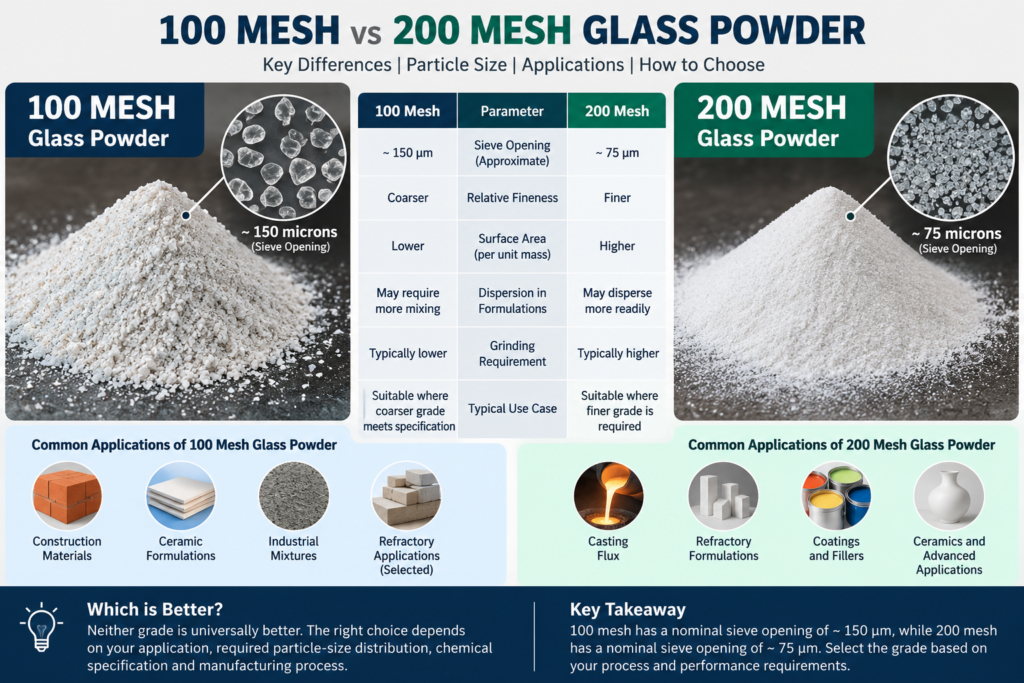
Choosing the right glass powder mesh size is important for industrial performance, processing efficiency and product consistency. Two commonly specified grades are 100 mesh glass powder and 200 mesh glass powder. Although both are used in industrial applications, they differ in particle fineness and may behave differently during mixing, melting and formulation.
In this guide, we explain the differences between 100 mesh and 200 mesh glass powder, their typical applications and the factors manufacturers should consider when selecting a grade.
What Does Mesh Size Mean in Glass Powder?
Mesh size describes the sieve classification used to separate particles according to size. A higher mesh number generally indicates a smaller sieve opening and a finer powder.
For common US standard sieve designations:
- 100 mesh: approximately 150 microns (µm)
- 200 mesh: approximately 75 microns (µm)
These figures represent sieve openings, not the exact diameter of every particle in a powder sample. Actual particle-size distribution depends on the grinding and screening process.
100 Mesh vs 200 Mesh Glass Powder: Key Differences
| Parameter | 100 Mesh Glass Powder | 200 Mesh Glass Powder |
|---|---|---|
| Approximate sieve opening | 150 µm | 75 µm |
| Relative fineness | Coarser | Finer |
| Particle surface area per unit mass | Generally lower | Generally higher |
| Dispersion in fine formulations | May require more mixing | May disperse more readily, depending on the formulation |
| Grinding requirements | Typically lower | Typically higher |
| Potential processing considerations | Coarser particles may remain visible or settle differently | Fine particles may generate more dust or agglomerate |
| Selection criteria | Suitable where a coarser grade meets the process specification | Suitable where a finer grade is required by the application |
Important: These are general tendencies. Actual performance depends on the glass composition, particle-size distribution, moisture, contamination and the customer’s manufacturing process.
What Is 100 Mesh Glass Powder?
100 mesh glass powder is a comparatively coarse powder grade with a nominal sieve opening of approximately 150 µm.
It may be considered for industrial applications where the required particle size does not need to be as fine as 200 mesh. Depending on the formulation and process, potential applications may include selected construction materials, mineral-filled products, ceramic formulations and other industrial mixtures.
Potential advantages
- May require less grinding than finer grades.
- Can be economical where a coarser particle size meets the specification.
- May be suitable for processes that tolerate larger particles.
The appropriate grade should be established through the customer’s process requirements and application testing.
What Is 200 Mesh Glass Powder?
200 mesh glass powder is finer than 100 mesh glass powder, with a nominal sieve opening of approximately 75 µm.
It may be considered for applications that require finer particles, such as selected ceramic formulations, coatings, construction materials and industrial fillers.
Potential advantages
- Smaller particles may provide greater surface area per unit mass.
- May help achieve a more uniform distribution in suitable formulations.
- Can be considered where finer material is required for processing or product performance.
A 200 mesh designation does not automatically mean that every particle is smaller than 75 µm. Buyers should specify the required percentage passing through the sieve and the permitted oversize fraction.
Which Is Better: 100 Mesh or 200 Mesh Glass Powder?
Neither grade is universally better. The correct choice depends on the application.
Choose 100 mesh when the customer’s process permits a coarser grade and the specified particle-size distribution is met.
Choose 200 mesh when the process requires a finer grade or when trials demonstrate a performance benefit from the smaller particles.
For applications involving casting flux, refractory formulations, ceramics or industrial coatings, mesh size is only one part of the qualification process. Chemical composition, alkali content, calcium and magnesium levels, iron contamination and moisture may also be critical.
For example, a buyer requiring a particular silica and sodium oxide range should verify those values through chemical analysis rather than selecting material by mesh size alone.
How to Specify Glass Powder Correctly
When requesting a quotation or qualifying a supplier, buyers should specify:
- Mesh size: 100 mesh, 200 mesh or another required grade.
- Sieve analysis: Percentage passing and retained at the specified sieve.
- Chemical composition: Required oxide ranges and impurity limits.
- Moisture content: Maximum acceptable moisture.
- Colour and contamination: Where relevant to the application.
- Packaging and quantity: Required bag size, monthly consumption and delivery schedule.
- Testing requirements: Chemical analysis, certificate of analysis (COA) and sample approval, as applicable.
Providing these details helps suppliers deliver material that matches the intended application.
Industrial Glass Powder from JB Glass Crushers
Jai Bhavani Glass Crushers, based in Hyderabad, Telangana, manufactures industrial glass powder in different mesh grades for B2B customers.
We work with industrial buyers to discuss particle-size requirements, chemical specifications, samples and bulk supply requirements.
If your application requires 100 mesh or 200 mesh glass powder, share your target specification and intended use so that the appropriate grade can be evaluated.
Contact JB Glass Crushers to discuss your industrial glass powder requirements.
Frequently Asked Questions
Is 200 mesh glass powder finer than 100 mesh?
Yes. A common 200 mesh sieve has an opening of approximately 75 µm, compared with approximately 150 µm for a 100 mesh sieve.
Can 100 mesh glass powder replace 200 mesh glass powder?
Not automatically. Replacement depends on the customer’s particle-size limits, formulation and process performance. Obtain approval and conduct trials before changing grades.
Does 200 mesh glass powder always perform better?
No. Finer particles may offer benefits in some applications, but they can also increase dust generation, affect handling and require additional grinding energy. Performance must be evaluated for the intended use.
Is mesh size the same as micron size?
No. Mesh identifies a sieve designation, while microns express a length. A sieve opening can be expressed in microns, but the mesh designation does not describe the exact size of every particle.
What should buyers check before purchasing glass powder?
Check the sieve analysis, chemical composition, moisture, contamination limits and packaging requirements. For critical applications, request a representative sample and certificate of analysis before approving bulk supply.
Conclusion
The main difference between 100 mesh and 200 mesh glass powder is fineness: 100 mesh has a nominal opening of approximately 150 µm, while 200 mesh has a nominal opening of approximately 75 µm. The right grade depends on the required particle-size distribution, chemical specification and intended industrial application.
For industrial glass powder supply, selecting the correct specification is more important than choosing the highest mesh number.