
The refractory industry plays a critical role in high-temperature industrial processes, including steel manufacturing, glass production, cement production, and ceramic processing. Refractory materials must withstand extreme heat, chemical corrosion, and mechanical stress. To improve performance and manufacturing efficiency, manufacturers continuously search for reliable raw materials that offer both technical and economic advantages.
One such emerging material is industrial glass powder. Due to its high silica content and fluxing oxides, glass powder has become an effective additive in refractory and ceramic formulations. Industrial-grade glass powder can improve bonding, reduce firing temperatures, and enhance the overall performance of refractory products.
What is Glass Powder?
Glass powder is a finely ground material produced by pulverising glass cullets into controlled particle sizes. The resulting powder contains a high concentration of silica (SiO₂) along with other oxides such as sodium oxide (Na₂O), calcium oxide (CaO), and magnesium oxide (MgO).
These chemical components make glass powder highly suitable for several industrial applications, including:
- Refractory formulations
- Ceramic frit and glaze production
- Industrial fillers
- Coatings and paints
- Construction materials
Because glass powder is made from recycled glass, it supports environmentally sustainable manufacturing practices.
Role of Glass Powder in Refractory Materials
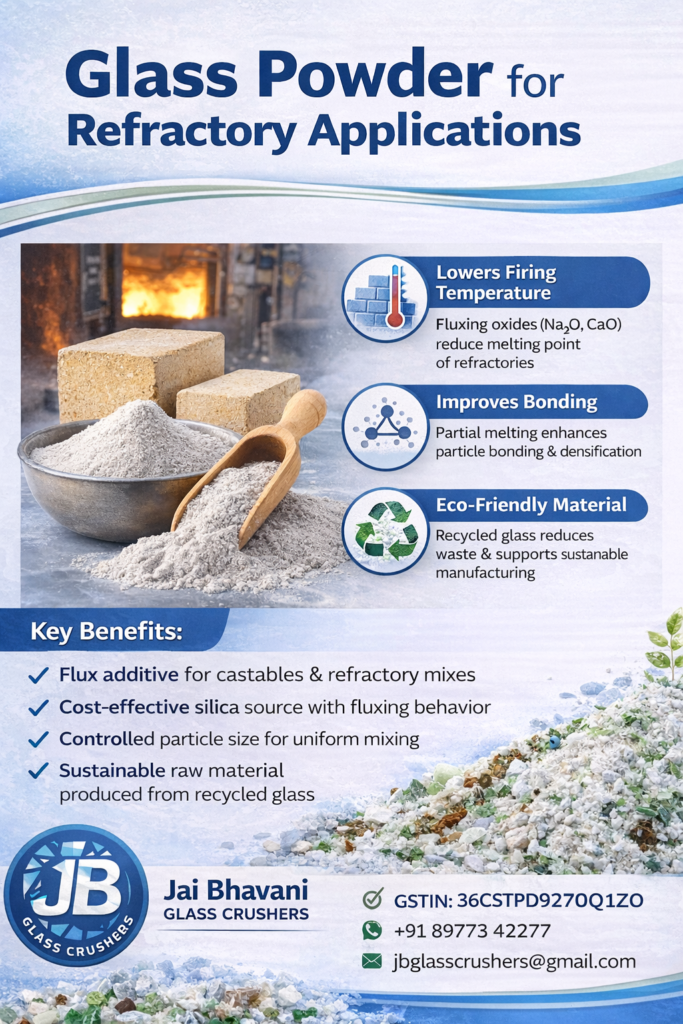
Glass powder can act as both a silica-rich filler and a fluxing additive in refractory mixtures. When exposed to high temperatures during firing, the glass particles soften and promote bonding between refractory grains. This improves densification and mechanical strength in the final product.
In refractory manufacturing, glass powder can contribute to:
- Improved particle packing
- Better bonding during firing
- Reduced energy consumption in kilns
- Enhanced structural stability of refractory components
These characteristics make it a valuable additive for refractory castables, ceramic bodies, and high-temperature insulation materials.
Key Benefits of Using Glass Powder in Refractories
1. High Silica Content
Glass powder contains a high percentage of silica, which is an important component in many refractory and ceramic formulations. Silica improves thermal resistance and structural stability in high-temperature environments.
2. Natural Fluxing Properties
The presence of sodium oxide and calcium oxide helps reduce the melting temperature of refractory mixtures. These fluxing oxides improve sintering and bonding during the firing process.
3. Improved Particle Distribution
Industrial glass powder is produced with controlled particle size distribution, allowing it to blend uniformly with other raw materials in refractory mixes.
4. Reduced Manufacturing Costs
Glass powder can partially replace certain mineral fillers or silica-based materials, helping manufacturers reduce raw material costs while maintaining product quality.
5. Sustainable Raw Material
Since glass powder is produced from recycled glass, it helps reduce landfill waste and supports circular economy practices in industrial manufacturing.
Applications in Refractory and Ceramic Industries
Glass powder is widely used in multiple industrial sectors due to its versatile properties.
Refractory Applications
- Refractory castables
- High-temperature insulation materials
- Refractory binders
- Furnace linings
Ceramic Industry Applications
- Ceramic frit production
- Tile and porcelain manufacturing
- Ceramic glaze formulations
- Industrial ceramic composites
In ceramic glaze production, glass powder can help improve melting behaviour and surface finish due to its natural fluxing oxides.
Manufacturing Process of Industrial Glass Powder
High-quality glass powder is produced through controlled industrial processes such as:
- Pulverisation of glass cullets
- Cyclone separation for particle classification
- Vibratory screening for size control
- Magnetic separation to remove metallic contamination
This ensures consistent particle size distribution and high purity for industrial applications.
Environmental Benefits of Recycled Glass Powder
One of the major advantages of glass powder is its environmental sustainability. Recycling glass into industrial powders helps:
- Reduce landfill waste
- Lower demand for virgin mineral extraction
- Support eco-friendly manufacturing practices
- Promote circular economy initiatives
Industries increasingly prefer recycled raw materials to meet sustainability goals and regulatory requirements.
Why Choose Industrial Glass Powder from JB Glass Crushers?
Jai Bhavani Glass Crushers specialises in producing high-quality recycled glass powder suitable for industrial applications. The material is manufactured using controlled processing techniques to ensure consistent particle size, low moisture content, and reliable performance.
Key advantages include:
- Controlled mesh sizes
- Free-flowing powder
- Low moisture content
- Batch-wise quality control
- Custom particle sizes available
These features make the product suitable for refractory, ceramic, coating, and filler applications.
Conclusion
Glass powder is becoming an important industrial raw material for the refractory and ceramic industries. With its high silica content, fluxing properties, and sustainable origin, recycled glass powder offers manufacturers an efficient and cost-effective solution for improving refractory formulations.
As industries continue to adopt environmentally responsible manufacturing practices, glass powder will play a growing role in modern industrial materials.