
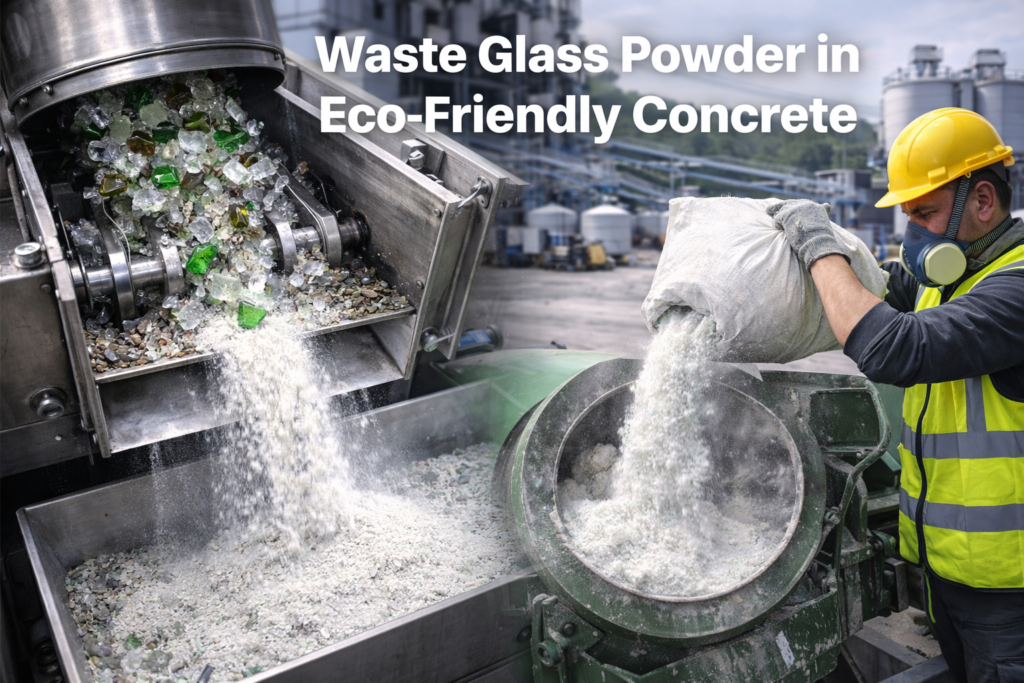
The construction industry is among the largest consumers of natural resources and a major contributor to global carbon emissions. Cement production alone accounts for nearly 7–8% of global CO₂ emissions. At the same time, millions of tons of waste glass are generated every year from bottles, windows, and industrial glass products. Much of this glass ends up in landfills due to contamination, color mixing, or lack of recycling infrastructure.
A sustainable solution to these two environmental challenges is the utilisation of waste glass powder (WGP) and waste glass sand (WGS) in concrete production. Recycled waste glass, when ground to a fine powder or to sand-sized particles, can be used as a partial replacement for cement and natural aggregates in concrete mixtures.
This approach not only reduces landfill waste but also produces eco-friendly concrete with improved mechanical and durability properties.
What is Waste Glass Powder and Waste Glass Sand?
Waste Glass Powder (WGP)
Waste glass powder is produced by crushing and grinding discarded glass into very fine particles, typically smaller than 75 microns. At this size, glass behaves as a pozzolanic material, meaning it reacts with calcium hydroxide in cement to form additional cementitious compounds that improve concrete strength.
Key characteristics:
- High silica content (SiO₂)
- Fine particle size
- Pozzolanic reactivity
- Good chemical stability
Because of these properties, WGP can partially replace cement in concrete mixtures.
Waste Glass Sand (WGS)
Waste glass sand refers to crushed glass particles that resemble natural sand in size. These particles are typically between 0.15 mm and 4.75 mm, similar to fine aggregates used in concrete.
Waste glass sand can replace:
- Natural river sand
- Manufactured sand
- Fine aggregates in concrete
Using WGS helps conserve natural sand resources, which are rapidly depleting due to large-scale construction activities.
Production Process of Glass Powder and Glass Sand
The transformation of waste glass into usable construction material involves several steps:
1. Collection of Waste Glass
Waste glass is collected from sources such as:
- Beverage bottles
- Window and architectural glass
- Automotive glass
- Industrial glass waste
2. Sorting and Cleaning
The glass is sorted to remove contaminants such as:
- Metal caps
- Plastic labels
- Organic waste
- Ceramic or stone fragments
3. Crushing
Glass crushers break the glass into small fragments.
4. Grinding
Grinding machines convert crushed glass into fine glass powder suitable for cement replacement.
5. Sieving and Classification
The material is sieved to obtain the desired particle size for:
- Glass powder (cement replacement)
- Glass sand (fine aggregate replacement)
This process ensures consistent quality and performance in concrete applications.
Role of Waste Glass Powder in Concrete
Waste glass powder acts as a supplementary cementitious material (SCM).
When added to concrete, the silica in glass powder reacts with calcium hydroxide produced during cement hydration. This reaction forms calcium silicate hydrate (C-S-H), the main compound responsible for concrete strength.
Benefits of Using Glass Powder in Concrete
1. Improved Compressive Strength
Finely ground glass powder improves concrete strength due to pozzolanic reactions and better particle packing.
2. Reduced Cement Consumption
Replacing a portion of cement with glass powder lowers the amount of cement required, reducing production costs and carbon emissions.
3. Enhanced Durability
Glass powder helps reduce permeability, making concrete more resistant to:
- Water penetration
- Chemical attacks
- Chloride ingress
4. Better Workability
Fine glass particles improve the flow and workability of concrete mixtures.
Role of Waste Glass Sand in Concrete
Waste glass sand can replace natural sand as a fine aggregate in concrete.
Advantages of Glass Sand in Concrete
1. Conservation of Natural Sand
River sand mining causes environmental damage and ecological imbalance. Using glass sand helps preserve natural resources.
2. Improved Surface Textur
Glass particles can improve the surface finish of concrete.
3. High Durability
Glass sand provides good resistance to:
- Weathering
- Chemical exposure
- Abrasion
4. Sustainable Construction Material
Using recycled glass aggregates supports green construction practices.
Optimal Replacement Levels
Research studies suggest specific replacement percentages for best performance.
Glass Powder Replacement for Cement
- 5% – 20% replacement shows improved strength and durability.
- Excessive replacement may reduce early strength.
Glass Sand Replacement for Fine Aggregates
- 10% – 30% replacement generally provides good results.
- Higher percentages may affect workability depending on particle shape.
Proper mix design is important to achieve optimal concrete performance.
Mechanical Properties of Glass-Based Concrete
Concrete incorporating waste glass materials demonstrates promising mechanical properties.
Compressive Strength
Concrete with glass powder often shows equal or higher compressive strength compared to conventional concrete.
Tensile Strength
The presence of finely ground glass improves bonding between particles, enhancing tensile strength.
Flexural Strength
Glass powder and sand improve particle packing, resulting in better load distribution under bending forces.
Durability Properties
Concrete containing waste glass materials often performs well in durability tests.
Resistance to Chemical Attack
Glass powder improves resistance to sulfate and acid attack.
Reduced Water Absorption
The fine particles fill voids, reducing porosity.
Improved Freeze-Thaw Resistance
Glass-based concrete shows better performance in cold environments.
Environmental Benefits
The use of waste glass in concrete provides several environmental advantages.
Reduction of Landfill Waste
Millions of tons of waste glass can be diverted from landfills.
Lower Carbon Emissions
Replacing cement reduces greenhouse gas emissions associated with cement manufacturing.
Conservation of Natural Resources
Using recycled glass reduces dependence on:
- Natural sand
- Limestone for cement
- Quarry aggregates
Sustainable Construction
Glass-based concrete contributes to green building practices and circular economy principles.
Applications of Glass-Based Eco-Friendly Concrete
Eco-friendly concrete containing glass powder and glass sand can be used in many construction applications:
- Pavements and sidewalks
- Road construction
- Precast concrete blocks
- Architectural concrete
- Decorative concrete surfaces
- Structural elements in buildings
The reflective nature of glass particles can also enhance the aesthetic appearance of decorative concrete.
Challenges and Considerations
Although waste glass concrete has many benefits, certain challenges must be addressed.
Alkali-Silica Reaction (ASR)
Coarse glass particles may react with cement alkalis and cause expansion. However, using finely ground glass powder significantly reduces the risk of ASR.
Proper Particle Size Control
Glass must be ground to appropriate sizes for safe use in concrete.
Quality Control
Contaminants must be removed to maintain material quality.
Future Potential of Glass-Based Concrete
As sustainability becomes a priority in construction, the demand for recycled materials will continue to grow. Waste glass powder and glass sand offer a promising solution for producing high-performance, eco-friendly concrete.
Research continues to explore:
- Ultra-fine glass powder as cement replacement
- Glass powder in geopolymer concrete
- High-performance green concrete mixes
With advanced recycling technologies and increased awareness, glass recycling for construction materials is expected to expand significantly.
Conclusion
The utilisation of waste glass powder and waste glass sand in eco-friendly concrete production represents a sustainable approach to addressing two major environmental challenges: construction-related carbon emissions and glass waste disposal.
By incorporating recycled glass materials into concrete, the construction industry can produce stronger, more durable, and environmentally friendly building materials. This innovative approach not only reduces waste but also conserves natural resources and promotes sustainable infrastructure development.
Companies involved in glass recycling and glass powder production, such as those specialising in crushing and grinding technologies, play a crucial role in enabling the transition to greener construction materials.