
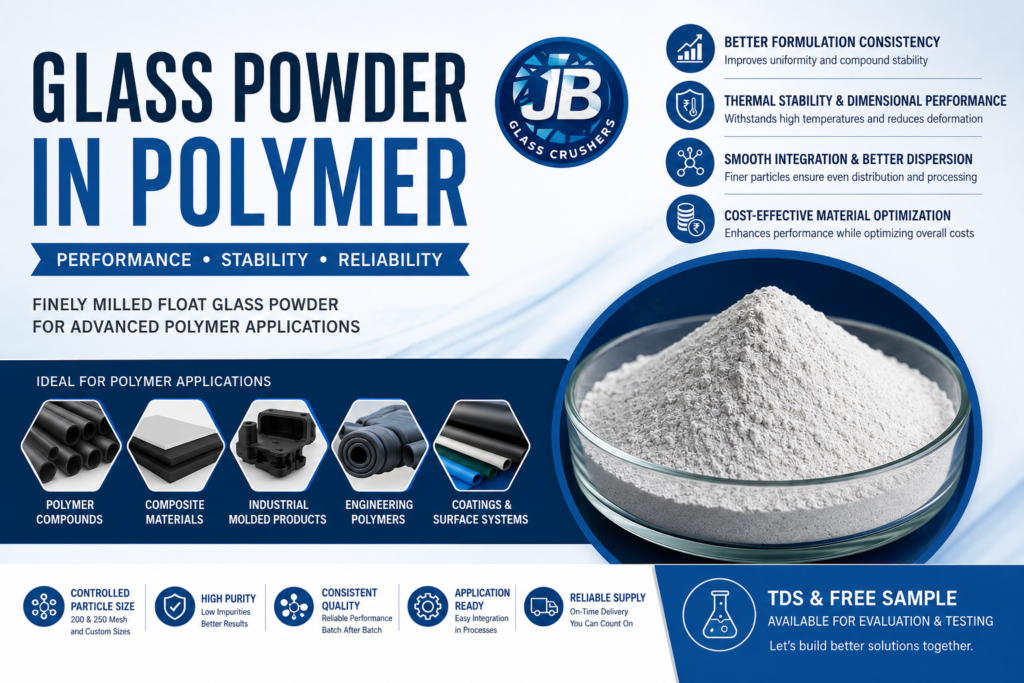
Modern polymer industries are continuously searching for materials that improve performance, enhance formulation consistency, and optimize production costs.
One material increasingly being explored across polymer systems is finely milled glass powder.
With controlled particle sizing, reliable purity, and strong thermal stability, glass powder can function as an effective industrial filler and performance-enhancing material in multiple polymer applications.
At JB Glass Crushers, we manufacture application-ready float glass powder with customizable mesh sizes including 200 and 250 mesh for industrial polymer systems.
Why Glass Powder Is Used in Polymers
Polymer formulations require fillers and reinforcing materials that support:
- Dimensional stability
- Thermal resistance
- Surface consistency
- Controlled processing behavior
- Cost optimization
Finely milled glass powder offers these advantages while integrating smoothly into polymer compounds.
Because the particles are controlled and uniform, the material behaves more consistently during mixing, extrusion, molding, and finishing operations.
Key Benefits of Glass Powder in Polymer Applications
1. Improved Filler Performance
Glass powder can act as a high-performance filler in polymer systems.
Benefits include:
- Better particle distribution
- Improved formulation consistency
- Enhanced structural behavior
- Stable processing performance
Controlled particle sizing helps improve overall material uniformity across the compound.
2. Better Thermal Stability
Many polymer applications require materials that can withstand elevated temperatures without significant degradation.
Glass powder supports:
- Thermal resistance
- Dimensional stability
- Reduced heat-related deformation
This makes it suitable for:
- Engineering polymers
- Industrial molded products
- Construction-related polymer systems
- Composite applications
3. Smooth Integration in Polymer Compounds
Because the particles are finely milled and controlled, glass powder disperses more evenly within polymer matrices.
This supports:
- Better mixing consistency
- Reduced agglomeration
- Improved process control
- More stable manufacturing performance
Uniform particle distribution is especially important in precision polymer applications.
4. Surface & Structural Consistency
In polymer manufacturing, surface quality and consistency are critical.
Controlled glass powder can help support:
- Better surface finish
- Improved rigidity
- Consistent molded appearance
- Stable product dimensions
This is valuable across industrial and consumer-grade polymer products.
5. Cost-Effective Material Optimization
Manufacturers often look for ways to optimize raw material usage without sacrificing performance.
Glass powder can help:
- Reduce dependency on expensive fillers
- Improve formulation economics
- Support material efficiency
- Lower overall production costs
This creates a balance between performance and cost optimization.
Why Particle Size Matters in Polymer Systems
Particle size plays a major role in polymer performance.
Fine Glass Powder
Fine particle grades support:
- Better dispersion
- Smoother integration
- Improved surface finish
- Enhanced formulation consistency
Best suited for:
- Precision polymer compounds
- Coatings
- High-performance composites
Medium Particle Grades
Medium-sized particles support:
- Balanced performance
- Cost optimization
- Controlled processing behavior
Commonly used in:
- Industrial molded products
- Construction polymers
- General industrial compounds
Importance of Purity in Polymer Applications
Contamination directly affects polymer quality.
Impurities such as:
- Metals
- Organics
- Mixed particles
can negatively impact:
- Surface finish
- Compound consistency
- Structural behavior
- Manufacturing efficiency
High-purity glass powder helps manufacturers maintain:
- Cleaner processing
- Better consistency
- Reduced rejection rates
- Reliable product quality
Applications of Glass Powder in Polymer Industries
Glass powder can support multiple polymer applications including:
Polymer Compounds
Used for:
- Filler systems
- Performance enhancement
- Cost optimization
Composite Materials
Supports:
- Structural stability
- Reinforcement systems
- Engineered materials
Industrial Molded Products
Helps improve:
- Dimensional consistency
- Surface quality
- Processing stability
Coatings & Surface Systems
Can support:
- Functional coatings
- Industrial finishes
- Specialized polymer systems
Why Controlled Processing Matters
Not all glass powder performs equally in polymer systems.
Industrial polymer applications require:
- Controlled particle sizing
- Reliable purity
- Consistent material behavior
- Stable industrial supply
At JB Glass Crushers, we focus on:
- Finely milled float glass powder
- Controlled processing
- Consistent industrial-grade quality
- Application-ready material solutions
Conclusion
Glass powder is becoming increasingly relevant in polymer manufacturing because of its ability to support:
- Better formulation consistency
- Thermal stability
- Filler performance
- Cost optimization
However, industrial performance depends heavily on particle control, purity, and consistent processing.
At JB Glass Crushers, we manufacture application-ready glass powder designed to support modern industrial polymer applications through controlled processing and reliable material quality.