
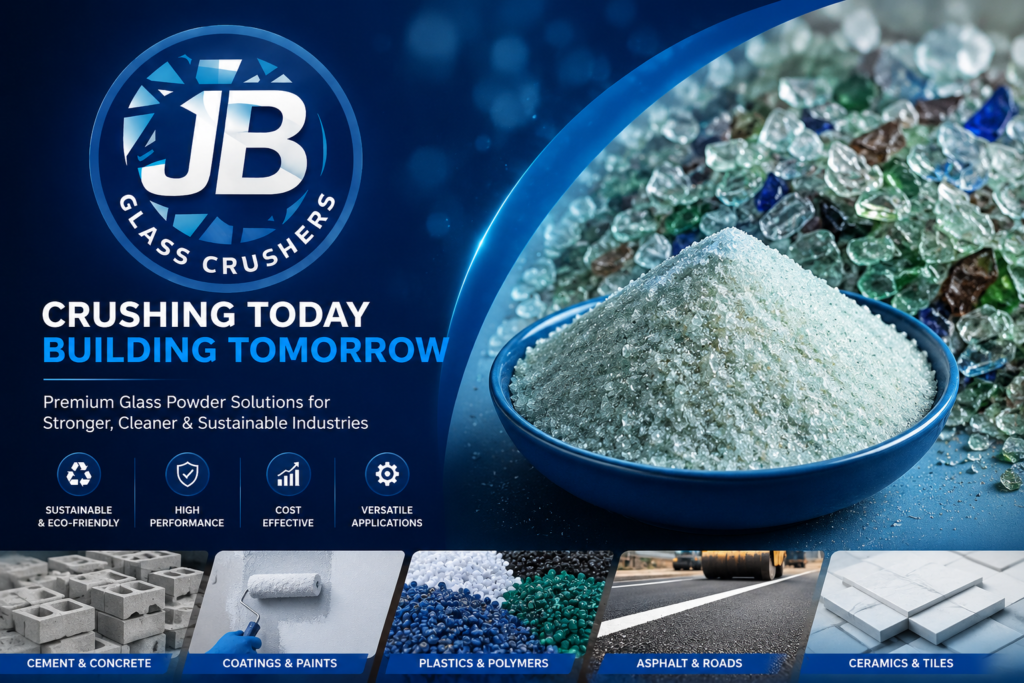
Glass powder, produced by finely grinding recycled soda-lime or borosilicate glass, is emerging as an important industrial filler and supplementary material across multiple sectors. Traditionally treated as waste, finely processed glass now offers functional value because of its hardness, chemical stability, particle packing capability, and, in cementitious systems, pozzolanic behavior.
Industries are increasingly exploring glass powder as a replacement for conventional fillers such as calcium carbonate, fly ash, slag, silica, talc, limestone powder, and mineral fillers. Depending on the formulation and particle size, glass powder can improve surface finish, abrasion resistance, density, stiffness, and long-term durability.
This article examines how glass powder is being used across major industries, the materials it can replace, the performance benefits it provides, and the practical limitations manufacturers must consider.
Why Glass Powder Works
Glass powder behaves as a hard mineral filler with several valuable characteristics:
- High hardness and scratch resistance
- Chemically stable structure
- Fine particle packing ability
- Optical brightness potential
- Low porosity contribution
- Potential pozzolanic reactivity in cement systems when ultrafine
When properly engineered, fine glass particles fill microscopic voids within formulations, creating denser microstructures and smoother finishes.
However, performance depends heavily on:
- Particle size distribution (PSD)
- Surface treatment
- Dispersion quality
- Loading percentage
- Compatibility with the matrix material
Poorly controlled particle size or excessive loading can reduce strength, increase brittleness, or create bonding problems.
1. Cement, Concrete, Mortar, and Construction Materials
Materials Glass Powder Can Replace
In cementitious systems, glass powder can partially replace:
- Portland cement
- Fly ash
- Ground granulated blast furnace slag (GGBS)
- Limestone powder
- Microfillers and stone dust
As availability of traditional supplementary cementitious materials declines in some markets, glass powder is receiving attention as an alternative SCM.
Performance Benefits
Improved Surface Finish
Fine glass particles improve particle packing within mortar and plaster systems. This reduces voids and creates smoother surfaces in:
- Wall plaster
- Tile adhesives
- Grouts
- Decorative concrete
- Wall putty
- Paver blocks
Strength Development
When glass powder is ground to cement-like fineness, it can react pozzolanically with calcium hydroxide produced during cement hydration. This can improve:
- Later-age compressive strength
- Durability
- Density
- Permeability resistance
Reduced Porosity
The microfiller effect improves matrix densification and reduces capillary voids.
Challenges
The main concern is alkali–silica reaction (ASR), which can occur if glass particles are too coarse or poorly incorporated into the mix.
To minimize ASR risk:
- Use ultrafine glass powder
- Optimize replacement levels
- Combine with SCMs such as slag or fly ash
- Control alkali levels in the mix design
Particle fineness is the most critical factor in successful cement applications.
2. Asphalt and Bitumen Applications
Glass powder is also being studied as a mineral filler in asphalt and road construction.
Replaceable Materials
Glass powder can partially replace:
- Limestone dust
- Stone dust
- Mineral filler fractions
Some formulations also use glass powder as a modifier in bitumen binders.
Performance Improvements
Properly graded glass powder can improve:
- Rutting resistance
- High-temperature stiffness
- Resistance to permanent deformation
These properties are particularly important in hot climate regions where asphalt deformation is common.
However, gradation and binder compatibility must be carefully optimized.
3. Paints, Coatings, Wall Putty, and Primers
One of the most commercially promising uses of glass powder is in coatings and decorative construction products.
Replaceable Fillers
Glass powder can replace portions of:
- Calcium carbonate (CaCO₃)
- Talc
- Barytes
- Silica fillers
Functional Benefits
Better Surface Smoothness
Fine particle packing improves coating uniformity and smoothness.
Increased Hardness
Glass is inherently hard, making coatings more resistant to:
- Scratches
- Abrasion
- Scrubbing
- Wear
Improved Density and Build
Properly engineered formulations can provide smoother high-build coatings with improved durability.
Matte vs Gloss Systems
Glass powder alone does not automatically create matte finishes.
Matting performance depends primarily on:
- Particle size distribution
- Surface texture
- Light scattering behavior
Silica matting agents are still commonly preferred for strong matte effects. However, glass powder performs well in premium smooth-finish and scrub-resistant coatings.
4. Plastics, Rubber, and Polymer Composites
Glass powder is increasingly used in thermoplastics and thermosetting resin systems.
Replaceable Fillers
Possible replacement materials include:
- Calcium carbonate
- Talc
- Mica
- Silica
Applications
- Polypropylene (PP)
- Polyethylene (PE)
- Epoxy systems
- Polyester resins
- Rubber compounds
Mechanical Advantages
At moderate loading levels, glass powder can improve:
- Modulus
- Stiffness
- Hardness
- Abrasion resistance
In epoxy flooring and industrial resin systems, it can significantly improve wear resistance.
Challenges
Mechanical performance depends strongly on dispersion and interfacial bonding.
Poor bonding can:
- Reduce tensile strength
- Increase brittleness
- Create weak interfaces
To solve this, manufacturers often use:
- Silane coupling agents
- Compatibilizers such as MAPP in polypropylene systems
These additives improve adhesion between glass particles and polymer matrices.
5. Ceramics, Tiles, and Glass-Ceramics
Glass powder can also be used in ceramic formulations.
Replaceable Materials
Depending on the ceramic body composition, glass powder can partially replace:
- Quartz
- Silica flour
- Flux materials
Benefits
Properly balanced formulations can improve:
- Vitrification
- Surface finish
- Densification
- Energy efficiency during firing
Risks
Ceramic systems are highly chemistry-sensitive.
Improper formulations may cause:
- Pinholing
- Warpage
- Shrinkage problems
- Surface defects
Therefore, successful ceramic applications require careful matching of:
- Glass chemistry
- Firing temperature
- Flux balance
- Particle size
Importance of Particle Size
Particle size is the single most important parameter governing glass powder performance.
Coarse Glass Powder
Coarser particles generally behave as inert fillers and may:
- Reduce bonding quality
- Increase brittleness
- Trigger ASR in concrete
Ultrafine Glass Powder
Ultrafine powder provides:
- Better packing density
- Improved smoothness
- Higher reactivity in cement systems
- Better mechanical integration
In cement applications especially, ultrafine grinding transforms glass powder from a simple filler into a functional supplementary cementitious material.
Commercial Potential and Sustainability
The industrial interest in glass powder is driven not only by performance benefits but also by sustainability.
Using recycled glass powder can:
- Divert waste glass from landfills
- Reduce raw material consumption
- Lower embodied carbon in some formulations
- Reduce dependence on diminishing fly ash supplies
High-potential commercial sectors include:
- Cement additives and SCMs
- Wall putty and decorative coatings
- Epoxy flooring systems
- Tile adhesives
- Polymer composites
- Road construction materials
As recycling infrastructure improves, glass powder is expected to become an increasingly valuable industrial raw material.
Conclusion
Glass powder is evolving from a recycled waste product into a versatile performance filler and supplementary material across construction, coatings, plastics, asphalt, and ceramics industries.
Its ability to improve hardness, surface finish, abrasion resistance, particle packing, and durability makes it a compelling alternative to conventional fillers such as calcium carbonate, fly ash, slag, silica, talc, and limestone powder.
However, successful implementation depends heavily on engineering factors such as particle size, dispersion quality, compatibility, and formulation design.
When properly processed and optimized, glass powder offers both performance and sustainability advantages, positioning it as a promising material for next-generation industrial formulations.