
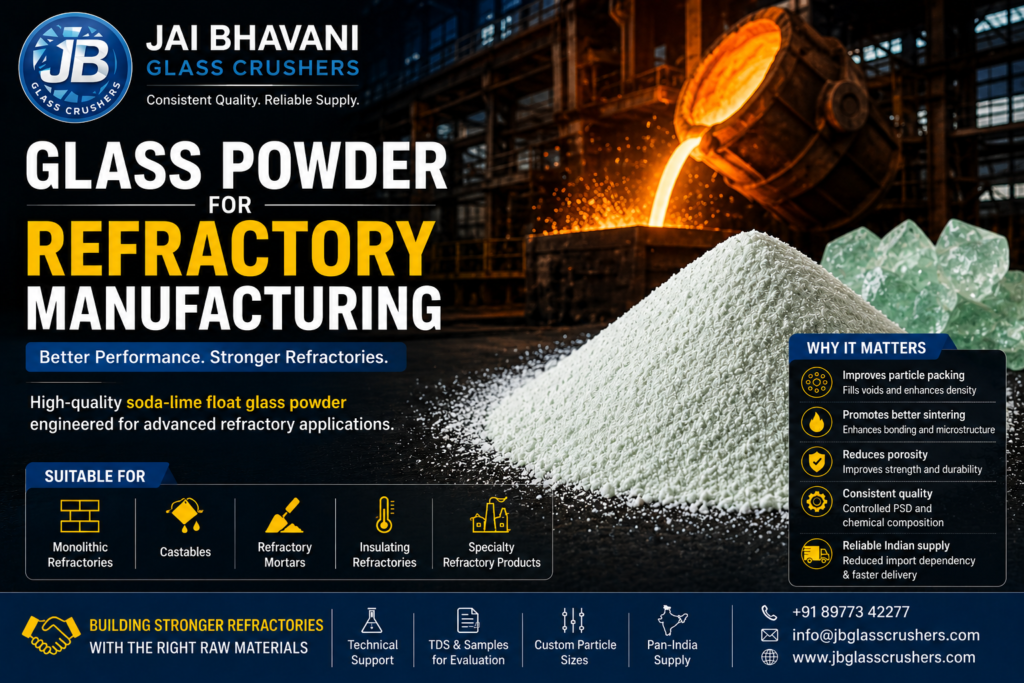
Refractory materials are engineered to withstand extreme temperatures, thermal shock, abrasion, and chemical attack in industries such as steel, cement, glass, foundry, and non-ferrous metals. As manufacturers strive to improve product performance while optimizing production costs, carefully selected raw materials play a crucial role.
One material receiving growing attention is industrial-grade soda-lime float glass powder. With its controlled particle size and fluxing characteristics, glass powder can be used in selected refractory formulations to enhance processing and microstructural development.
What is Glass Powder?
Glass powder is produced by finely grinding high-quality soda-lime float glass powder into controlled particle sizes. It consists primarily of:
- Silicon Dioxide (SiO₂)
- Sodium Oxide (Na₂O)
- Calcium Oxide (CaO)
Its uniform chemistry and fine particle size make it suitable for industrial applications where consistent material behavior is essential.
Role of Glass Powder in Refractory Manufacturing
In selected refractory formulations, glass powder can contribute to:
Improved Sintering
Glass powder begins to soften at elevated temperatures, promoting particle bonding during firing.
Benefits include:
- Better particle packing
- Enhanced densification
- Improved microstructure
- Lower porosity
Fluxing Action
The alkali components in soda-lime glass can assist in controlled liquid-phase formation during sintering.
This may help:
- Improve bonding between particles
- Enhance firing efficiency
- Reduce localized voids
The suitability and dosage depend on the refractory formulation and service conditions.
Better Particle Packing
Fine glass powder fills the voids between larger refractory aggregates.
Advantages include:
- Improved bulk density
- Reduced pore volume
- More uniform microstructure
- Better dimensional stability
Consistent Raw Material Quality
Using industrially processed glass powder offers:
- Controlled particle size distribution
- Consistent chemical composition
- Low moisture
- Reliable batch-to-batch performance
These characteristics contribute to stable manufacturing processes and predictable product quality.
Potential Benefits
When incorporated appropriately into suitable refractory formulations, glass powder may help achieve:
- Improved green strength
- Better fired density
- Enhanced particle bonding
- Reduced porosity
- Improved manufacturing consistency
- Better process repeatability
Performance depends on the refractory type, formulation, and firing conditions, so laboratory and production trials are recommended.
Applications
Glass powder may be evaluated for use in:
- Monolithic refractories
- Castables
- Mortars
- Insulating refractories
- Specialty refractory products
- Non-structural refractory formulations
Its suitability should always be validated against the intended operating temperature and performance requirements.
Why Particle Size Matters
The effectiveness of glass powder depends heavily on particle size distribution.
Controlled PSD provides:
- Uniform mixing
- Improved dispersion
- Better packing efficiency
- Consistent sintering behavior
- Predictable processing performance
Manufacturers often require customized particle sizes depending on the formulation and production process.
Advantages of Indian-Manufactured Glass Powder
Choosing a reliable Indian supplier offers several advantages:
- Consistent product quality
- Shorter lead times
- Reduced dependence on imports
- Faster technical support
- Flexible supply for trial and production quantities
- Custom particle sizes based on customer requirements
Quality Parameters to Consider
When evaluating glass powder for refractory applications, important characteristics include:
- Particle size distribution (PSD)
- Chemical composition
- Moisture content
- Purity and contamination control
- Batch consistency
- Packaging quality
These parameters directly influence processing consistency and finished product performance.
Why Choose Jai Bhavani Glass Crushers?
At Jai Bhavani Glass Crushers, we manufacture industrial-grade soda-lime float glass powder with controlled particle size for industrial applications.
Our focus includes:
- Consistent particle size distribution
- Reliable batch-to-batch quality
- Custom mesh sizes based on application
- Technical support for product evaluation
- Bulk supply across India
We work with manufacturers in:
- Refractories
- Ceramics
- Construction Chemicals
- Glass Industry
- Foundries
- Industrial Fillers
Conclusion
Glass powder is emerging as a valuable industrial raw material for selected refractory applications where controlled particle size, consistent chemistry, and reliable supply are essential. When properly evaluated and incorporated into suitable formulations, it can support improved processing, better microstructural development, and enhanced manufacturing consistency.
As the refractory industry continues to optimize formulations and reduce dependence on imported raw materials, high-quality Indian-manufactured glass powder offers an opportunity for technical collaboration and sustainable supply.
About Jai Bhavani Glass Crushers
Jai Bhavani Glass Crushers is a manufacturer of industrial-grade soda-lime float glass powder, supplying consistent, application-ready materials for refractories, ceramics, construction chemicals, road marking, and other industrial sectors. We provide customized particle sizes, technical support, and samples for laboratory and plant-scale evaluation.