
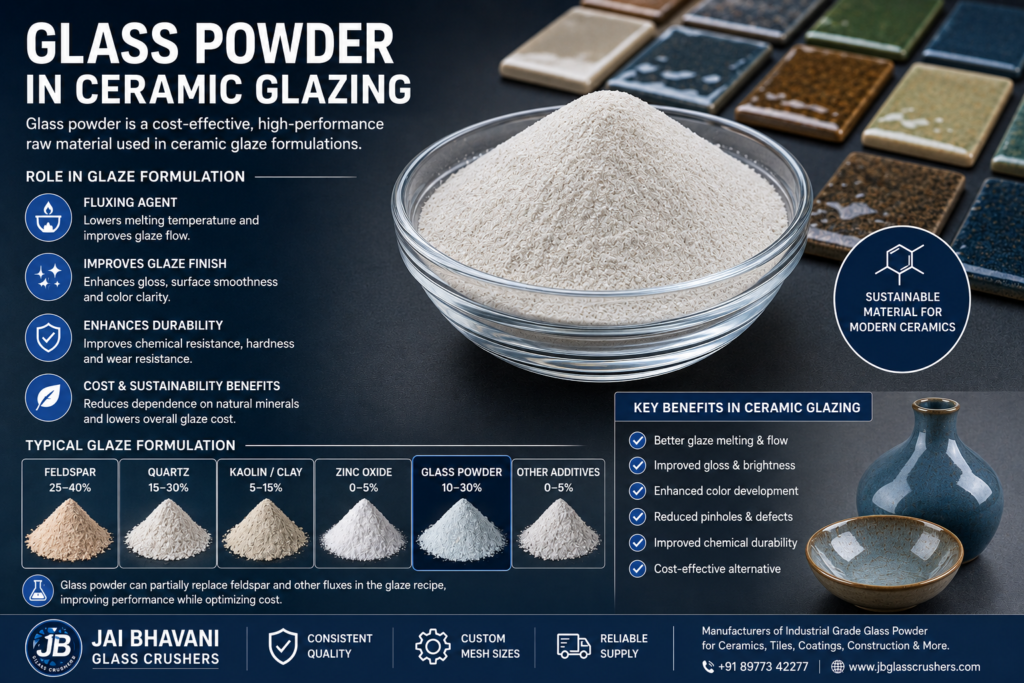
Ceramic glazing plays a critical role in determining the appearance, durability, and functionality of ceramic tiles, sanitaryware, tableware, and technical ceramics. One of the important raw materials used in glaze formulations is glass powder (glass frit or finely ground soda-lime glass), which helps develop a smooth, durable, and visually appealing surface after firing.
What is Glass Powder in Glazing?
Glass powder is a finely ground glass material that softens and melts during the firing process, forming a continuous glassy layer over the ceramic body. This layer provides protection while enhancing the product’s aesthetic and functional properties.
Benefits of Glass Powder in Ceramic Glazing
Improved Surface Finish
Glass powder melts uniformly during firing, producing a smooth, glossy surface with excellent visual appeal.
Better Glaze Flow
Controlled particle size promotes uniform melting and even glaze distribution, reducing surface defects.
Enhanced Adhesion
Properly formulated glass powder helps improve the bond between the glaze and the ceramic body.
Increased Chemical Resistance
The glassy surface improves resistance to moisture, household chemicals, stains, and cleaning agents.
Improved Scratch & Wear Resistance
Well-designed glaze formulations contribute to better abrasion resistance and longer product life.
Consistent Batch Quality
Uniform particle size distribution helps manufacturers achieve consistent glaze performance from batch to batch.
Typical Applications
- Ceramic Wall Tiles
- Floor Tiles
- Vitrified Tiles
- Sanitaryware
- Porcelain Products
- Tableware
- Decorative Ceramics
- Technical Ceramics
Why Particle Size Matters
The performance of glass powder in glazing depends largely on its particle size distribution.
A controlled particle size helps achieve:
- Uniform melting
- Better glaze dispersion
- Improved surface smoothness
- Reduced pinholes and surface defects
- Consistent firing behavior
Key Parameters to Evaluate
When selecting glass powder for glaze formulations, manufacturers typically evaluate:
- Particle Size Distribution (PSD)
- Chemical Composition
- Purity
- Moisture Content
- Batch Consistency
- Iron Content (where color sensitivity is important)
Advantages of Indian-Manufactured Glass Powder
Using a reliable Indian supplier offers several benefits:
- Consistent product quality
- Faster delivery
- Reduced dependence on imports
- Technical support
- Custom particle sizes
- Reliable bulk supply
Applications Across the Ceramic Industry
Glass powder can support manufacturers producing:
- Ceramic Tiles
- Sanitaryware
- Glazed Porcelain
- Decorative Ceramics
- Specialty Ceramic Products
Why Choose Jai Bhavani Glass Crushers?
At Jai Bhavani Glass Crushers, we manufacture industrial-grade soda-lime float glass powder with controlled particle size for ceramic and industrial applications.
We offer:
- Controlled particle size distribution
- Custom mesh sizes
- Consistent batch quality
- Technical Data Sheet (TDS)
- Samples for laboratory evaluation
- Reliable Pan-India supply
Conclusion
Glass powder is an important ingredient in many ceramic glaze formulations, contributing to smooth surface finish, controlled melting, and consistent production quality. Selecting the appropriate particle size and composition for the specific glaze system is essential, and laboratory trials should always be carried out to optimize performance.
If your ceramic manufacturing facility is evaluating Indian-made alternatives to imported glass powder, Jai Bhavani Glass Crushers can provide technical support, customized grades, and samples for evaluation.