
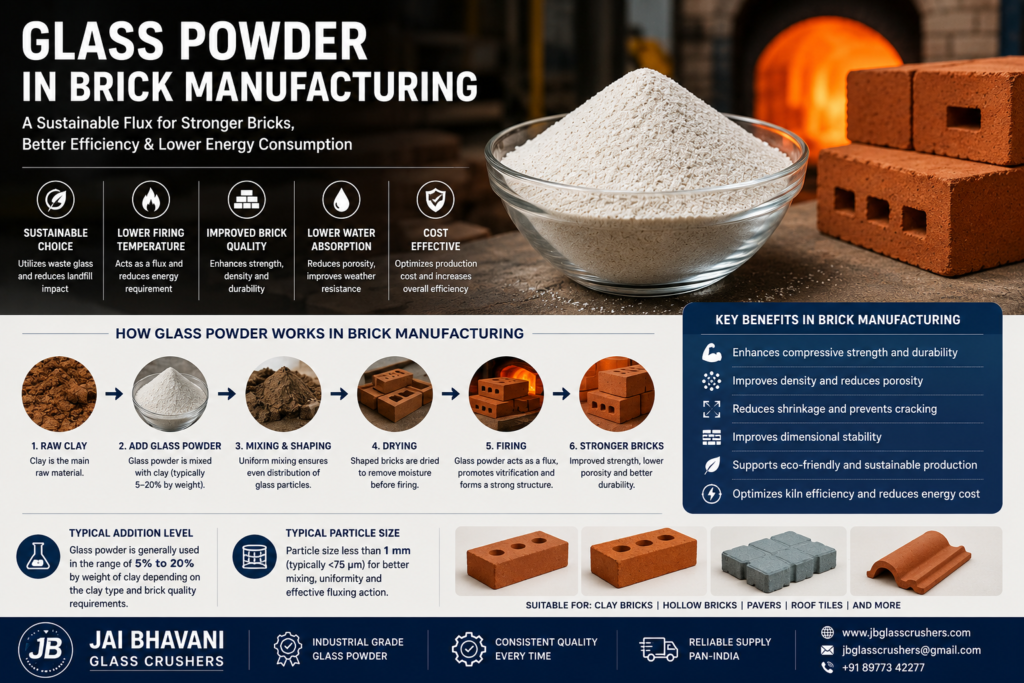
The brick manufacturing industry is continuously looking for innovative raw materials that improve product quality while reducing production costs and energy consumption. One material gaining increasing attention is industrial-grade soda-lime glass powder, which can act as a flux in clay brick production.
When incorporated into suitable clay formulations, glass powder helps promote vitrification during firing, supporting better bonding, reduced porosity, and improved brick performance.
What is Glass Powder?
Glass powder is produced by finely grinding high-quality soda-lime float glass into controlled particle sizes. Its primary chemical constituents include:
- Silicon Dioxide (SiO₂)
- Sodium Oxide (Na₂O)
- Calcium Oxide (CaO)
Due to its glassy (amorphous) structure and natural fluxing properties, glass powder begins softening during firing and assists in the formation of a strong ceramic matrix.
What is a Flux?
A flux is a material that lowers the melting temperature of ceramic and clay bodies during firing.
In brick manufacturing, fluxes help:
- Promote vitrification
- Improve particle bonding
- Enhance densification
- Reduce firing energy requirements
- Improve finished brick properties
Glass powder can serve as an alternative flux in selected brick formulations.
How Glass Powder Benefits Brick Manufacturing
Promotes Better Vitrification
During firing, glass powder softens and forms a glassy phase that fills voids between clay particles.
This promotes:
- Improved particle bonding
- Better microstructure
- Increased brick density
- Enhanced mechanical integrity
Improves Brick Strength
Better vitrification produces a denser ceramic body, which can contribute to:
- Higher compressive strength
- Better abrasion resistance
- Improved structural durability
The final performance depends on the clay composition, firing temperature, and glass powder dosage.
Reduces Water Absorption
As vitrification increases, open pores within the brick decrease.
This may result in:
- Lower water absorption
- Improved weather resistance
- Enhanced durability
- Longer service life
Supports Lower Firing Temperatures
Because soda-lime glass softens earlier than many clay minerals, it assists the firing process by encouraging earlier liquid-phase formation.
Depending on the formulation, manufacturers may be able to optimize firing conditions and improve kiln efficiency through laboratory validation.
Improves Dimensional Stability
Properly selected particle sizes help improve particle packing and reduce internal voids.
Optimized formulations can contribute to:
- Better shape retention
- Reduced firing shrinkage
- Improved dimensional consistency
Typical Applications
Glass powder may be evaluated for use in:
- Clay Bricks
- Facing Bricks
- Hollow Bricks
- Pavers
- Roofing Tiles
- Structural Clay Products
- Other Fired Ceramic Building Materials
Recommended Trial Levels
Glass powder is generally evaluated as a partial replacement for traditional mineral components in clay formulations.
Many manufacturers begin laboratory trials with 5–10% addition, while higher percentages may be assessed depending on:
- Clay composition
- Brick type
- Firing temperature
- Required mechanical properties
The optimum dosage should always be established through laboratory and plant-scale testing.
Why Particle Size Matters
The effectiveness of glass powder depends greatly on its particle size distribution.
Controlled particle size provides:
- Better mixing with clay
- Uniform distribution
- Consistent vitrification
- Improved firing behavior
- Stable production quality
Advantages of Indian-Manufactured Glass Powder
Choosing a reliable Indian supplier offers:
- Consistent product quality
- Controlled particle size distribution
- Reduced dependence on imports
- Faster delivery
- Technical support
- Reliable bulk supply
Why Choose Jai Bhavani Glass Crushers?
At Jai Bhavani Glass Crushers, we manufacture industrial-grade soda-lime float glass powder designed for industrial applications.
We offer:
- Controlled particle size distribution
- Custom mesh sizes
- Consistent batch-to-batch quality
- Technical Data Sheet (TDS)
- Samples for laboratory evaluation
- Reliable Pan-India supply
Conclusion
Industrial-grade glass powder is emerging as a valuable raw material for brick manufacturing. When properly evaluated in suitable clay formulations, it can support improved vitrification, enhanced strength, reduced water absorption, and more efficient firing.
As manufacturers seek cost-effective and sustainable alternatives to conventional fluxes, Jai Bhavani Glass Crushers provides high-quality, application-ready glass powder backed by technical support and reliable supply for laboratory and production trials.