
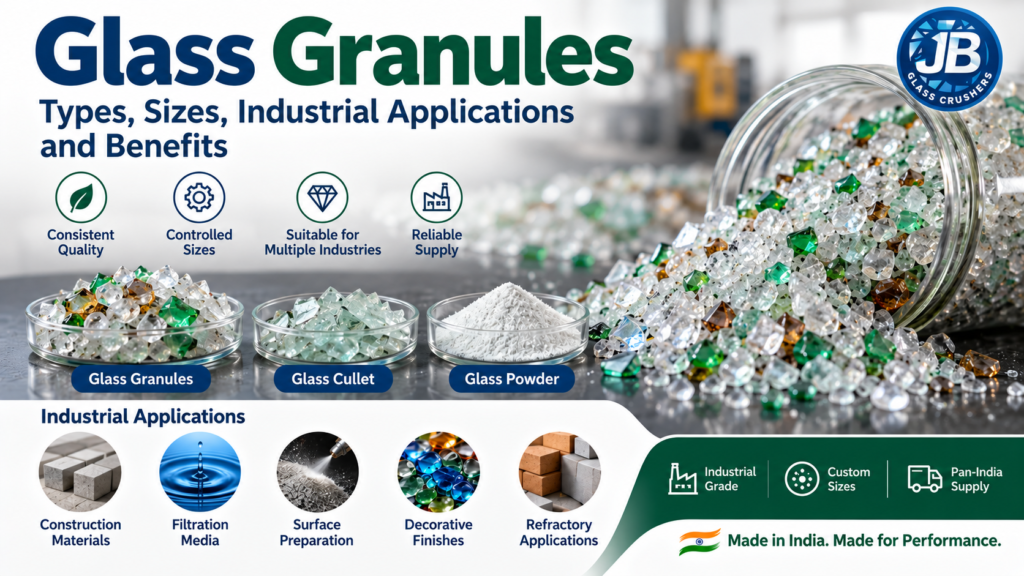
Glass granules are small, granular particles produced by crushing and processing glass. Depending on their size, composition and surface characteristics, they are used in various industrial applications, including construction materials, filtration, surface preparation, decorative finishes and manufacturing.
For industrial buyers, selecting the right glass granules requires attention to particle size, chemical composition, purity and the intended application.
What Are Glass Granules?
Glass granules are granular pieces of processed glass that are larger than fine glass powder. They can be manufactured from suitable flat glass, container glass or other glass feedstocks, depending on the required product specifications.
Their size and shape vary according to the crushing, screening and processing methods used.
Glass granules are also known as glass grit or granular glass in some commercial contexts. However, these terms are not always interchangeable, so buyers should confirm the supplier’s particle-size specifications.
How Are Glass Granules Manufactured?
The production process generally involves several stages:
- Glass selection: Suitable glass feedstock is selected according to the required composition and purity.
- Crushing: Glass is broken into smaller fragments using suitable crushing equipment.
- Screening: The crushed material is separated into specified size fractions.
- Cleaning and separation: Unwanted contaminants are removed where required.
- Quality testing: Particle-size distribution, appearance and relevant chemical properties are checked.
- Packaging: The finished material is packed according to customer and transportation requirements.
For applications requiring consistent performance, controlled processing and batch-level quality checks are important.
Types of Glass Granules
1. Clear Glass Granules
Clear glass granules are produced from suitable transparent glass feedstock. They may be considered for decorative applications, selected industrial uses and manufacturing processes that require a relatively consistent appearance.
2. Mixed-Colour Glass Granules
These granules contain glass particles of different colours. Depending on their composition and quality, they may be suitable for decorative aggregates, landscaping products and selected construction applications.
3. Glass Grit for Surface Preparation
Glass grit is used as an abrasive medium in certain surface-preparation applications. The appropriate grade depends on particle shape, hardness, size distribution and the substrate being treated.
4. Glass Granules for Filtration
Selected granular glass products can serve as filtration media. Suitability depends on particle grading, hydraulic characteristics, cleanliness and the requirements of the filtration system.
5. Glass Granules for Manufacturing
Glass granules can serve as feedstock for processes such as glass-bead manufacturing and other products made through controlled thermal processing. The required feedstock specifications depend on the final product.
Industrial Applications of Glass Granules
Construction Materials
Glass granules may be incorporated into selected construction products, decorative aggregates and building materials. Their use must account for particle grading, compatibility and the performance requirements of the finished product.
Surface Preparation and Abrasive Applications
Specially processed glass grit can be used for cleaning or preparing certain surfaces. The appropriate size and abrasive properties should be selected according to the equipment, substrate and required finish.
Water Filtration
Suitable granular glass media can be used in certain filtration systems. Buyers should assess the specified grading, media performance and applicable water-quality requirements.
Decorative Finishes and Landscaping
Coloured or clear glass granules may be used in decorative surfaces, architectural finishes and landscaping products where their appearance and particle size meet design requirements.
Glass-Bead Manufacturing
Glass granules can be used as feedstock in processes that produce spherical glass beads. The feedstock size and composition influence processing and final product quality.
Glass Granules vs Glass Cullet vs Glass Powder
| Feature | Glass Granules | Glass Cullet | Glass Powder |
|---|---|---|---|
| Physical form | Granular particles | Crushed glass fragments for processing | Fine particles |
| Typical size | Depends on product specification | Often coarse to intermediate fragments | Fine, commonly specified by mesh or microns |
| Common uses | Filtration, abrasives, decorative and industrial applications | Glass manufacturing and further processing | Selected ceramics, coatings, construction materials and industrial formulations |
| Key specifications | Size distribution, shape, cleanliness | Composition, purity, size and contaminants | Mesh or micron range, chemistry, moisture and contamination |
The terms can overlap in commercial use. A product should be identified by its actual particle-size distribution and intended application rather than its name alone.
How to Choose the Right Glass Granules
Before purchasing glass granules, industrial buyers should evaluate the following factors:
- Particle size: Confirm the required size range and allowable oversize or undersize material.
- Chemical composition: Check the relevant oxide composition and impurity limits.
- Purity: Establish acceptable levels of ceramics, metals and other contaminants.
- Particle shape: Determine whether angular, rounded or more uniform particles are needed.
- Moisture: Specify the maximum permissible moisture content.
- Application requirements: Confirm compatibility with the intended process and finished product.
- Packaging and supply: Agree on bag size, quantity, delivery schedule and quality documentation.
For critical applications, request a representative sample and test it against the customer’s specifications before approving bulk supply.
Glass Granules and Glass Powder from JB Glass Crushers
Jai Bhavani Glass Crushers, based in Hyderabad, Telangana, manufactures industrial glass powder in different mesh grades for B2B applications.
For buyers comparing glass granules with finer glass powder, the correct choice depends on the required particle size, chemical composition and manufacturing process.
Contact our team to discuss your industrial material requirements, available powder grades, specifications and sample evaluation.
Frequently Asked Questions
What are glass granules used for?
Depending on their specifications, glass granules can be used in filtration, surface preparation, decorative finishes, construction products and manufacturing processes.
Are glass granules and glass powder the same?
No. Glass granules are generally larger particles, while glass powder consists of finer particles. The boundary depends on the supplier’s grading system and the application.
What is the difference between glass grit and glass granules?
Glass grit usually refers to granular material used as an abrasive, often with angular particles. Glass granules is a broader term for granular glass products. Confirm the particle shape and intended use when purchasing.
How are glass granules sized?
They are commonly classified through screening and sieve analysis. The required size range should be specified clearly in the purchase specification.
Can glass granules be used in refractory manufacturing?
Potentially, in selected processes where the material is suitable. Chemical composition, alkali content, particle size and thermal behaviour must be evaluated against the refractory formulation and operating conditions.
Conclusion
Glass granules are versatile industrial materials whose applications depend on their size, composition, shape and quality. From filtration and surface preparation to decorative products and manufacturing feedstock, selecting the correct grade starts with clearly defined technical requirements.
For industrial glass materials, always confirm the specification and test suitability before moving to bulk procurement.