
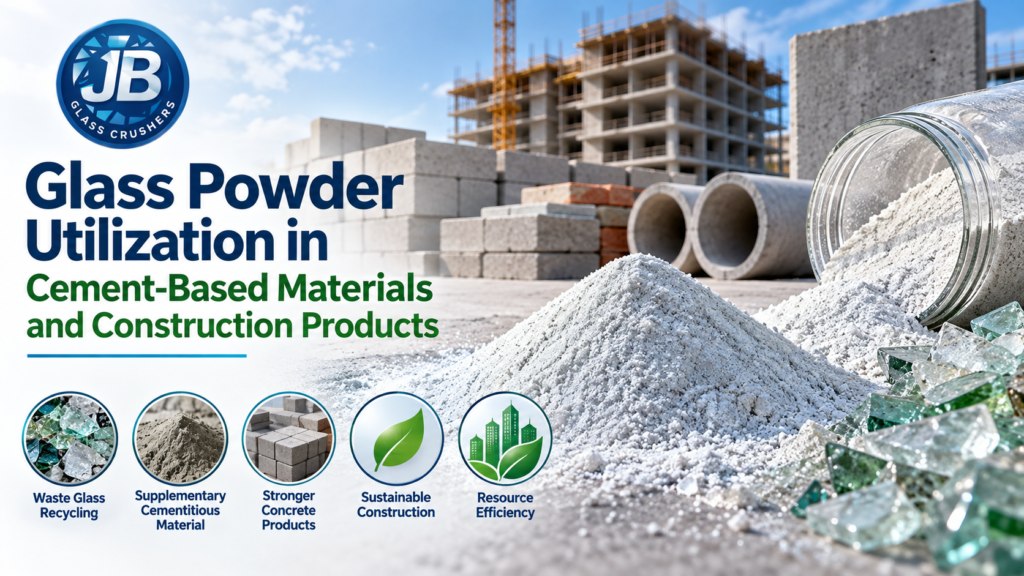
Glass powder is attracting growing interest in the construction industry as manufacturers explore alternative mineral materials for cement-based products, concrete and other building applications. When processed to a suitable particle size and evaluated for its chemical and physical properties, finely ground glass powder can serve as a potential supplementary cementitious material or mineral component in selected construction formulations.
For construction material manufacturers, the opportunity lies in identifying the right glass powder grade, validating its performance and determining whether it can meet specific product requirements.
At Jai Bhavani Glass Crushers, Hyderabad, Telangana, India, we manufacture industrial-grade glass powder from soda-lime float glass in controlled particle-size grades for industrial applications. We work with businesses seeking glass powder for evaluation in suitable manufacturing processes.
This article examines the scientific research behind glass powder in construction, its potential applications, important technical considerations and the testing required before commercial use.
1. What Is Glass Powder?
Glass powder is a finely ground material produced by processing glass into particles of a specified size. Its properties depend on the original glass composition, manufacturing process, grinding method and final particle-size distribution.
Soda-lime glass, commonly used in float glass products, contains silica along with other constituents such as sodium oxide and calcium oxide. These components influence the material’s behaviour when incorporated into cementitious and other construction formulations.
For industrial applications, glass powder should be evaluated according to measurable parameters, including:
- Particle-size distribution
- Chemical composition
- Moisture content
- Colour and appearance
- Contamination levels
- Consistency between production batches
These characteristics help manufacturers determine whether a particular grade is appropriate for their intended application.
2. What Does Scientific Research Say About Glass Powder in Construction?
Research into glass powder in construction has examined its potential use in cement-based materials, concrete and specialised construction products.
A major review by Jiang, Ling, Mo and Shi, published in the Journal of Environmental Management in 2019, examined the interaction and effects of glass powder in cement-based and other construction materials.
The authors identified glass powder as a promising supplementary cementitious material and discussed its potential use in geopolymer materials, eco-cement, artificial lightweight aggregates and composite phase-change materials.
A separate review by Khan, Saha and Sarker, published in the Journal of Building Engineering in 2020, examined glass powder as a supplementary binder and the use of glass particles in cement-based construction materials. It highlighted the importance of glass fineness and material type in determining performance.
Together, these studies indicate that glass powder has several potential construction applications. However, the results of individual studies cannot automatically be applied to every commercially available glass powder grade.
The composition, fineness, dosage and formulation must be considered before selecting a material for a specific product.
3. Potential Applications of Glass Powder in Construction
1 Concrete and Cement-Based Materials
One of the most extensively researched applications of finely ground glass powder is its use in cement-based materials.
Depending on its properties and fineness, glass powder may be investigated as a partial replacement for cement or as an additional mineral component in concrete formulations.
Finely ground glass can contribute through particle packing and, under suitable conditions, pozzolanic reactions. These reactions may contribute to the formation of additional cementitious binding products.
Potential benefits depend on the formulation and may include changes in strength development, porosity and durability.
Before using glass powder in concrete, manufacturers should evaluate:
- Compressive strength at specified curing ages
- Workability and water demand
- Setting behaviour
- Water absorption and permeability
- Long-term durability
- Alkali–silica reaction risk
The appropriate replacement level must be established through laboratory trials. Results vary with glass composition, particle size, cement type, water-to-cement ratio and curing conditions.
2 Supplementary Cementitious Material
A supplementary cementitious material is used alongside cement to contribute to the performance of a cement-based formulation.
Research indicates that sufficiently fine glass powder may exhibit pozzolanic activity under suitable conditions. This means reactive silica in the powder can react with calcium hydroxide in the cementitious system to form additional binding products.
The effectiveness of this process depends on the material’s fineness, chemistry and reaction conditions.
Consequently, glass powder intended for this application should be evaluated using appropriate chemical, physical and performance tests. Mesh size alone is not sufficient to establish its suitability as a supplementary cementitious material.
3 Mortar and Dry-Mix Construction Products
Mortars and dry-mix products rely on carefully balanced combinations of binders, mineral fillers, aggregates and performance additives.
Glass powder may be investigated as a mineral component in selected formulations, depending on its particle size, surface characteristics and compatibility with the other ingredients.
Potential areas for evaluation include:
- Dry-mix mortar
- Cement-based repair products
- Selected construction compounds
- Specialised mineral-filled formulations
Testing should examine workability, water demand, setting behaviour, adhesion and the mechanical properties relevant to the intended product.
Glass powder should not be assumed to replace an existing filler or binder without formulation trials.
4 Tile Adhesives and Grouts
Tile adhesives and grouts are specialised construction products in which particle distribution, water retention, workability and adhesion are important performance factors.
A suitably characterised glass powder may be investigated as a potential mineral filler in selected formulations.
Its suitability will depend on the existing formulation and the manufacturer’s technical requirements.
Evaluation may include:
- Particle-size compatibility
- Water demand and workability
- Open time
- Slip resistance, where applicable
- Tensile adhesion strength
- Setting and curing behaviour
- Performance after relevant water or heat exposure
These tests are important because a material that performs well as a filler in one formulation may not provide the same results in another.
For manufacturers developing tile adhesives and grouts, glass powder should therefore be considered a material for technical evaluation rather than an automatic substitute for conventional mineral fillers.
5 Wall Putty and Surface-Finishing Products
Wall putty and other surface-finishing products require suitable fineness, colour, workability and surface performance.
Glass powder may be investigated as a potential mineral filler in selected formulations where its properties are compatible with the product.
Relevant evaluation parameters include:
- Particle-size distribution
- Whiteness and colour consistency
- Moisture content
- Water demand
- Application smoothness
- Adhesion to the substrate
- Drying behaviour
- Cracking and surface-finish performance
The suitability of glass powder will depend on the formulation, particularly where whiteness, fine surface finish or specific application properties are required.
Manufacturers should assess the powder alongside their existing raw materials before deciding whether it is commercially suitable.
6 Geopolymer Materials
Geopolymers and other alkali-activated materials use reactive source materials and activating solutions to form hardened binding systems.
The 2019 review by Jiang and colleagues identifies glass powder as a potential precursor in geopolymer applications.
However, the effectiveness of glass powder depends on its chemical composition, fineness, reactivity and compatibility with the activating system.
Testing may include setting behaviour, compressive strength, dimensional stability and durability.
This is a specialised application that requires formulation development and laboratory validation.
7 Artificial Lightweight Aggregates and Specialised Construction Products
Research has also explored glass powder in the manufacture of artificial lightweight aggregates and certain specialised construction materials.
These applications may require additional processing, controlled heating or specific formulation techniques.
They are therefore different from using glass powder directly as a filler in a conventional construction product.
Manufacturers interested in these applications should assess processing requirements, product performance, energy consumption and commercial feasibility before considering large-scale production.
4. Why Particle Size Matters
Particle size is one of the most important factors influencing the behaviour of glass powder in construction materials.
Fine particles can improve particle packing and, depending on their properties, may contribute to chemical reactions in cementitious systems.
However, finer powder is not automatically better for every application. An unsuitable particle-size distribution may affect water demand, workability, processing requirements and final product performance.
For this reason, construction manufacturers should distinguish between mesh size and measured particle-size distribution.
Mesh size describes a screening classification, whereas particle-size distribution provides information about the range of particle sizes present in a sample.
Important measurements may include:
- D10: The particle diameter below which 10% of the measured sample falls.
- D50: The median particle diameter, below which 50% of the measured sample falls.
- D90: The particle diameter below which 90% of the measured sample falls.
These values help manufacturers understand the material more precisely than a mesh designation alone.
For cement replacement, fine glass powder may be required to achieve the intended reactivity. For filler applications, the required distribution will depend on the formulation and the properties of the existing ingredients.
The appropriate grade must therefore be selected according to the intended end use.
5. Chemical Composition and Material Quality
Particle size is only one part of the technical assessment.
Glass powder’s chemical composition can influence its performance in cementitious and other construction materials.
For soda-lime glass powder, manufacturers may need to evaluate:
- Silicon dioxide (SiO₂)
- Sodium oxide (Na₂O)
- Calcium oxide (CaO)
- Aluminium oxide (Al₂O₃)
- Iron oxide content
- Other relevant constituents and potential contaminants
Silica is particularly relevant when investigating potential pozzolanic activity. However, total silica content alone does not establish how reactive the material will be.
The form of the silica, particle size, glass composition and test conditions also matter.
Contamination should also be considered. For example, grinding media and processing equipment can influence the final composition of the powder.
A chemical analysis report helps manufacturers compare a proposed glass powder grade with their raw-material specifications.
6. Understanding Alkali–Silica Reaction in Concrete
Alkali–silica reaction, commonly known as ASR, is a chemical reaction between certain reactive forms of silica in aggregates and alkalis in concrete pore solutions.
Under suitable moisture conditions, this reaction can cause expansion and cracking.
Research has found that sufficiently fine glass powder can reduce ASR-related expansion under certain conditions. The effect depends on the glass properties, particle size, dosage and overall concrete formulation.
This does not mean that all glass powder prevents ASR.
Concrete formulations containing glass materials should be evaluated using appropriate testing methods and relevant standards. Manufacturers must also consider the properties of the cement, aggregates and other ingredients.
ASR performance should be established through testing rather than assumed from the presence of finely ground glass.
7. Testing Glass Powder Before Commercial Use
For construction manufacturers, laboratory evaluation is an essential step in selecting an alternative raw material.
The required tests will depend on the intended application.
| Parameter | Why it matters |
|---|---|
| Particle-size distribution | Helps determine fineness and compatibility with the formulation |
| Chemical composition | Establishes the major chemical constituents |
| Moisture content | Supports quality control and formulation consistency |
| Colour and appearance | Important for white, light-coloured and decorative products |
| Compressive strength | Relevant to concrete and cementitious products |
| Adhesion strength | Relevant to tile adhesives and other bonding products |
| Water demand and workability | Important for fresh mortar and concrete |
| Durability testing | Helps assess long-term performance |
| Alkali–silica reaction testing | Relevant when evaluating glass-containing concrete |
Not every application requires every test. The manufacturer’s technical team or an independent laboratory should determine the appropriate test programme.
The objective is to establish whether the selected grade performs consistently and meets the requirements of the intended end product.
8. Selecting the Right Glass Powder Supplier
When evaluating glass powder for industrial use, manufacturers should consider more than price alone.
A suitable supplier should be able to discuss the available grades, particle-size characteristics, quality-control practices and documentation relevant to the intended application.
Key considerations include:
Consistent specifications: The material should be assessed against agreed particle-size and chemical requirements.
Quality documentation: Technical data sheets and available laboratory reports help buyers evaluate the material.
Application-based selection: The grade should be chosen according to the manufacturer’s formulation and performance targets.
Sample evaluation: Samples allow technical teams to conduct initial laboratory trials before considering commercial volumes.
Supply planning: Available production capacity, lead time, packaging and delivery arrangements should be confirmed before placing a bulk order.
A structured evaluation process helps buyers make decisions based on material performance and manufacturing requirements.
9. Glass Powder from Jai Bhavani Glass Crushers
Jai Bhavani Glass Crushers is based in Hyderabad, Telangana, India, and manufactures industrial-grade glass powder from soda-lime float glass.
Our business focuses on supplying glass powder in controlled particle-size grades for industrial applications.
For manufacturers investigating potential construction applications, material selection should be based on the required particle-size distribution, chemical composition, moisture limits, colour requirements and end-product performance criteria.
We encourage prospective buyers to share their technical specifications so that the availability of a suitable grade can be assessed.
Depending on the application, technical evaluation may involve reviewing the available grade, examining laboratory documentation and arranging a sample for testing.
We recommend confirming technical suitability before proceeding with commercial-scale use.
10. Frequently Asked Questions
What is glass powder used for in construction?
Research has examined glass powder in concrete, cement-based materials, geopolymer systems and selected specialised construction products. Its suitability depends on the grade, formulation and intended application.
Can glass powder replace cement in concrete?
Certain finely ground glass powders can be evaluated as partial cement replacements. The appropriate replacement level and resulting performance must be established through laboratory testing.
Is glass powder suitable for tile adhesives?
Glass powder may be investigated as a potential mineral filler in selected tile adhesive formulations. Adhesion strength, workability, water demand, open time and other relevant properties must be tested.
Can glass powder be used in wall putty?
It may be evaluated as a potential filler, depending on its fineness, colour, moisture and compatibility with the formulation. Whiteness, adhesion, application properties and cracking performance should be assessed.
Why is particle-size distribution important?
Particle size influences packing, workability and, in suitable cementitious systems, potential reactivity. D10, D50 and D90 measurements provide more detailed information than mesh size alone.
Does a high silica content guarantee good performance?
No. Performance depends on several factors, including the form and reactivity of silica, particle size, other chemical constituents, dosage and formulation.
What information should buyers provide when requesting a quotation?
Buyers should specify the intended application, required particle-size distribution, chemical and physical limits, expected quantity, packaging requirements and delivery location. This information helps determine whether an available grade may meet their needs.
Conclusion
Glass powder presents several potential opportunities in construction materials, particularly in cement-based systems where particle size, composition and formulation can influence performance.
Scientific reviews support continued investigation of glass powder in concrete, supplementary cementitious materials, geopolymer systems and selected specialised construction products. However, successful commercial use depends on matching the material to the application and validating performance through appropriate testing.
For construction manufacturers, the most effective starting point is to define the required specifications, evaluate a representative sample and compare its performance against the existing formulation.
Jai Bhavani Glass Crushers supplies industrial-grade glass powder from Hyderabad, Telangana, India. Contact us to discuss your particle-size requirements, intended application and sample-evaluation needs.
Contact Jai Bhavani Glass Crushers
- Location: Hyderabad, Telangana, India
- Website: jbglasscrushers.com
- Phone: +91 89773 42277
- Email: info@jbglasscrushers.com
Material suitability, specifications and availability should be confirmed for each application before commercial use.
Best construction applications for your glass powder
| Industry / Application | Potential use of glass powder | Priority |
|---|---|---|
| Tile adhesives and grouts | Mineral filler in cement-based or epoxy formulations, subject to testing | Very high |
| Wall putty | Potential mineral filler, depending on whiteness, fineness and formulation | Very high |
| Construction chemicals | Filler in selected dry-mix mortar and cement-based formulations | Very high |
| Epoxy flooring | Mineral filler in resin-based flooring systems | High |
| Concrete and precast products | Potential partial cement replacement or supplementary cementitious material when sufficiently fine and tested | High |
| Cement blocks and pavers | Potential fine mineral addition or cement replacement, subject to performance testing | High |
| Paints and primers | Functional filler in suitable formulations | Medium–high |
| Terrazzo and engineered stone | Potential mineral ingredient, depending on particle size, colour and formulation | Medium–high |
Research reviews support the use of finely ground glass in cementitious materials, but the optimum particle size and replacement percentage vary by application.