
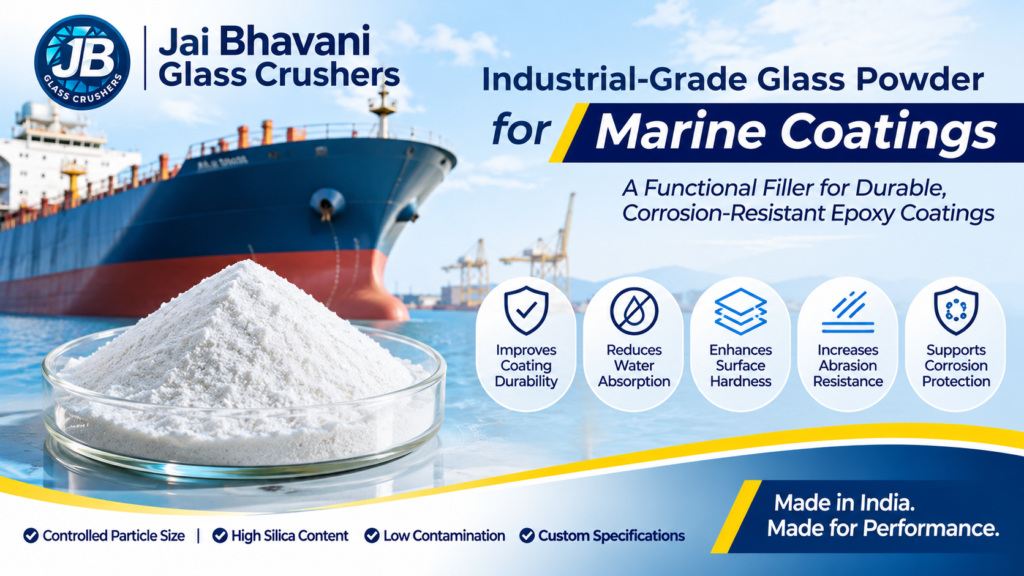
By Jai Bhavani Glass Crushers | Industrial Glass Powder Solutions
Marine environments present some of the most challenging conditions for protective coating systems. Ships, offshore structures, port facilities, marine equipment and coastal infrastructure are continuously exposed to seawater, humidity, salt spray, abrasion and changing temperatures.
These conditions can accelerate corrosion, damage protective surfaces and increase maintenance requirements. Consequently, marine coating manufacturers continually explore advanced coating formulations that provide improved mechanical strength, moisture resistance and long-term protection.
Epoxy-based protective coatings are widely used in industrial and marine applications because of their adhesion, mechanical strength and chemical resistance. However, their performance depends significantly on the resin formulation, curing system and selection of functional fillers.
Glass powder is an interesting mineral filler for epoxy coating formulations. Its silica-rich composition, hardness and potential to improve coating properties make it a material worth investigating for marine protective coatings.
This article explores the technical potential of industrial-grade glass powder in marine coating formulations, its functional properties, particle-size considerations and opportunities for coating manufacturers.
1. Why Marine Coatings Require Advanced Functional Fillers
Marine protective coatings must withstand several environmental and mechanical challenges.
Some of the major performance requirements include:
- Corrosion protection: Reducing the penetration of moisture and corrosive substances towards the underlying metal.
- Water resistance: Limiting water absorption within the coating film.
- Abrasion resistance: Withstanding friction, impact and mechanical wear.
- Chemical resistance: Maintaining coating integrity during exposure to salts and industrial chemicals.
- Adhesion: Maintaining a strong bond between the coating and the substrate.
- Long-term durability: Maintaining protective performance under prolonged environmental exposure.
Conventional epoxy coatings can be modified using mineral fillers, pigments and reinforcing materials to improve selected performance characteristics.
Glass powder offers another potential filler option for these formulations.
2. How Glass Powder Can Contribute to Marine Coating Formulations
Industrial glass powder is a finely ground inorganic material primarily composed of silica, along with other constituents characteristic of soda-lime glass.
When appropriately selected and dispersed in an epoxy resin system, glass powder can contribute to the coating’s physical and mechanical properties.
A. Improved Surface Hardness
Glass is a hard inorganic material. Incorporating appropriately sized glass particles into an epoxy matrix may increase the hardness of the cured coating.
A 2022 research study titled The Enhancement of Polymer Composite Coating by Using a Waste Glass Powder as Alternative Reinforcement investigated glass powder as a filler in epoxy resin.
The researchers reported significantly increased Vickers hardness compared with unfilled epoxy resin.
For coating manufacturers, this finding provides a basis for investigating glass powder as a functional filler in industrial protective coating systems.
B. Improved Abrasion Resistance
Marine equipment and offshore structures can experience continuous mechanical wear.
Glass powder may contribute to abrasion resistance by modifying the hardness and mechanical characteristics of the coating composite.
The same 2022 study reported improved abrasion resistance in glass-powder-filled epoxy composites.
However, the actual result depends on particle-size distribution, filler loading, dispersion quality and the compatibility of the glass particles with the epoxy matrix.
C. Reduced Water Absorption
Water penetration is an important consideration in marine coating performance.
The incorporation of suitable inorganic fillers can influence the microstructure of an epoxy coating.
In the 2022 polymer composite coating study, glass powder incorporation reduced the water absorption of the epoxy composites.
This finding makes glass powder an interesting material for further investigation in moisture-resistant coating formulations.
It is important to note that reduced water absorption in laboratory testing does not automatically establish long-term seawater protection.
D. Potential Improvement in Anticorrosive Performance
Corrosion protection depends on the coating’s ability to maintain an effective barrier between the substrate and the surrounding environment.
Glass powder can influence the coating microstructure and physical properties, potentially contributing to improved protective performance.
The 2022 study reported improved anticorrosive performance in glass-powder-filled epoxy coatings.
Further testing under marine exposure conditions is necessary to establish the suitability of individual formulations for specific marine applications.
3. Glass Powder in Epoxy Protective Coatings
Published research provides useful evidence for investigating glass powder as a functional coating filler.
Glass Powder as an Alternative Epoxy Reinforcement
The researchers investigated the incorporation of finely processed glass powder into epoxy resin.
The study evaluated:
- Physical properties and microstructure.
- Mechanical properties.
- Electrical properties.
- Water absorption.
- Corrosion resistance.
Key findings:
- Increased Vickers hardness.
- Improved abrasion resistance.
- Reduced water absorption.
- Improved anticorrosive performance.
The findings demonstrate the potential of glass powder as an alternative inorganic filler in epoxy-based coating formulations.
Influence of Glass Particle Shape on Epoxy Coating Performance
This research investigated different filler particle shapes and their influence on epoxy coating properties.
The researchers evaluated coatings exposed to aggressive chemical environments, including sulphuric acid, hydrochloric acid, formic acid and sodium hydroxide.
Key findings:
- Glass-containing epoxy coatings demonstrated improved mechanical properties in selected formulations.
- Filler particle shape influenced coating degradation and chemical resistance.
- A formulation containing 25% pre-treated windshield glass particles demonstrated properties comparable to or better than the reference formulation in several tests.
This research highlights an important consideration for glass powder manufacturers: particle characteristics can influence the performance of the final coating.
These studies support further formulation research, but they do not establish that every glass powder grade will perform equally well in marine coatings.
4. Glass Powder vs. Glass Flakes in Marine Coatings
Glass powder and glass flakes have different physical characteristics and should be considered separately when developing coating formulations.
| Property | Glass powder | Glass flakes |
|---|---|---|
| Particle structure | Finely ground particles | Thin, plate-like particles |
| Primary role | Mineral filler and reinforcement | Barrier reinforcement |
| Typical function | Modify hardness and physical properties | Create overlapping barrier paths |
| Formulation consideration | Particle size and dispersion | Flake orientation and distribution |
| Potential application | Epoxy and industrial protective coatings | Heavy-duty marine epoxy coatings |
Glass flakes are particularly interesting for barrier-type marine coatings because overlapping flakes can create a more tortuous pathway for moisture and corrosive substances.
Finely ground glass powder serves a different purpose. It can be evaluated as a mineral filler to modify the mechanical and physical properties of an epoxy coating.
Therefore, coating manufacturers should select the appropriate glass material according to their formulation objectives.
5. Selecting the Right Glass Powder for Marine Coatings
Not all glass powder grades are suitable for every coating formulation.
The following material characteristics should be evaluated before incorporating glass powder into marine epoxy coatings.
Particle Size Distribution
Particle size influences dispersion, surface finish, packing characteristics and the interaction between filler particles and the resin.
Fine and controlled particle-size distributions may be useful for developing smooth, uniform coating formulations.
Coating manufacturers should evaluate different grades through laboratory trials rather than selecting a mesh size based on fineness alone.
Chemical Composition
The chemical composition of glass powder influences its compatibility with the selected resin system and other coating ingredients.
For soda-lime float glass powder, manufacturers should evaluate:
- Silica content.
- Sodium oxide and calcium oxide content.
- Aluminium oxide content.
- Iron content.
- Other trace impurities.
Consistency in chemical composition is important when developing repeatable industrial coating formulations.
Moisture Content
Moisture in mineral fillers can affect processing, dispersion and coating performance.
Glass powder intended for epoxy formulations should be appropriately dried and stored to maintain consistent moisture levels.
Particle Shape and Surface Characteristics
Particle morphology influences filler distribution, resin interaction and the resulting coating microstructure.
Manufacturers should evaluate particle shape, agglomeration and dispersion behaviour during formulation development.
Contamination Control
Foreign particles and unwanted impurities can affect the appearance, colour and performance of protective coatings.
Low-contamination glass powder with controlled material characteristics is preferable for applications requiring consistent formulation quality.
6. Potential Applications of Glass Powder in Marine Protective Coatings
Glass powder can be investigated in several coating-related applications.
Marine epoxy primers
Potential use as an inorganic filler in epoxy primer formulations designed for metal substrates.
Protective coatings for offshore structures
Potential use in selected protective coating formulations for offshore steel structures, subject to corrosion and seawater exposure testing.
Ship maintenance coatings
Potential use as a functional filler in industrial coating systems where abrasion resistance and mechanical properties are important.
Marine equipment coatings
Potential use in epoxy-based protective coatings for industrial and marine equipment.
Coatings for port and harbour infrastructure
Potential use in protective coating formulations for suitable steel and concrete substrates.
These are potential formulation applications, not certified end uses. Final suitability depends on the complete coating system and relevant performance testing.
7. Recommended Testing Before Commercial Adoption
For marine coating manufacturers, the performance of glass powder should be established through controlled formulation trials.
The following tests are recommended:
| Test | Purpose |
|---|---|
| Particle size analysis | Verify particle-size distribution |
| Moisture analysis | Check filler moisture content |
| Chemical composition | Evaluate material consistency |
| Coating hardness | Measure surface hardness |
| Abrasion resistance | Evaluate wear performance |
| Water absorption | Measure moisture uptake |
| Adhesion testing | Evaluate coating-to-substrate bonding |
| Salt spray testing | Assess corrosion performance |
| Electrochemical impedance spectroscopy | Evaluate coating barrier properties |
| Seawater immersion | Study performance under marine exposure |
Testing should compare an unfilled epoxy formulation with multiple glass powder loading levels.
The resin-to-hardener ratio, curing conditions, film thickness and application method should remain controlled to ensure meaningful comparisons.
8. Why Industrial-Grade Glass Powder Matters
For coating manufacturers, the performance of a filler depends not only on its chemical composition but also on the consistency of its physical characteristics.
Industrial-grade glass powder should be evaluated for:
- Controlled particle-size distribution.
- Consistent silica-rich composition.
- Low contamination.
- Controlled moisture.
- Uniform colour and appearance.
- Reliable batch-to-batch quality.
These characteristics can help coating formulators maintain greater control over their manufacturing processes and formulation trials.
9. JB Glass Crushers: Industrial Glass Powder for Coating Applications
Jai Bhavani Glass Crushers manufactures and supplies industrial-grade glass powder and glass materials from Hyderabad, Telangana, India.
Our product range is developed for industrial applications requiring controlled particle-size distribution and consistent material characteristics.
For coating manufacturers and formulation developers, we offer glass powder grades that can be evaluated as mineral fillers in epoxy and other polymer-based systems.
Our material supply capabilities include:
- Multiple mesh grades.
- Controlled particle-size distribution.
- Snow White and other colour variants.
- Industrial-grade glass powder.
- Custom particle-size requirements, subject to production feasibility.
- Bulk supply for industrial customers.
We encourage coating manufacturers to evaluate glass powder through application-specific laboratory trials before finalising a formulation.
Conclusion
Marine coating systems require materials that can withstand demanding environmental and mechanical conditions.
Research on glass-powder-filled epoxy composites has demonstrated promising improvements in hardness, abrasion resistance, water absorption and anticorrosive performance.
Although further marine-specific testing is necessary, industrial glass powder represents an interesting mineral filler option for epoxy coating manufacturers exploring alternative formulation materials.
With appropriate particle-size selection, chemical consistency, moisture control and dispersion, glass powder can be investigated as a functional component in advanced industrial protective coating systems.
Looking for industrial-grade glass powder for epoxy and protective coating formulations?
Contact Jai Bhavani Glass Crushers to discuss particle-size requirements, material specifications and bulk supply opportunities.
Jai Bhavani Glass Crushers
Hyderabad, Telangana, India
Website: https://jbglasscrushers.com/
Email: info@jbglasscrushers.com
Industrial Glass Powder | Consistent Quality | Custom Specifications | Pan-India Supply