
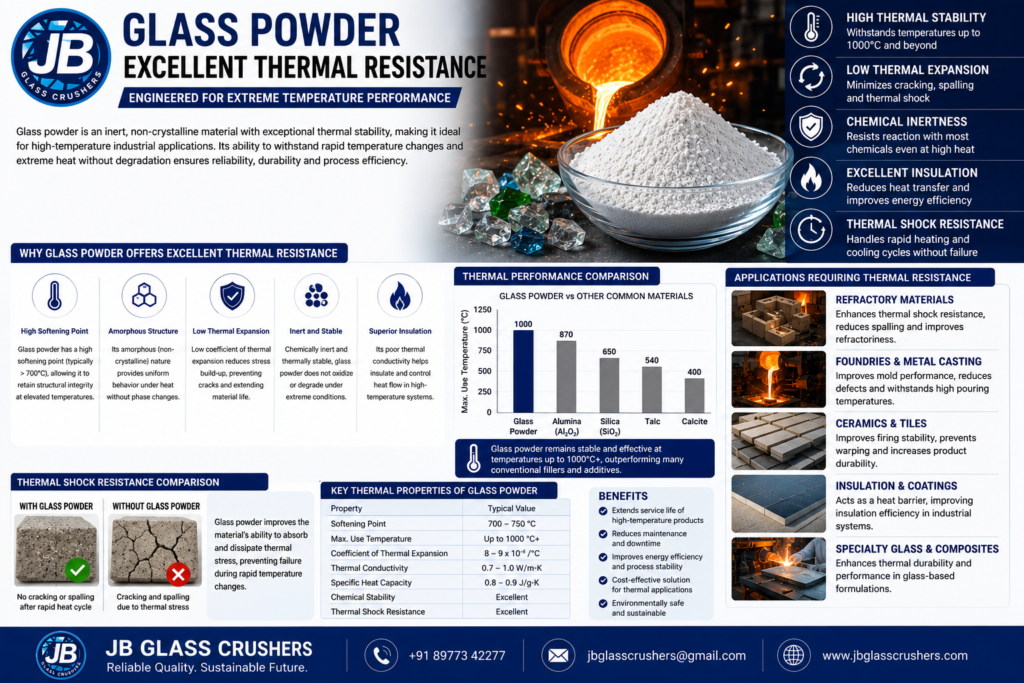
Understanding the Thermal Stability of Finely Milled Glass Powder
In industries where materials are routinely exposed to extreme temperatures, thermal resistance is one of the most important performance characteristics. Whether in foundries, refractories, ceramics, construction materials, or advanced composites, materials must withstand thermal stress without losing their structural integrity or performance.
Among industrial mineral additives, finely milled glass powder has emerged as a highly valuable material due to its excellent thermal resistance, high silica content, controlled particle size distribution, and ability to improve the performance of high-temperature systems.
At JB Glass Crushers, we manufacture premium-quality glass powder from carefully selected clear float glass, delivering consistent thermal performance for demanding industrial applications.
What is Thermal Resistance?
Thermal resistance refers to a material’s ability to withstand elevated temperatures, thermal cycling, and rapid temperature changes without degradation.
A thermally resistant material can:
- Maintain structural stability
- Resist thermal shock
- Minimize cracking
- Reduce deformation
- Preserve performance under prolonged heat exposure
For industries operating above 500°C, thermal resistance directly influences product quality, process efficiency, equipment life, and operating costs.
Why Glass Powder Exhibits Excellent Thermal Resistance
Glass powder derives its thermal stability from its unique chemical composition.
Typical Composition
| Component | Typical Range |
|---|---|
| Silicon Dioxide (SiO₂) | 70–75% |
| Sodium Oxide (Na₂O) | 12–15% |
| Calcium Oxide (CaO) | 8–12% |
| Magnesium Oxide (MgO) | 2–4% |
| Other Minerals | Trace |
The high silica content is the primary contributor to thermal resistance.
Silica is widely recognized for:
- High temperature stability
- Low thermal expansion
- Resistance to thermal degradation
- Excellent refractory behavior
These characteristics allow glass powder to perform reliably in high-temperature environments.
Thermal Resistance in Foundry Applications
Improved Furnace Performance
Foundries operate under extreme thermal conditions where molten metal temperatures often exceed 1400°C.
Glass powder contributes to:
- Stable slag formation
- Controlled melting behavior
- Improved furnace efficiency
- Reduced thermal fluctuations
Its ability to withstand elevated temperatures makes it an effective additive for foundry operations.
Enhanced Slag Fluidity
When used as a fluxing agent, glass powder forms a stable and fluid slag layer.
Benefits include:
- Better impurity removal
- Cleaner molten metal
- Reduced oxidation losses
- Improved casting quality
The thermal stability of glass powder ensures consistent performance throughout the melting cycle.
Benefits in Refractory Manufacturing
Refractories are specifically designed to resist extreme temperatures.
Glass powder contributes significantly to refractory performance by improving:
Thermal Shock Resistance
Thermal shock occurs when materials experience rapid temperature changes.
Glass powder helps reduce internal stresses, resulting in:
- Fewer cracks
- Improved structural integrity
- Longer refractory life
Improved Sintering
Uniformly sized glass powder particles promote controlled sintering and stronger particle bonding.
Reduced Porosity
Dense particle packing minimizes voids and enhances resistance to heat penetration.
Glass Powder in Ceramic Applications
Ceramic manufacturers require materials capable of surviving repeated firing cycles.
Glass powder provides:
Uniform Heat Distribution
Its fine particle structure promotes consistent thermal behavior throughout ceramic bodies.
Reduced Firing Defects
Benefits include:
- Less warping
- Fewer cracks
- Improved dimensional stability
- Better surface finish
Enhanced Product Durability
Thermally stable ceramics are more resistant to long-term wear and temperature fluctuations.
Role in Construction Materials
Modern construction increasingly utilizes glass powder as a supplementary cementitious material (SCM).
Improved Fire Resistance
Glass powder enhances the thermal performance of concrete and cementitious systems.
Benefits include:
- Better fire resistance
- Reduced thermal cracking
- Improved structural stability during heat exposure
Enhanced Long-Term Durability
Thermal stability contributes to:
- Lower maintenance costs
- Longer service life
- Improved structural reliability
Performance Under Thermal Cycling
Industrial materials are often subjected to repeated heating and cooling cycles.
This process can cause:
- Expansion and contraction
- Microcracking
- Material fatigue
Finely milled glass powder helps mitigate these effects through:
Controlled Thermal Expansion
The silica-rich composition exhibits predictable thermal behavior.
Improved Structural Stability
Uniform particle distribution reduces localized stress concentrations.
Longer Equipment Life
Thermally stable materials experience less degradation over time.
Energy Efficiency Benefits
Excellent thermal resistance contributes directly to operational efficiency.
Improved Heat Retention
Materials containing glass powder retain heat more effectively.
Lower Energy Consumption
Reduced heat loss results in:
- Lower fuel requirements
- Improved process efficiency
- Reduced operating costs
More Consistent Processing
Stable thermal behavior leads to predictable manufacturing outcomes.
Thermal Resistance in Advanced Composites
Glass powder is increasingly incorporated into:
- Polymer composites
- Insulation products
- Industrial coatings
- Engineering materials
Benefits include:
- Improved thermal insulation
- Enhanced dimensional stability
- Better resistance to thermal aging
- Increased product lifespan
Importance of Uniform Particle Size
Thermal performance depends not only on chemical composition but also on particle size consistency.
A uniform particle size distribution provides:
- Even heat distribution
- Consistent thermal conductivity
- Improved particle packing
- Enhanced structural stability
At JB Glass Crushers, advanced milling technology ensures precise particle size control for maximum thermal performance.
Why Industries Choose JB Glass Crushers Glass Powder
Our glass powder is engineered to deliver reliable thermal performance across multiple industries.
Key Features
- High silica content
- Excellent thermal resistance
- Uniform particle size distribution
- Consistent batch-to-batch quality
- Low contamination levels
- Custom mesh sizes available
- Suitable for high-temperature applications
Applications
Foundries
- Fluxing agent
- Slag conditioning
- Metal melting operations
Refractories
- Castables
- Ramming masses
- Gunning mixes
- Furnace linings
Ceramics
- Ceramic bodies
- Tiles
- Sanitary ware
Construction
- Supplementary cementitious materials
- High-performance concrete
- Fire-resistant products
Industrial Composites
- Thermal insulation systems
- Advanced engineering materials
Conclusion
Excellent thermal resistance is one of the most valuable characteristics of finely milled glass powder. Its silica-rich composition, thermal stability, resistance to thermal shock, and ability to perform consistently under extreme temperatures make it an ideal material for foundry, refractory, ceramic, construction, and industrial applications.
By combining superior thermal performance with consistent quality and controlled particle size distribution, JB Glass Crushers Glass Powder provides manufacturers with a reliable solution for improving product performance, increasing process efficiency, and extending service life in demanding high-temperature environments.
Contact JB Glass Crushers
📞 +91 89773 42277