
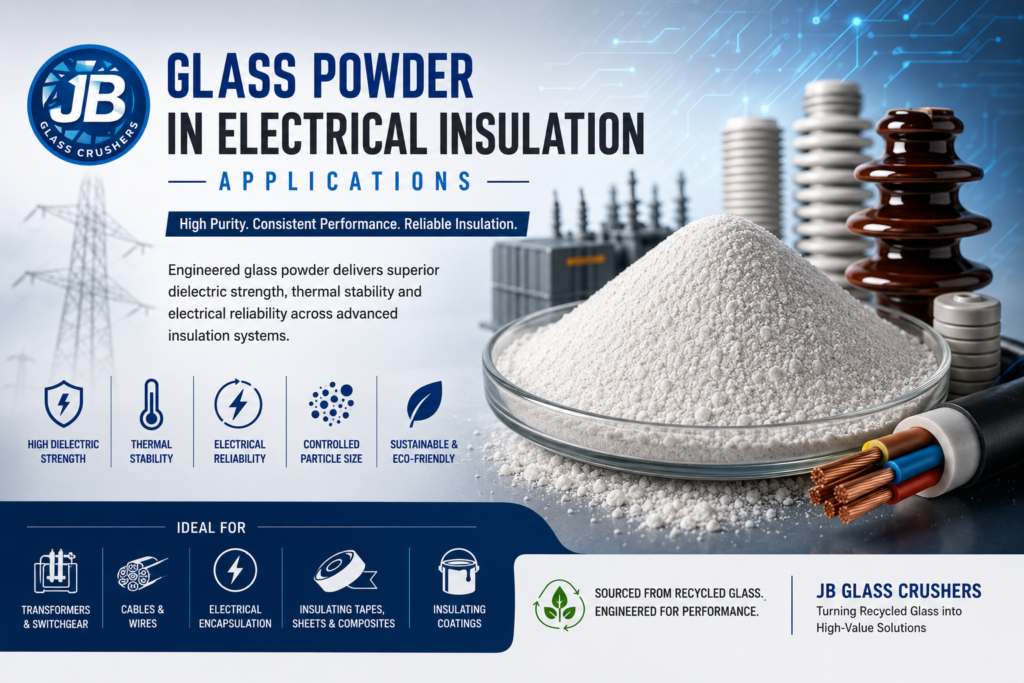
Electrical insulation materials are expected to deliver high dielectric strength, thermal stability, durability, and long-term reliability. Modern industries require engineered materials that can support controlled electrical performance while maintaining manufacturing efficiency and cost control.
This is where glass powder is becoming increasingly relevant.
At JB Glass Crushers, we manufacture application-ready glass powder through controlled processes, delivering consistent material quality for industrial applications—including electrical insulation applications.
What Is Glass Powder?
Glass powder is a finely processed glass-based material produced through controlled crushing, grinding, and particle sizing processes. Depending on the application, the powder can be manufactured in different mesh sizes and purity levels.
Unlike irregular raw waste material, industrial-grade glass powder is engineered for:
- Consistent particle size distribution
- Controlled purity levels
- Better formulation compatibility
- Reliable industrial performance
These characteristics make it suitable for multiple insulation-related applications.
Why Glass Powder Is Used in Electrical Insulation Applications
Electrical insulation systems require materials that support:
- Electrical resistance
- Dielectric stability
- Thermal resistance
- Dimensional stability
- Moisture resistance
- Long-term operational reliability
Glass powder contributes to these properties while also improving formulation flexibility and process efficiency.
Finely processed glass powder can support electrical insulation formulations due to its stability, controlled particle structure, and compatibility with industrial compounds used in insulation systems.
Key Benefits of Glass Powder in Electrical Insulation Applications
1. Lightweight Material Characteristics
Fine glass powder can help reduce overall product density when used in insulation formulations. This is especially valuable in modern construction systems where lightweight materials improve handling, transportation, and installation efficiency.
Industries increasingly prefer lightweight insulation systems because they:
- Reduce structural load
- Improve installation speed
- Lower transportation costs
- Improve handling efficiency
2. Electrical and Thermal Stability
Electrical insulation systems are exposed to continuous thermal and electrical stress.
Controlled glass powder can support:
- Stable dielectric properties
- Thermal resistance
- Reduced conductivity
- Improved formulation stability
This makes it suitable for applications such as:
- Electrical insulation compounds
- Cable insulation materials
- Switchgear components
- Insulating coatings
- Industrial electrical systems
3. Better Formulation Consistency
In industrial manufacturing, consistency is critical.
Irregular material size or contamination can negatively impact insulation products by causing:
- Uneven density
- Weak bonding
- Inconsistent thermal properties
- Production inefficiencies
Application-ready glass powder helps manufacturers maintain more predictable production results through controlled particle size and purity.
4. Improved Material Integration
Glass powder can integrate effectively into multiple insulation-related formulations including:
- Cement-based systems
- Composite materials
- Coatings
- Lightweight construction materials
- Polymer-based insulation products
Fine particle sizing improves blending and distribution throughout the material matrix.
5. Cost Optimization
Manufacturers are constantly searching for ways to optimize raw material costs without compromising performance.
Glass powder can support this objective by:
- Reducing dependency on expensive virgin materials
- Improving formulation efficiency
- Supporting controlled material utilization
- Lowering overall processing costs
For many manufacturers, this creates a balance between performance and cost efficiency.
Why Particle Size Matters in Insulation Applications
Particle size plays a major role in how glass powder performs.
Coarse Particles
Larger particle sizes may be used in:
- Bulk filling
- Lightweight structural materials
- Non-fine insulation blends
Medium Particles
Medium-grade powders often support:
- Balanced workability
- Controlled density
- General-purpose formulations
Fine Glass Powder
Fine application-ready glass powder is preferred where:
- Smooth integration is required
- Better bonding performance matters
- Higher consistency is needed
- Thermal efficiency is critical
At JB Glass Crushers, controlled processing helps ensure consistent particle size distribution for reliable industrial performance.
Importance of Purity in Glass Powder
Purity directly impacts insulation material quality.
Contaminants such as:
- Metals
- Ceramics
- Organic impurities
- Mixed materials
can reduce performance consistency and create processing issues.
High-purity glass powder helps manufacturers achieve:
- Better formulation stability
- Cleaner processing
- More predictable results
- Reduced rejection rates
This is especially important in large-scale industrial production.
Industries Using Glass Powder in Electrical Insulation Systems
Glass powder can support insulation-related applications across multiple industries.
Electrical and Electronics Industry
Used in:
- Electrical insulation compounds
- Cable and wire systems
- Electrical panels
- Insulating fillers
- High-temperature electrical components
Industrial Manufacturing
Used in:
- Composite insulation materials
- Thermal-electric barrier systems
- Industrial coatings
- Engineered polymer systems
Coatings & Surface Systems
Glass powder can support coatings designed for:
- Heat resistance
- Surface durability
- Specialized industrial applications
Why Controlled Processing Matters
Not all glass powder performs the same.
Industrial applications require:
- Controlled mesh size
- Reliable purity
- Consistent supply
- Repeatable material performance
This is why process control is central to high-quality glass powder manufacturing.
At JB Glass Crushers, our approach focuses on:
- Consistency
- Process control
- Reliable industrial performance
We manufacture application-ready glass materials designed for industrial use.
The Future of Glass Powder in Electrical Insulation Applications
As industries continue moving toward efficient and performance-driven materials, demand for engineered powder materials is expected to grow.
Glass powder offers manufacturers an opportunity to:
- Improve material efficiency
- Support thermal performance
- Optimize raw material costs
- Build more sustainable product systems
Its versatility and adaptability make it increasingly relevant across modern insulation and construction applications.
Conclusion
Glass powder is becoming an increasingly important industrial material in electrical insulation applications due to its stability, formulation flexibility, purity, and controlled performance characteristics.
However, performance depends heavily on consistency, particle size control, and purity.
At JB Glass Crushers, we focus on manufacturing application-ready glass powder through controlled processes—delivering reliable material performance for industrial applications.
About JB Glass Crushers
JB Glass Crushers manufactures consistent, application-ready glass materials for industrial use.
Our focus:
- Controlled processing
- Consistent particle sizing
- Reliable material quality
- Industrial-grade performance
For bulk supply and industrial inquiries, contact JB Glass Crushers.