
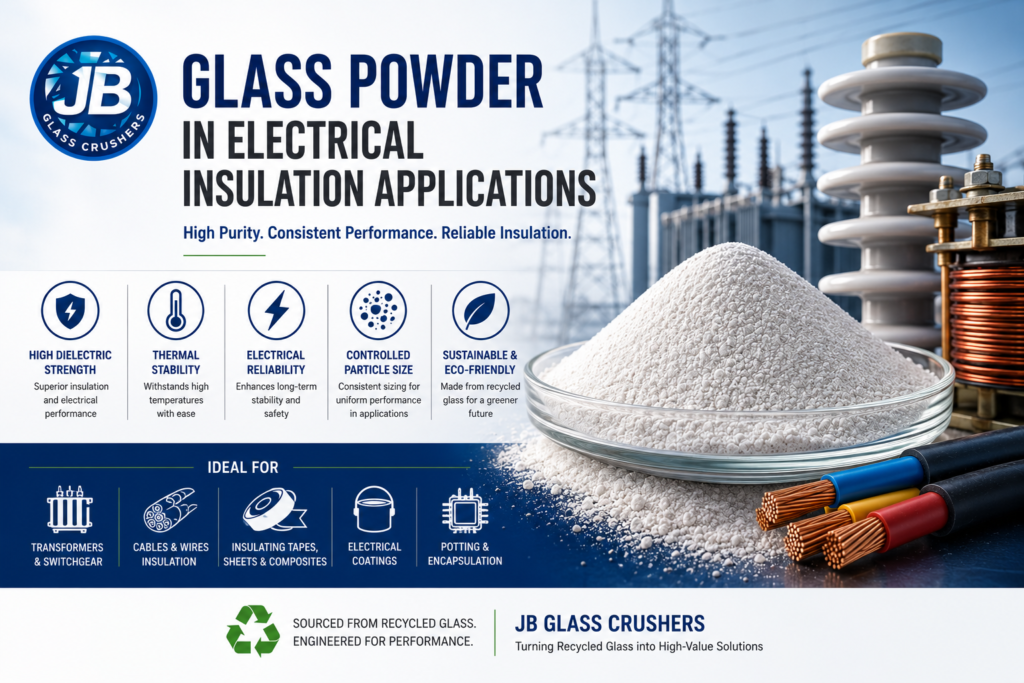
High Dielectric Strength Meets Cost-Effective Performance
Electrical insulation materials are expected to do more than simply block electrical current. Today’s manufacturers need materials that can withstand heat, resist moisture, maintain long-term stability, and still remain cost-effective in large-scale production. This is where glass powder is becoming an increasingly valuable solution.
From cable insulation and transformer coatings to electronic encapsulation and high-voltage composites, finely processed glass powder offers a unique combination of dielectric strength, thermal stability, and durability. With the right particle size and purity, manufacturers can improve insulation performance while lowering overall raw material costs.
At JB Glass Crushers, we supply application-ready glass powders engineered for demanding industrial insulation applications.
Why Glass Powder Works in Electrical Insulation
Glass is naturally an excellent electrical insulator. It offers:
- High dielectric strength
- Extremely high resistivity
- Low dielectric loss
- Moisture resistance
- Thermal stability
- Chemical inertness
These properties make glass powder an ideal filler or reinforcing material in insulation systems used across electrical and electronic industries.
When integrated into polymers, resins, silicone compounds, or coatings, glass powder helps create insulation materials that remain stable even in harsh operating environments.
Key Benefits of Glass Powder for Insulation Applications
1. High Dielectric Performance
Glass powder helps improve insulation resistance and dielectric stability in electrical components.
Applications include:
- Cable insulation compounds
- High-voltage coatings
- Electrical laminates
- Encapsulation systems
Fine glass particles reduce voids inside the material structure, helping improve breakdown strength and overall insulation reliability.
2. Excellent Thermal Stability
Electrical systems generate heat continuously. Glass powder helps insulation materials maintain dimensional and electrical stability under elevated temperatures.
Benefits include:
- Reduced thermal degradation
- Improved fire resistance
- Better thermal endurance
- Stable performance during thermal cycling
This makes glass powder useful in:
- Fire-resistant cables
- Transformer insulation
- Industrial electrical coatings
- Potting compounds
3. Moisture Resistance
Moisture is one of the biggest enemies of insulation materials because it increases dielectric loss and reduces reliability.
Glass powder is:
- Non-porous
- Chemically stable
- Highly moisture-resistant
This helps manufacturers produce insulation materials suitable for humid and outdoor environments.
Why Particle Size Matters
One of the most important factors in insulation-grade glass powder is particle size distribution.
Ultra-Fine Glass Powder (<10 µm)
Talcum-like ultra-fine powder provides:
- Better dispersion
- Higher packing density
- Lower air gaps
- Improved dielectric performance
Best suited for:
- Premium insulation coatings
- Electrical varnishes
- High-performance composites
- Precision electronic applications
Medium Grade Powder (10–50 µm)
This grade balances:
- Performance
- Processability
- Cost efficiency
Commonly used in:
- Cable compounds
- Polymer insulation systems
- Electrical molded parts
Coarser Powder (>50 µm)
Coarser grades are often selected for:
- Bulk fillers
- Cementitious insulation systems
- Cost-sensitive applications
They offer good insulation performance at lower production cost.
Purity is Critical for Electrical Applications
Not all glass powders are suitable for electrical insulation.
For insulation-grade applications, purity directly impacts:
- Resistivity
- Dielectric loss
- Long-term reliability
Contaminants such as:
- Carbon residues
- Metallic particles
- Excess alkali content
can reduce insulation efficiency.
At JB Glass Crushers, our processing systems ensure:
- Controlled particle sizing
- Clean and consistent material quality
- Low contamination levels
- Reliable batch consistency
This helps manufacturers achieve dependable electrical performance in final products.
Applications of Glass Powder in Electrical Industries
Glass powder is increasingly used in:
Cable & Wire Insulation
Improves:
- Heat resistance
- Flame retardancy
- Structural stability
Electrical Coatings & Enamels
Used in:
- Protective coatings
- Insulating layers
- Surface protection systems
Potting & Encapsulation
Glass powder enhances:
- Dimensional stability
- Thermal resistance
- Insulation performance
for transformers, sensors, and electronic assemblies.
Composite Insulation Materials
Widely used in:
- Polymer composites
- Resin systems
- Electrical laminates
- Industrial molded components
Sustainability Meets Performance
Another major advantage of glass powder is sustainability.
Using recycled glass-derived powder helps:
- Reduce industrial waste
- Lower raw material consumption
- Support circular manufacturing practices
At the same time, manufacturers gain a cost-effective insulating filler without compromising performance.
Why Manufacturers Choose JB Glass Crushers
JB Glass Crushers supplies application-ready glass powder tailored for industrial performance.
We provide:
- Fine to coarse particle grades
- Consistent quality control
- Custom sizing options
- Reliable industrial supply
- Cost-effective solutions for insulation manufacturers
Whether your application requires ultra-fine dielectric fillers or economical bulk insulation materials, our team can help you select the right glass powder grade.
Conclusion
As electrical systems become more demanding, manufacturers need insulation materials that offer both performance and efficiency. Glass powder delivers exactly that.
With excellent dielectric properties, thermal stability, moisture resistance, and customizable particle sizes, glass powder is emerging as a smart material choice for modern electrical insulation applications.
For manufacturers looking to improve product performance while reducing material costs, JB Glass Crushers offers reliable, high-quality glass powder solutions engineered for industrial success.