
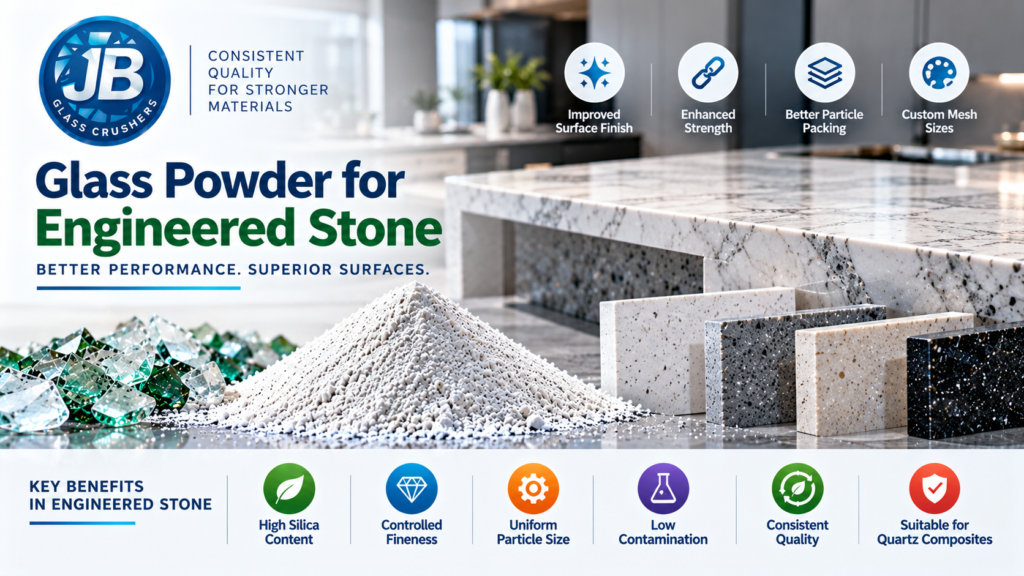
Engineered stone manufacturers continually evaluate mineral materials to achieve the desired appearance, surface finish, mechanical performance and production consistency. Glass powder is one material that can be investigated in selected artificial stone formulations, particularly where manufacturers want to incorporate glass particles into resin-bound composite products.
The suitability of glass powder depends on several factors, including particle-size distribution, colour, chemical composition, surface characteristics and compatibility with the binder system.
At Jai Bhavani Glass Crushers, we manufacture industrial-grade glass powder from soda-lime float glass in controlled particle-size grades. Our material can be evaluated by manufacturers investigating suitable glass powder applications, subject to their technical requirements and laboratory testing.
This guide explains how particle size, colour, material quality and formulation requirements influence the evaluation of glass powder for engineered stone.
1. What Is Engineered Stone?
Engineered stone is a manufactured composite material produced by combining mineral particles with a binding system and, where required, pigments or other additives.
Depending on the manufacturing process and intended application, the mineral component may contain quartz, other natural minerals, glass particles or combinations of different materials.
The finished product’s characteristics depend on the selection and proportion of its ingredients, particle packing, binder compatibility, processing conditions and surface finishing.
Glass powder can be investigated as a constituent of selected engineered stone formulations. However, its suitability must be established for the specific manufacturing process rather than assumed from its appearance or silica content alone.
2. Can Glass Powder Be Used in Engineered Stone?
Research has demonstrated the technical feasibility of manufacturing artificial stone using glass particles, mineral powders and polymer binders.
A 2022 study published in Sustainability investigated engineered stone produced using glass packaging material, quartz powder and epoxy resin. The researchers examined particle-size distribution, resin requirements and the physical, chemical and mechanical properties of the resulting composite.
The research demonstrates that glass-containing artificial stone can be investigated as an engineered material. It does not establish that every glass powder grade is suitable for every engineered stone formulation.
For manufacturers, the important question is whether the selected glass powder can meet the required processing and finished-product specifications.
Potential evaluation areas include:
- Incorporation into resin-bound mineral composites
- Adjustment of particle-size distribution
- Development of decorative colour and visual effects
- Particle packing and void reduction
- Surface appearance and polishing performance
- Physical and mechanical performance of the finished composite
These are potential areas for formulation development, not guaranteed benefits of adding glass powder.
3. Why Particle Size Matters in Engineered Stone
Particle size is one of the key variables in engineered stone manufacturing because it influences how particles pack together and how the binder occupies the spaces between them.
A formulation containing a suitable combination of particle sizes may achieve more efficient packing than a formulation containing particles of only one size. The actual result depends on particle shape, size distribution, binder properties, mixing and compaction.
Research on artificial stone containing glass particles has examined particle sizes around 150, 300 and 600 micrometres. Results indicate that particle-size distribution can influence porosity, interfacial bonding, water absorption and surface characteristics.
These experimental sizes are examples from a particular study, not universal specifications for commercial engineered stone.
Understanding fine and coarse glass particles
Fine glass powder
Fine particles may fill spaces between larger mineral particles. However, very fine material can also change binder demand, mixing behaviour and the viscosity of the mixture.
Medium-sized glass particles
Intermediate sizes may help balance particle packing and binder penetration when combined with other fractions. Their suitability depends on the overall formulation.
Coarser glass particles
Coarser particles can contribute to visible decorative effects, but excessive coarse material or an unsuitable distribution may increase voids or weaken the interface between particles and binder.
The ideal particle distribution must be established through formulation trials.
Why D10, D50 and D90 matter
Mesh size provides a useful screening classification, but it does not fully describe the particle-size distribution of a powder.
Manufacturers may request the following measurements:
- D10: The particle diameter below which 10% of the measured sample falls.
- D50: The median particle diameter.
- D90: The particle diameter below which 90% of the measured sample falls.
These measurements help manufacturers compare grades and determine whether a material is appropriate for a particular formulation.
For example, two powders sold under the same mesh designation may have different particle-size distributions and behave differently during mixing.
For this reason, engineered stone manufacturers should assess measured particle-size data rather than select a grade on mesh size alone.
4. Colour Selection: Clear, White, Green and Mixed Glass
Colour is an important consideration when developing decorative composite surfaces.
The appearance of the finished product depends on the colour of the glass particles, their particle size, the surrounding mineral materials, the binder, pigments and the thickness of the finished surface.
Clear glass
Clear glass particles may be considered when a manufacturer wants to develop a translucent or visually distinctive particulate effect.
However, clear particles do not necessarily produce a transparent finished composite. The binder, particle distribution, air voids and surrounding materials can affect the final appearance.
White glass
White or light-coloured glass powder may be evaluated in formulations where colour consistency and a lighter visual appearance are important.
The suitability of a grade should be confirmed through colour measurements and sample testing. A supplier’s description of a powder as white does not replace objective colour data.
Green glass
Green glass may be useful for selected decorative designs where a coloured glass component is desired.
Its suitability depends on the target shade, colour consistency, particle size and compatibility with the other ingredients.
Mixed-colour glass
Mixed-colour material may be considered for formulations designed around varied decorative particles.
However, colour variation can make batch-to-batch consistency more difficult. Manufacturers requiring a repeatable appearance should establish acceptable colour limits before approving the material.
How manufacturers should evaluate colour
Before selecting a glass powder grade, assess:
- Colour consistency between samples and production batches.
- Particle appearance under the intended lighting conditions.
- The effect of the binder and surrounding mineral materials.
- Appearance after curing, cutting and polishing.
- Colour stability under the environmental conditions relevant to the finished product.
A laboratory sample or small production trial is the best way to establish whether a particular colour grade meets the intended design requirements.
5. Chemical Composition and Material Quality
Particle size and colour are not the only considerations when evaluating glass powder for engineered stone.
Soda-lime float glass contains silica along with other constituents, commonly including sodium oxide and calcium oxide. The precise composition depends on the original glass and should be verified using laboratory analysis.
Relevant parameters may include:
- Silicon dioxide (SiO₂)
- Sodium oxide (Na₂O)
- Calcium oxide (CaO)
- Aluminium oxide (Al₂O₃)
- Iron content
- Moisture content
- Visible impurities and contamination
These parameters help manufacturers assess consistency and compatibility with their existing raw materials.
Contamination can be particularly important in applications requiring light colours or tightly controlled chemical composition. Grinding and processing equipment can also influence the final material.
A chemical analysis report and an agreed product specification help buyers compare suppliers and manage quality requirements.
6. Glass Powder and Resin Compatibility
Many engineered stone products use polymer binders, including epoxy or polyester resin systems.
In these products, the interaction between the mineral particles and the binder can influence mixing, compaction, curing, void formation and the properties of the finished composite.
Glass powder should therefore be evaluated within the intended resin formulation.
Important considerations include:
Binder demand: Fine particles can change the surface area and packing characteristics of the mineral mixture, potentially affecting the quantity of binder required.
Mixing behaviour: Particle-size distribution and moisture can influence how the ingredients mix and whether the formulation remains workable.
Particle–binder interface: The adhesion between glass particles and the binder may affect the mechanical integrity of the composite.
Curing: The binder system and processing conditions influence the final product’s properties.
Surface finishing: The distribution and characteristics of the particles can influence the appearance after cutting and polishing.
A glass powder grade should not be assumed to reduce resin consumption or improve mechanical strength without controlled testing.
7. Laboratory Tests Before Approving a Glass Powder Grade
Engineered stone manufacturers should establish a test programme based on their intended product and production process.
| Parameter | Purpose |
|---|---|
| Particle-size distribution | Evaluates particle sizes and distribution |
| Chemical composition | Establishes the material’s major chemical constituents |
| Colour measurement | Assesses colour consistency |
| Moisture content | Helps control raw-material consistency |
| Bulk density | Supports storage, handling and formulation calculations |
| Binder compatibility | Evaluates mixing and interaction with the selected resin |
| Void content or porosity | Assesses the compactness of the finished composite |
| Water absorption | Evaluates one aspect of the finished material’s physical performance |
| Flexural and other relevant mechanical tests | Assesses whether the finished product meets its design requirements |
| Surface finish and polish evaluation | Determines whether the finished appearance meets the specification |
| Batch consistency | Checks whether the material remains consistent over time |
Not every test is necessary for every product. The manufacturer’s quality and R&D teams should select methods appropriate to the formulation and applicable product standards.
A sensible approval process begins with laboratory characterisation, followed by small-scale formulation trials and, where appropriate, a controlled production trial.
8. Choosing a Glass Powder Supplier for Engineered Stone
When comparing suppliers, manufacturers should evaluate the consistency and suitability of the material rather than relying on mesh size or price alone.
A structured supplier assessment should cover:
Available grades: Confirm the particle-size grades currently available and whether they match the formulation requirements.
Technical documentation: Request a technical data sheet and available laboratory reports.
Colour consistency: Confirm the required colour and acceptable variation.
Chemical composition: Review the composition against the manufacturer’s specification.
Sample evaluation: Test a representative sample before approving a grade for regular production.
Production consistency: Discuss quality-control practices and how the supplier manages variation between batches.
Commercial supply: Confirm available quantities, packaging, lead times and delivery arrangements before placing an order.
These checks help the buyer determine whether a material can be incorporated into the manufacturing process and supplied consistently.
9. Glass Powder from Jai Bhavani Glass Crushers
Jai Bhavani Glass Crushers is based in Hyderabad, Telangana, India, and manufactures industrial-grade glass powder from soda-lime float glass.
We supply glass powder in controlled particle-size grades for industrial applications.
Manufacturers investigating glass powder for engineered stone can share their requirements for particle size, colour, chemical composition, moisture and expected consumption. These details help determine whether an available grade may be suitable for technical evaluation.
Where appropriate, prospective buyers can discuss sample availability and request the relevant product documentation.
Final suitability should be established through the manufacturer’s own laboratory and production trials. Available grades, technical specifications and supply quantities should be confirmed before an order is placed.
10. Frequently Asked Questions
Is glass powder suitable for engineered stone?
Glass powder can be investigated as a component of selected engineered stone formulations. Suitability depends on particle size, colour, chemical composition, binder compatibility and the requirements of the finished product.
What particle size is best for engineered stone?
There is no single particle size suitable for every formulation. Manufacturers should evaluate the particle-size distribution required by their process, including the interaction between fine particles and larger mineral fractions.
Does finer glass powder always produce better engineered stone?
No. Fine particles may improve packing in some formulations, but they can also change binder demand and mixing behaviour. The best particle distribution must be established experimentally.
Does glass powder affect the colour of engineered stone?
Yes. Glass colour and particle size can influence the appearance of the finished composite. The binder, pigments and other mineral components also contribute to the final colour.
Can glass powder reduce resin consumption?
It may influence packing and binder requirements, but a reduction in resin consumption should not be assumed. Controlled trials are needed to determine the binder demand for a particular formulation.
What information should buyers provide when requesting a quotation?
Buyers should specify the intended application, required particle-size distribution, colour, relevant chemical and physical limits, expected quantity, packaging requirements and delivery location.
How can manufacturers evaluate a glass powder sample?
Begin with particle-size and chemical analysis, then conduct formulation trials to assess mixing behaviour, binder compatibility and finished-product performance.
Conclusion
Glass powder offers a potential material option for manufacturers developing selected engineered stone and artificial stone formulations.
Published research indicates that particle-size distribution can influence packing, porosity, binder penetration and the physical characteristics of glass-containing artificial stone. Colour, chemical composition, moisture and resin compatibility are also important when evaluating a material for commercial use.
The best approach is to establish a clear raw-material specification, test a representative sample and confirm performance before scaling up production.
Jai Bhavani Glass Crushers, Hyderabad, India, supplies industrial-grade glass powder for industrial evaluation. Contact us to discuss available grades, technical requirements and sample availability.
Contact Jai Bhavani Glass Crushers
- Location: Hyderabad, Telangana, India
- Website: jbglasscrushers.com
- Phone: +91 89773 42277
- Email: info@jbglasscrushers.com
All application claims are subject to grade-specific testing and validation. Actual product specifications and availability must be confirmed with the supplier.