
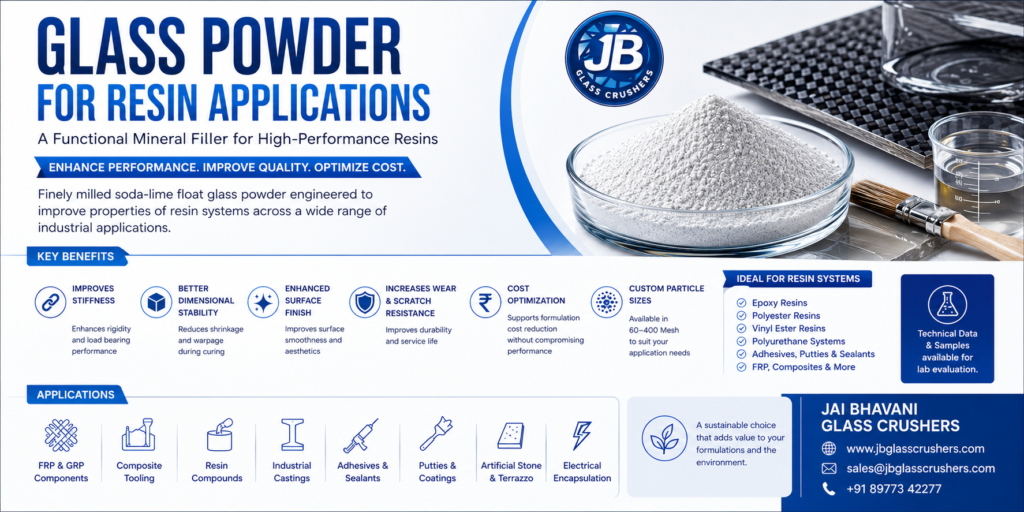
Modern resin systems are expected to deliver more than just bonding or encapsulation. Manufacturers today seek materials that improve mechanical performance, dimensional stability, processing efficiency, and cost optimization without compromising product quality.
One material gaining attention across industrial applications is finely milled soda-lime float glass powder. While traditionally associated with construction and ceramics, glass powder is increasingly being evaluated as a functional mineral filler in selected resin formulations.
What is Glass Powder?
Glass powder is produced by grinding high-quality soda-lime float glass into controlled particle sizes.
Because of its hardness, chemical stability, and controlled particle size, glass powder can serve as a functional inorganic filler in selected resin systems after formulation testing.
Why Fillers Are Used in Resins
Most industrial resin formulations contain fillers to improve processing and tailor final properties.
Common fillers include:
- Calcium carbonate
- Talc
- Silica flour
- Wollastonite
- Alumina trihydrate
- Glass microspheres
- Glass powder
The right filler depends on the desired balance of mechanical properties, processing, appearance, and cost.
Potential Benefits of Glass Powder in Resin Systems
1. Improved Stiffness
Glass particles are rigid and may increase the stiffness of cured resin systems.
Potential applications include:
- Epoxy castings
- Composite parts
- Industrial components
Performance depends on formulation and filler loading.
2. Better Dimensional Stability
Resins naturally shrink during curing.
Fine glass powder may help reduce:
- Shrinkage
- Warpage
- Dimensional changes
This can be valuable for precision moulded parts and cast components.
3. Improved Surface Finish
Fine particle sizes can improve packing within the resin matrix.
Benefits may include:
- Smoother surfaces
- Better appearance
- Improved machinability
4. Wear and Scratch Resistance
Glass is significantly harder than most polymer matrices.
When appropriately incorporated, it may enhance:
- Surface hardness
- Abrasion resistance
- Scratch resistance
5. Cost Optimization
Mineral fillers often reduce formulation cost by replacing a portion of the resin or higher-cost fillers.
Glass powder may provide an economical option where technical performance is maintained through formulation development.
6. Processing Control
Particle size distribution influences:
- Resin viscosity
- Flow behaviour
- Dispersion
- Mixing efficiency
Selecting the appropriate mesh size helps formulators balance processability and performance.
Resin Systems Suitable for Evaluation
Glass powder can be investigated in various resin systems, including:
Epoxy Resins
Potential applications:
- Industrial flooring
- Electrical encapsulation
- Composite laminates
- Tooling systems
- Structural adhesives (where formulation permits)
Polyester Resins
Common uses:
- FRP products
- Decorative panels
- Artificial stone
- Automotive components
Vinyl Ester Resins
Possible applications:
- Chemical-resistant equipment
- Tanks
- Pipes
- Composite structures
Polyurethane Systems
Potential evaluation in:
- Cast components
- Industrial mouldings
- Specialty formulations
Each resin system should be validated independently through laboratory testing.
Typical Applications
Glass powder may be evaluated for:
- Resin compounds
- Polymer composites
- Composite tooling
- FRP components
- Industrial castings
- Adhesives
- Putties
- Polymer concrete
- Artificial stone
- Surface coatings
- Electrical compounds
Importance of Particle Size
Particle size strongly influences formulation performance.
Typical ranges include:
| Mesh | Typical Use |
|---|---|
| 60–100 | Heavy-filled systems |
| 100–200 | General-purpose fillers |
| 200–300 | Fine resin formulations |
| 300–400 | Premium surface finish applications |
Custom particle size distribution can often provide better processing than relying on a single nominal mesh size.
Why Manufacturers Are Exploring Glass Powder
Manufacturers continuously seek materials that help them:
- Improve formulation performance
- Increase process consistency
- Enhance finished-part quality
- Reduce production costs
- Maintain reliable raw material supply
Glass powder offers an additional option that may meet these objectives in suitable formulations.
Choosing the Right Glass Powder Supplier
A consistent filler is as important as the formulation itself.
When selecting glass powder, manufacturers should consider:
- Consistent particle size distribution
- High-purity soda-lime float glass
- Low contamination
- Reliable batch-to-batch quality
- Custom mesh sizes
- Technical support
- Bulk supply capability
How Jai Bhavani Glass Crushers Supports Resin Manufacturers
At Jai Bhavani Glass Crushers, we manufacture premium soda-lime float glass powder for industrial applications.
We offer:
- Custom particle sizes from 60–400 mesh
- Controlled particle size distribution
- High-purity float glass feedstock
- Consistent industrial quality
- Bulk supply
- Technical samples for laboratory evaluation
We work closely with manufacturers to help them assess whether our material is suitable for their specific resin formulation.
Conclusion
Glass powder is not a universal replacement for conventional fillers, but it is a promising functional mineral filler that deserves evaluation in many resin systems. Depending on the formulation, it may contribute to improved stiffness, dimensional stability, surface finish, wear resistance, and cost optimization.
For manufacturers developing the next generation of resin-based products, laboratory trials are the best way to determine whether finely milled soda-lime float glass powder can deliver the desired balance of performance and processability.
Interested in evaluating glass powder for your resin formulations?
Jai Bhavani Glass Crushers
sales@jbglasscrushers.com
www.jbglasscrushers.com
+91 89773 42277