
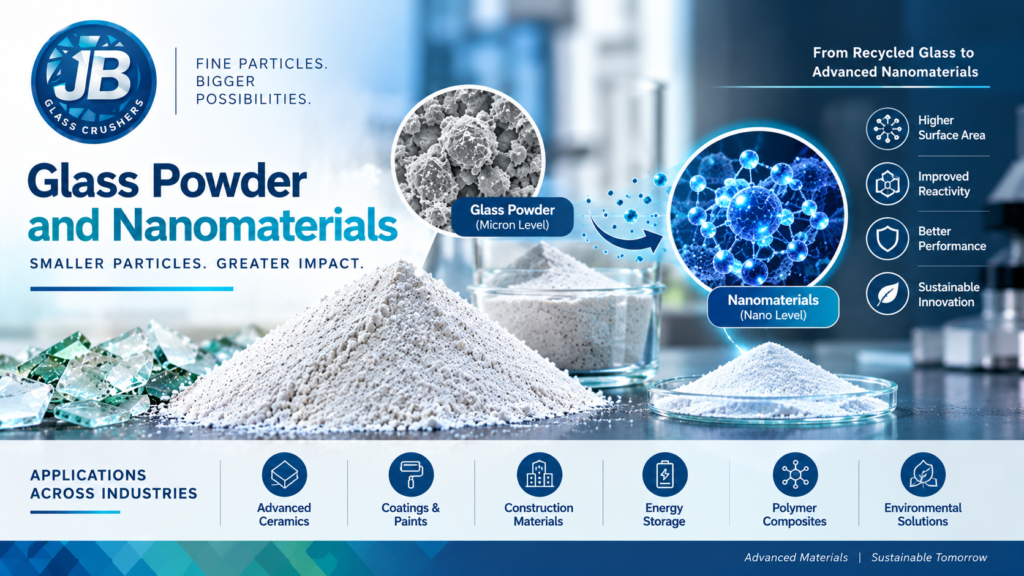
The development of nanomaterials is creating new opportunities across advanced manufacturing, materials science, electronics, healthcare research and industrial technology. Glass-based materials are an important part of this research landscape because their chemical composition, structure and physical properties can be tailored for specific applications.
Glass powder is a processed material used in many industrial applications. Depending on its composition and particle characteristics, it may also be investigated as a starting material for certain advanced-material research projects.
However, conventional glass powder and engineered glass nanoparticles are not the same. Understanding their differences is essential when selecting materials for research, product development and industrial manufacturing.
At Jai Bhavani Glass Crushers, Hyderabad, India, we manufacture industrial-grade glass powder from soda-lime float glass in controlled particle-size grades. This article explores the relationship between glass powder and nanomaterials, potential research applications and the technical considerations involved in evaluating glass-derived materials.
1. What Are Glass Powder and Nanomaterials?
Understanding glass powder
Glass powder is produced by grinding glass into smaller particles. Its properties depend on the original glass composition, manufacturing process, grinding conditions and particle-size distribution.
Soda-lime float glass typically contains silica, sodium oxide and calcium oxide, along with other constituents. The precise composition should be established through laboratory analysis.
Industrial glass powder can be evaluated for applications in construction materials, ceramics, coatings, engineered stone and composite formulations, depending on its properties.
Understanding nanomaterials
Nanomaterials are materials whose relevant structural features or particle dimensions fall within the nanoscale, often approximately 1–100 nanometres under commonly used definitions.
At this scale, certain materials can exhibit properties that differ from those of larger particles of the same composition. These differences may arise from surface effects, quantum phenomena or changes in material structure.
Nevertheless, not every fine powder is a nanomaterial. Conventional industrial glass powder is generally much coarser than engineered glass nanoparticles.
The distinction must be supported by appropriate particle characterisation rather than inferred from the appearance or mesh size of a powder.
2. How Is Glass Connected to Nanotechnology?
Glass science and nanotechnology overlap in several areas of advanced materials research.
Researchers investigate glass materials containing nanoparticles, glass matrices with controlled nanoscale structures, and specialised glass-derived particles designed for particular functions.
A 2022 review by Javier Fonseca, published in Frontiers of Materials Science, examined glass nanocomposites and the methods used to create nanoparticles within glass matrices.
The review discussed potential applications in:
- Optoelectronics and photonics
- Sensors and sensing technologies
- Electrochemistry
- Catalysis
- Biomedical research
- Specialised optical materials
These applications involve engineered glass systems rather than simply using conventional glass powder as a finished nanomaterial.
The research demonstrates that glass-based materials can play an important role in advanced-material development when their composition and structure are appropriately controlled.
3. Glass Powder vs. Glass Nanoparticles
Although both materials originate from glass or glass-based compositions, their specifications and intended uses can differ substantially.
| Characteristic | Conventional glass powder | Engineered glass nanoparticles |
|---|---|---|
| Particle dimensions | Generally micrometre-scale | Designed or characterised at the nanoscale |
| Production methods | Grinding, milling and classification | May involve chemical synthesis or specialised physical processing |
| Characterisation | Sieve analysis and particle-size distribution | May require electron microscopy and other specialised techniques |
| Quality requirements | Depend on the industrial application | May include morphology, surface chemistry, aggregation and nanoscale distribution |
| Potential applications | Industrial fillers, construction materials, ceramics and composites | Specialised optical, electronic, biomedical and functional materials |
| Processing complexity | Depends on the required industrial grade | Often requires additional processing and analytical control |
The appropriate material depends on the application.
For example, a manufacturer looking for a mineral filler may require conventional industrial glass powder. A research laboratory developing a glass nanocomposite may need a material with a specifically engineered composition and nanoscale characteristics.
These requirements should not be treated as interchangeable.
4. Potential Applications of Glass-Based Nanomaterials
1 Electronics and photonics
Glass-based nanocomposites are investigated for applications in optical and electronic technologies.
Researchers may incorporate nanoparticles into glass matrices to modify optical transmission, light emission or other functional properties.
Potential research areas include photonic components, optical sensors and specialised electronic materials.
The performance of these systems depends on the glass composition, the type of nanoparticles, their dimensions and their distribution within the material.
Conventional soda-lime glass powder should not be assumed to meet the requirements of specialised optical or electronic applications without further processing and testing.
2 Sensors and functional materials
Glass-based nanostructures are also investigated for sensing applications.
Depending on their composition and design, specialised materials may be developed to respond to changes in temperature, light or chemical conditions.
Researchers may use surface modification, functional nanoparticles or engineered glass structures to achieve a particular response.
These applications require controlled material characteristics and repeatable testing.
3 Biomedical materials research
Bioactive glass nanoparticles are an established research area in biomedical materials science.
A review by Vichery and Nedelec, published in Materials in 2016, examined the synthesis and design of bioactive glass nanoparticles for applications involving tissue repair and engineering.
Research areas include specialised scaffolds, coatings, drug-delivery systems and other biomedical materials.
These applications require specifically designed glass compositions and careful assessment of biological compatibility, material behaviour and safety.
Ordinary industrial soda-lime glass powder is not equivalent to bioactive glass nanoparticles and should not be marketed as a biomedical material without appropriate development, testing and regulatory assessment.
4 Advanced coatings and nanocomposites
Nanocomposites combine two or more materials to obtain particular properties.
Glass-based systems may incorporate nanoparticles within a glass matrix or use specialised glass-derived materials in composite formulations.
Researchers investigate these systems for optical, thermal, electrical and other application-specific properties.
Conventional glass powder may also be evaluated as a mineral component in selected industrial coatings and composites. However, its role as a filler should be distinguished from the function of engineered nanoparticles.