
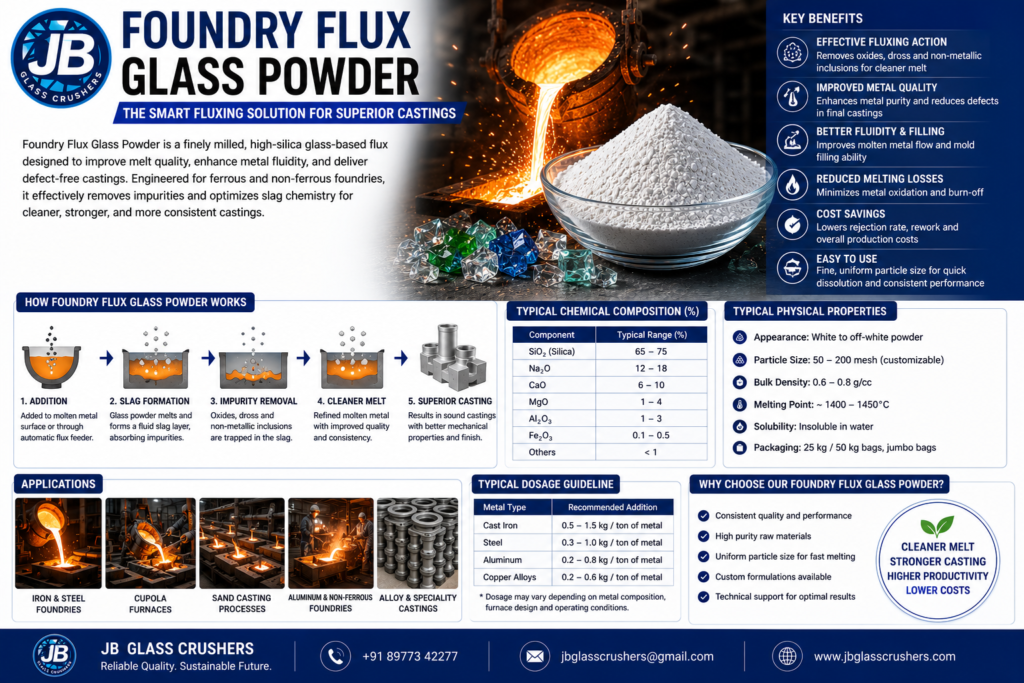
Modern foundries continuously seek methods to improve casting quality, reduce production costs, and enhance furnace efficiency. One material gaining attention across the metal casting industry is finely milled glass powder. Due to its high silica content, controlled particle size distribution, and fluxing characteristics, glass powder serves as an effective additive in foundry operations.
JB Glass Crushers produces premium-quality silica-rich glass powder manufactured from selected float glass, offering consistent performance for foundry and refractory applications.
Understanding Fluxes in Foundry Operations
A flux is a material added during melting to facilitate the removal of impurities, improve slag fluidity, and enhance metal cleanliness. Fluxes help:
- Reduce melting temperatures
- Improve slag flow characteristics
- Promote separation of impurities
- Enhance metal recovery
- Minimize oxidation losses
- Improve casting surface quality
Foundry fluxes are commonly used in iron, steel, aluminum, brass, copper, and specialty alloy casting operations. Fluxing materials work by modifying the chemistry and viscosity of the molten slag layer, enabling easier removal of unwanted inclusions. Research shows that flux materials play a critical role in reducing processing temperatures and improving energy efficiency in silicate and metallurgical systems.
Why Glass Powder Works as a Foundry Flux
1. High Silica Content
Glass powder derived from float glass contains a significant amount of amorphous silica. Unlike crystalline silica, the amorphous structure softens more uniformly when exposed to elevated temperatures.
This characteristic enables glass powder to:
- Participate in slag formation
- Improve slag fluidity
- Promote impurity encapsulation
- Enhance furnace efficiency
2. Uniform Particle Size Distribution
Finely milled glass powder provides:
- Rapid melting behavior
- Consistent dispersion
- Predictable fluxing performance
- Uniform reaction throughout the melt
The controlled particle size allows foundries to maintain consistent process parameters from batch to batch.
3. Low Softening Temperature
Glass begins to soften significantly below the melting temperatures encountered in most foundry furnaces. This early softening behavior helps create a fluid phase that assists in:
- Wetting solid particles
- Binding impurities
- Improving slag mobility
Benefits of Glass Powder in Foundries
Improved Slag Fluidity
One of the primary functions of a flux is reducing slag viscosity. Glass powder contributes silica-based glassy phases that assist in producing a more fluid slag layer.
Benefits include:
- Easier slag removal
- Cleaner metal
- Reduced furnace downtime
- Better melt management
Enhanced Metal Cleanliness
A fluid slag captures:
- Oxides
- Non-metallic inclusions
- Dirt
- Furnace contaminants
Removal of these impurities improves final casting quality and reduces rejection rates.
Increased Metal Recovery
When impurities are effectively separated into slag, valuable molten metal remains available for casting.
Benefits include:
- Higher yield
- Lower metal losses
- Improved process economics
Better Surface Finish
Cleaner molten metal produces:
- Smoother castings
- Reduced defects
- Improved machining performance
- Enhanced product appearance
Energy Savings
Fluxing materials help lower processing temperatures and improve heat transfer characteristics, reducing overall energy consumption during melting operations.
Applications in Foundry Industries
Iron Foundries
Glass powder can support:
- Slag conditioning
- Furnace efficiency
- Cleaner iron melts
- Improved casting consistency
Steel Foundries
Silica-rich glass powder contributes to:
- Slag control
- Inclusion reduction
- Enhanced melt cleanliness
- Improved surface quality
Non-Ferrous Foundries
For aluminum, brass, bronze, and copper alloys, flux systems are commonly used to remove impurities and improve metal quality. Fluxes help separate oxides and contaminants from molten metal, contributing to superior casting performance.
Refractory Manufacturing
Glass powder is also utilized in refractory systems where its fluxing action assists:
- Sintering
- Bond formation
- Thermal stability
- Structural integrity
Technical Advantages of JB Glass Crushers Glass Powder
JB Glass Crushers supplies high-performance glass powder featuring:
High Purity
Manufactured from selected float glass.
Consistent Chemistry
Reliable composition for predictable foundry performance.
Uniform Mesh Sizes
Available in customized particle size ranges.
Low Moisture Content
Supports efficient storage and handling.
Excellent Flowability
Easy blending with foundry formulations.
Reliable Supply
Suitable for industrial-scale foundry operations.
Future of Glass Powder in Foundry Technology
As foundries focus on efficiency, sustainability, and process optimization, glass powder is emerging as a valuable fluxing material. Its combination of silica-rich chemistry, controlled particle size, thermal stability, and slag-forming capability makes it an attractive solution for modern casting operations.
With growing demand for cleaner production methods and improved casting quality, finely milled glass powder is expected to become an increasingly important component in foundry and refractory applications worldwide.
Conclusion
Foundry flux glass powder provides a practical solution for improving slag fluidity, enhancing metal cleanliness, reducing defects, and increasing process efficiency. Through its high silica content and consistent particle characteristics, JB Glass Crushers’ glass powder supports foundries in producing superior castings while optimizing operational performance.
For foundries seeking reliable, high-quality silica-rich glass powder, JB Glass Crushers offers tailored solutions designed to meet demanding industrial requirements.