
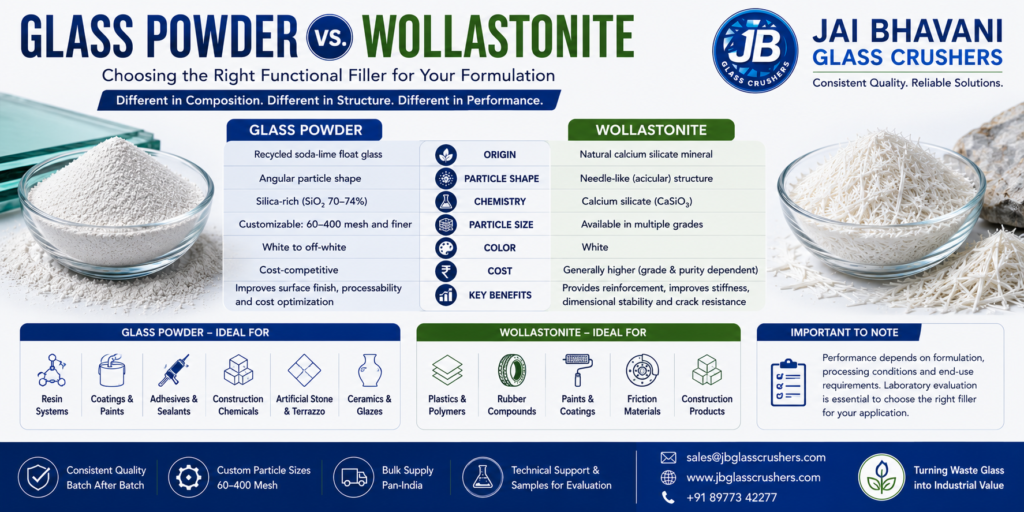
Selecting the right functional filler is one of the most important decisions in developing high-performance industrial formulations. Among the many mineral fillers available, glass powder and wollastonite are widely evaluated across industries such as composites, adhesives, coatings, construction materials, engineered stone, and polymers.
Although both are inorganic mineral fillers, they differ significantly in composition, particle shape, and the properties they impart. Understanding these differences helps manufacturers choose the most suitable material for their application.
What is Glass Powder?
Glass powder is produced by finely grinding soda-lime float glass into controlled particle sizes.
Glass powder consists primarily of angular particles and is commonly evaluated as a functional mineral filler in resin systems, composites, adhesives, coatings, ceramics, and construction materials.
What is Wollastonite?
Wollastonite is a naturally occurring calcium silicate mineral (CaSiO₃).
Unlike glass powder, wollastonite has a needle-like (acicular) particle shape, which contributes reinforcement in many formulations.
It is widely used in:
- Plastics
- Rubber
- Paints
- Ceramics
- Friction materials
- Construction products
Glass Powder vs. Wollastonite
| Property | Glass Powder | Wollastonite |
|---|---|---|
| Origin | Recycled soda-lime float glass | Natural calcium silicate mineral |
| Particle Shape | Angular | Needle-like (acicular) |
| Main Chemistry | Silica-rich glass | Calcium silicate |
| Hardness | High | High |
| Particle Size | Customizable (60–400 mesh and finer) | Available in multiple grades |
| Color | White to off-white | White |
| Reinforcement | Limited; depends on formulation | Often provides reinforcement due to aspect ratio |
| Cost | Can be cost-competitive | Often higher, depending on grade and purity |
When Glass Powder May Be Preferred
Glass powder can be an attractive option when manufacturers are looking for:
1. Cost Optimization
Finely milled glass powder can be a cost-effective filler for many industrial formulations, depending on performance requirements.
2. Consistent Particle Size
Controlled milling allows manufacturers to specify particle size distributions suited to their processing needs.
3. Improved Surface Finish
Fine particles can contribute to smoother surfaces in suitable formulations.
4. Sustainable Material Choice
Glass powder produced from processed float glass supports the use of secondary raw materials and can contribute to circular manufacturing initiatives.
5. Broad Industrial Compatibility
Glass powder is evaluated in:
- Epoxy systems
- Polyester resins
- Vinyl ester systems
- FRP composites
- Adhesives
- Construction chemicals
- Ceramic glazes
- Artificial stone
When Wollastonite May Be Preferred
Wollastonite is often selected when a formulation specifically benefits from its high aspect ratio.
Potential advantages include:
- Improved stiffness
- Reduced shrinkage
- Better dimensional stability
- Improved crack resistance
- Reinforcement effects in some polymer systems
Its needle-like structure distinguishes it from equiaxed fillers such as glass powder.
Can Glass Powder Replace Wollastonite?
There is no universal answer.
Glass powder is not a direct replacement for wollastonite in every application. Because the two materials differ in chemistry and particle morphology, performance will vary depending on the formulation and end-use requirements.
In some applications, glass powder may be evaluated as:
- A partial replacement for wollastonite
- An alternative mineral filler
- A complementary filler used alongside wollastonite
The appropriate choice should always be confirmed through laboratory testing.
Industries Evaluating Both Materials
Both glass powder and wollastonite are considered for:
- Composite manufacturing
- Polymer compounds
- Resin systems
- Construction chemicals
- Adhesives & sealants
- Artificial stone
- Industrial castings
- Ceramic products
The final selection depends on target properties such as strength, processing behavior, surface quality, cost, and durability.
Why Evaluation Matters
Every formulation is unique.
Factors influencing filler selection include:
- Resin type
- Processing method
- Required mechanical properties
- Surface finish
- Cost targets
- Filler loading
- Particle size distribution
- Compatibility with other ingredients
Laboratory evaluation remains the most reliable way to determine the best filler for a specific application.
How Jai Bhavani Glass Crushers Can Help
At Jai Bhavani Glass Crushers, we manufacture premium soda-lime float glass powder with:
- Custom particle sizes from 60–400 mesh
- Controlled particle size distribution
- Consistent industrial quality
- Bulk supply capability
- Technical Data Sheets (TDS)
- Samples for laboratory evaluation
If your R&D team is exploring alternatives to traditional mineral fillers, we would be pleased to support your evaluation with technical data and application-ready samples.
Conclusion
Glass powder and wollastonite each have strengths, and neither is inherently “better” than the other across all applications. Wollastonite is often chosen where its acicular particle shape provides reinforcement, while glass powder offers a silica-rich, finely milled filler that may help optimize cost, processing, and surface characteristics in suitable formulations.
The best choice depends on your formulation goals—and careful testing is the key to identifying the right fit.
Jai Bhavani Glass Crushers
Premium Soda-Lime Float Glass Powder for Industrial Applications
📧 sales@jbglasscrushers.com
🌐 www.jbglasscrushers.com
📞 +91 89773 42277