
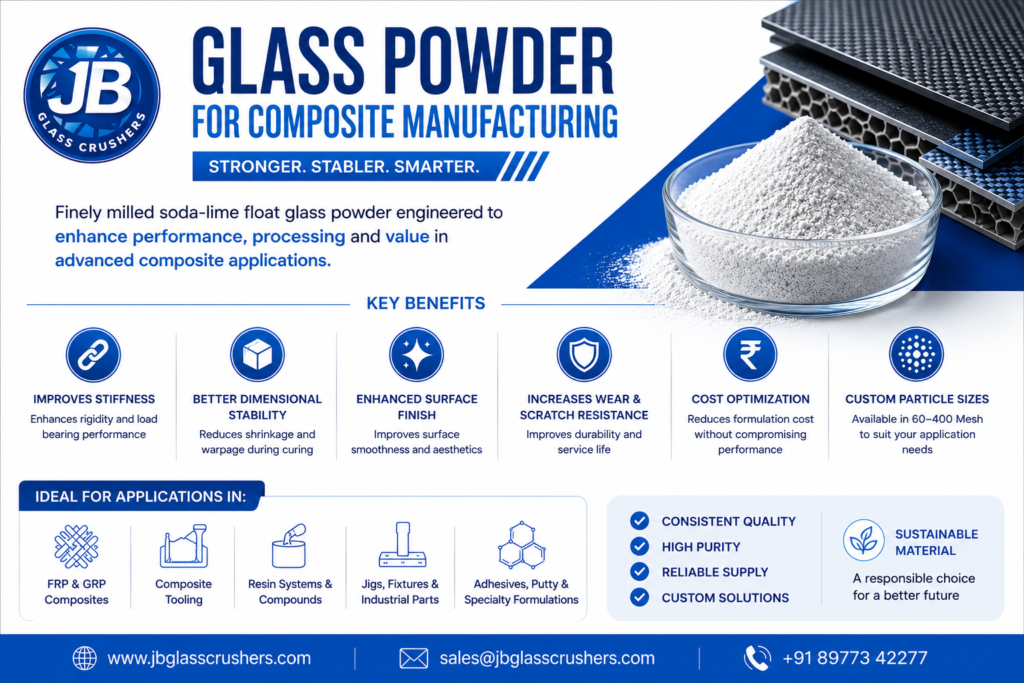
Composite materials combine a polymer matrix (epoxy, polyester, vinyl ester, polyurethane, etc.) with reinforcing fibers (glass, carbon, aramid) and functional fillers.
While fibers provide most of the structural strength, fillers are added to modify processing, mechanical performance, dimensional stability, surface finish, thermal behavior, and cost.
Soda-lime float glass powder is one such functional inorganic filler that can be evaluated in selected composite formulations. Its suitability depends on the resin system, filler loading, particle size distribution, and the performance targets of the final product. It is not a replacement for reinforcing fibers.
What is Glass Powder?
Glass powder is finely ground glass, typically produced from soda-lime float glass.
The material is:
- Hard
- Chemically stable
- Non-flammable
- High in silica
- Electrically insulating
- Compatible with many thermoset resin systems after formulation development.
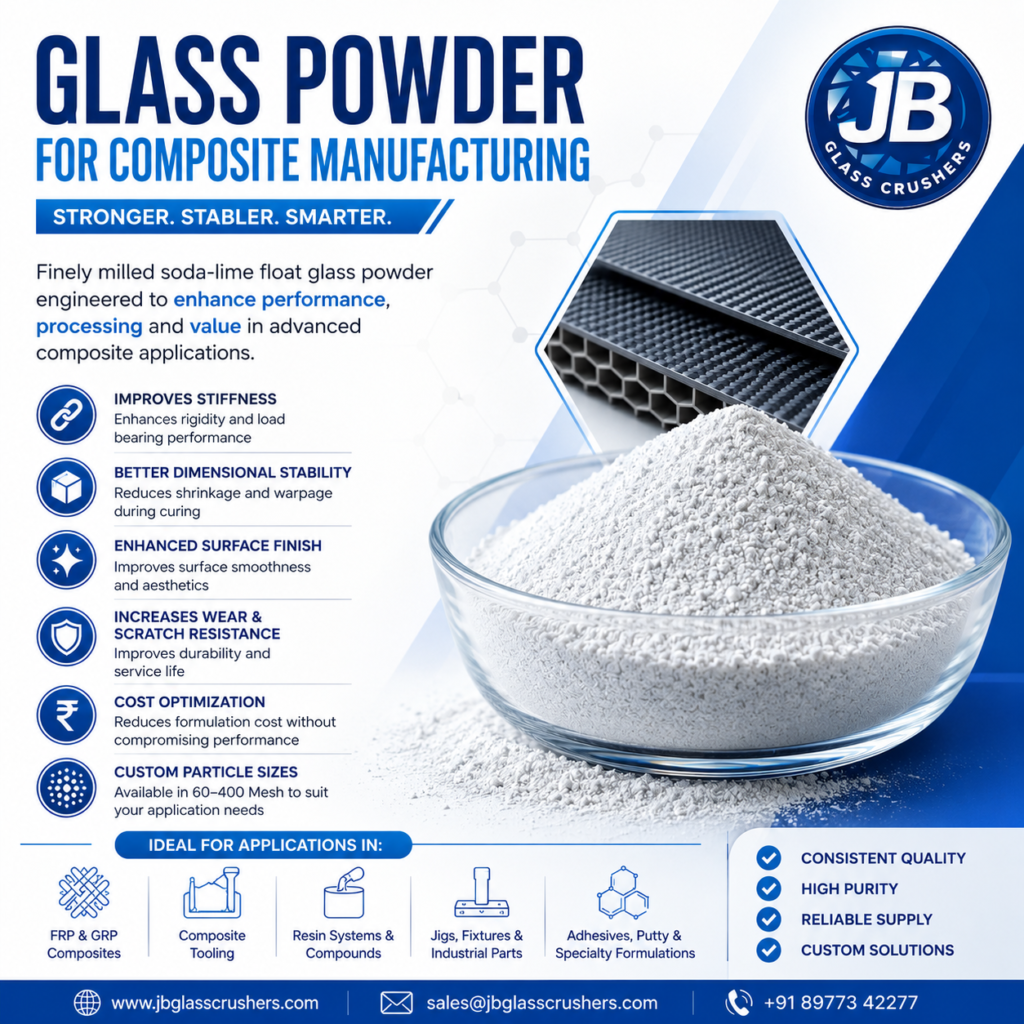
Where Does Glass Powder Fit in a Composite?
A typical FRP composite contains:
- Resin
- Reinforcement (glass fiber/carbon fiber)
- Catalyst
- Pigments
- Functional fillers
Glass powder belongs in the functional filler category.
It does not replace glass fiber or carbon fiber.
Instead, it modifies material behavior.
Potential Benefits
1. Cost Optimization
Glass powder may partially replace higher-cost mineral fillers in suitable formulations while maintaining target performance.
Possible replacement candidates include:
- Ground silica
- Quartz flour
- Calcium carbonate
- Talc
- Selected mineral fillers
The economic benefit depends on formulation and qualification testing.
2. Increased Stiffness
Rigid glass particles may increase composite stiffness in some resin systems.
Possible applications:
- FRP panels
- Industrial housings
- Electrical enclosures
- Machine covers
This benefit depends on filler loading and particle dispersion.
3. Better Dimensional Stability
Fine inorganic fillers can reduce resin shrinkage during curing.
Possible benefits:
- Better dimensional accuracy
- Reduced warpage
- Improved mould repeatability
Important for:
- Precision moulds
- Aerospace tooling
- Automotive composite parts
4. Improved Surface Finish
Fine particle size can:
- Fill micro-voids
- Improve packing density
- Produce smoother surfaces
Useful for:
- Decorative panels
- Tooling
- Gel-coat backed laminates
5. Increased Wear Resistance
Glass is significantly harder than most polymers.
Appropriate use may improve:
- Scratch resistance
- Abrasion resistance
- Surface durability
Applications include industrial panels and equipment covers.
6. Thermal Stability
Because glass is inorganic, it can improve dimensional stability at elevated temperatures in selected formulations.
It does not make a composite fireproof, but it can influence thermal behavior depending on the system.
7. Density Control
Glass powder allows formulators to adjust density and rheology alongside other fillers.
This is useful where weight, processing, and filler balance must be optimized.
Composite Industries That Could Evaluate Glass Powder
FRP Manufacturers
Potential uses:
- FRP tanks
- Pipes
- Gratings
- Cable trays
Aerospace Composite Tooling
Potential non-flight applications:
- Tooling boards
- Jigs
- Fixtures
- Mould compounds
Primary flight structures require extensive qualification and should not be assumed as a target without validation.
Automotive
Possible evaluation in:
- SMC/BMC systems
- Interior composite components
- Under-body panels
Wind Energy
Potential evaluation in:
- Composite moulds
- Tooling systems
Construction Composites
Possible uses:
- Artificial stone
- Polymer concrete
- Engineered panels
Importance of Particle Size
Particle size directly influences:
- Resin viscosity
- Packing density
- Surface finish
- Dispersion
- Mechanical properties
Typical ranges:
| Mesh | Approximate Size | Typical Purpose |
|---|---|---|
| 60–100 | Coarse | Heavy filled systems |
| 100–200 | Medium | General fillers |
| 200–300 | Fine | FRP and polymer systems |
| 300–400 | Very Fine | High-quality finishes |
Custom particle size distribution is often more valuable than a single mesh number because formulators optimize around rheology and performance.
Why Composite Manufacturers Should Evaluate It
Composite manufacturers continuously look for:
- Lower formulation cost
- Better processing
- Improved dimensional control
- Consistent filler quality
- Reliable supply
A consistent soda-lime float glass powder may help achieve these goals in selected formulations after laboratory validation.
Current Industry Trends
Recent research continues to explore glass-based fillers and particles for polymer composites, including:
- Improved particle dispersion
- Functional fillers for thermoset resins
- Glass-filled polymer systems
- Additive manufacturing with glass powders
- Hybrid composite materials.