
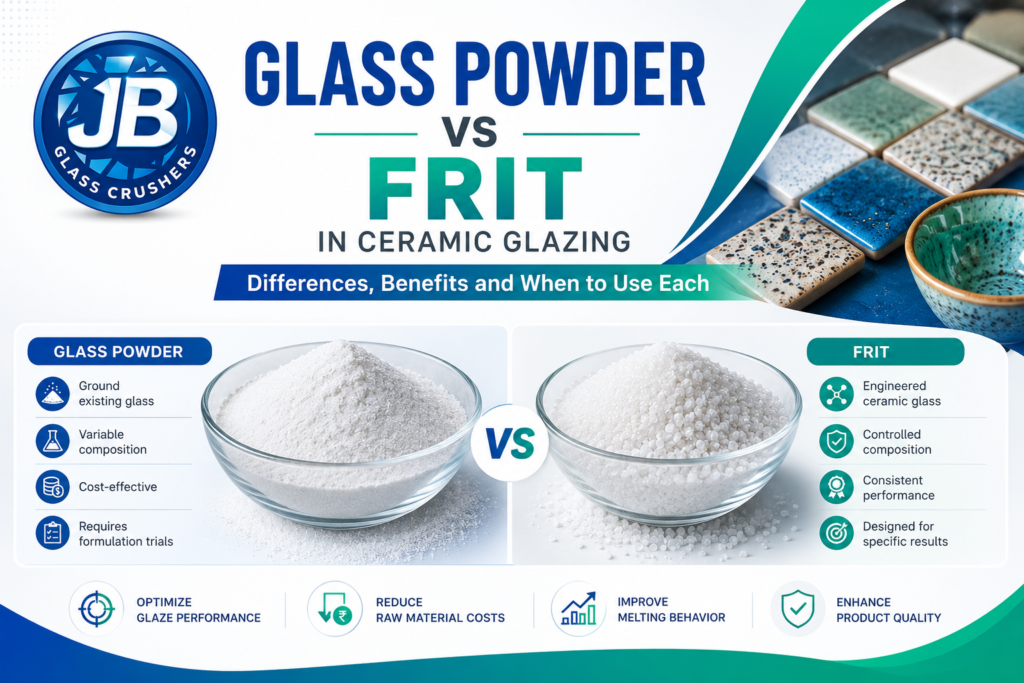
Ceramic manufacturers continuously look for ways to improve glaze performance while controlling raw-material and firing costs. Glass powder and ceramic frit can both contribute a glass-forming phase and fluxing action, but they are not equivalent materials.
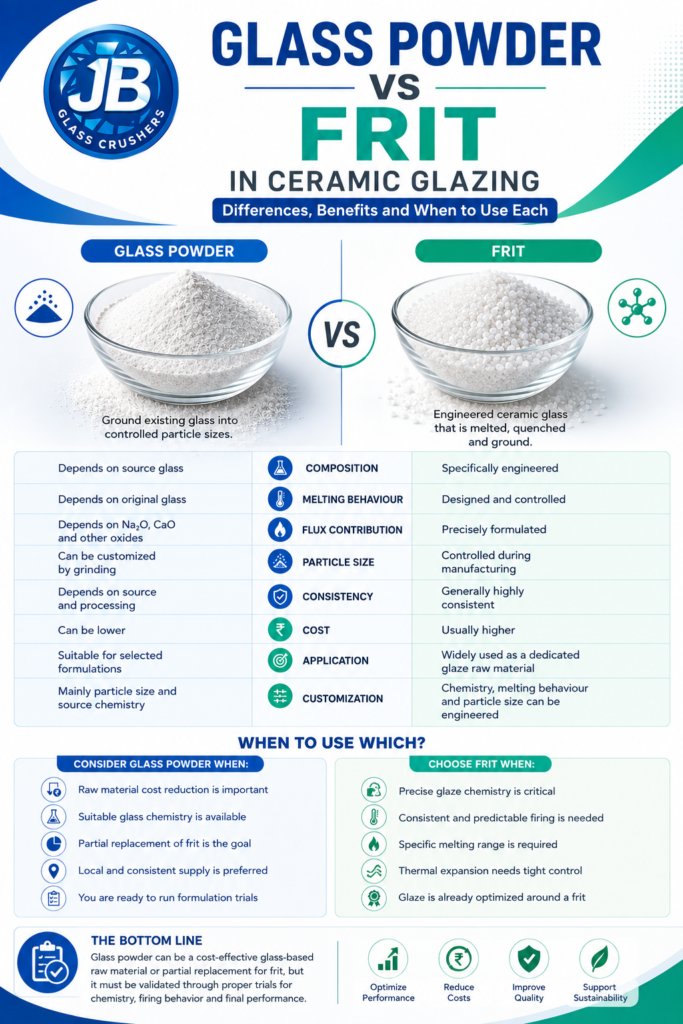
The key difference is that glass powder is generally ground existing glass, while frit is an engineered glass that has been formulated, melted, quenched and ground specifically for a particular ceramic application.
What Is Glass Powder?
Glass powder is finely ground glass produced by crushing and milling suitable glass into a controlled particle-size range.
For ceramic applications, the most important factors are:
- Chemical composition
- Particle-size distribution
- Colour
- Iron and other impurities
- Moisture
- Bulk density
- Thermal expansion
- Compatibility with the ceramic body and glaze
Fine grinding increases the available surface area and can influence how readily the material reacts during firing. Ceramic glaze raw materials are commonly processed to controlled particle sizes to promote a homogeneous melt and surface finish.
For soda-lime float glass powder, the glass itself already contains silica along with sodium, calcium and other oxides. These components can contribute to glass formation and fluxing during firing.
What Is Ceramic Frit?
Frit is a purpose-formulated glass. Raw materials are mixed, melted at high temperature, rapidly cooled or quenched, and then ground into a powder.
Unlike ordinary ground glass, frit is designed around a specific chemical composition and firing behaviour.
A frit may be formulated to provide:
- Controlled melting behaviour
- Specific firing-temperature characteristics
- Desired gloss or matt finish
- Opacity or transparency
- Controlled thermal expansion
- Specific colour response
- Chemical durability
- Compatibility with a particular ceramic body
This controlled composition is one of the major reasons frit is widely used in industrial ceramic glazes.
Glass Powder vs Frit: Key Differences
| Property | Glass Powder | Ceramic Frit |
|---|---|---|
| Origin | Ground existing glass | Purpose-formulated and manufactured glass |
| Composition | Depends on source glass | Specifically engineered |
| Melting behaviour | Depends on original glass chemistry | Designed and controlled |
| Flux contribution | Depends on Na₂O, CaO and other oxides present | Precisely formulated |
| Particle size | Can be customized by grinding | Controlled during frit milling |
| Consistency | Depends on source and processing | Generally highly consistent |
| Cost | Can be lower | Usually higher due to formulation and melting process |
| Application | Suitable for selected glaze/body formulations | Widely used as a dedicated glaze raw material |
| Customization | Mainly particle size and source chemistry | Chemistry, melting behaviour and particle size can all be engineered |
| Technical development | Requires formulation trials | Established frit chemistry can simplify formulation |
Frits offer a particularly high degree of compositional control because their constituent oxides have already been melted together before entering the glaze formulation.
Can Glass Powder Replace Frit?
Sometimes—but not as a universal one-to-one replacement.
This is an important distinction for ceramic manufacturers.
A standard soda-lime glass powder does not automatically have the same chemistry or melting behaviour as a commercial ceramic frit.
A frit may contain carefully controlled levels of:
- SiO₂
- Al₂O₃
- Na₂O
- K₂O
- CaO
- ZnO
- B₂O₃
- ZrO₂
- Other oxides
depending on the desired glaze.
Therefore, replacing a frit with ordinary glass powder should be treated as a formulation-development exercise, not simply a weight-for-weight substitution.
The glaze manufacturer needs to evaluate the resulting chemistry, firing behaviour, thermal expansion, surface appearance and defects.
Where Glass Powder Can Offer an Advantage
1. Potential raw-material cost reduction
One of the biggest reasons to investigate glass powder is cost optimization.
Frit is a manufactured, engineered product involving raw-material blending, high-temperature melting, quenching and grinding. Glass powder produced from suitable glass feedstock can potentially provide a lower-cost glass-forming/fluxing input.
Frit’s higher cost is one of the commonly recognized disadvantages compared with less processed raw materials.
For a large ceramic manufacturer, even a partial substitution can therefore justify technical trials.
2. Additional glass-forming phase
Glass powder already exists in an amorphous glassy state. During firing, it can soften and participate in the developing glaze melt.
Its effectiveness depends strongly on its chemistry and particle size.
3. Controlled particle size
Fine glass powder can be produced in different mesh ranges.
For example, manufacturers can evaluate:
- 100–150 mesh
- 150–200 mesh
- 200–300 mesh
- 300–325 mesh
The appropriate size depends on the formulation and processing conditions.
Finer particles generally offer greater surface area, which can influence reaction and melting behaviour.
4. Potential firing-temperature benefits
Because glass is already in an amorphous state, suitable glass compositions can contribute to formation of a liquid/glassy phase during firing.
However, the actual firing-temperature reduction must be demonstrated through trials. It cannot be guaranteed simply because the material is glass.
Frits are specifically engineered to melt predictably within a targeted firing range, which is one reason they are valuable in low- and mid-temperature glaze systems.
Where Frit Has an Advantage
Frit has a major advantage when the manufacturer needs precise chemistry and predictable firing behaviour.
A frit manufacturer can design the composition around the desired:
- Melting range
- Thermal expansion
- Gloss
- Opacity
- Colour response
- Chemical resistance
- Surface quality
For example, the thermal expansion relationship between glaze and ceramic body is critical. Poor compatibility can contribute to defects such as crazing or adhesion problems.
This is why a ceramic manufacturer should not assume that a low-cost glass powder will automatically perform like an established commercial frit.
Glass Powder as a Partial Frit Replacement
For many manufacturers, the most interesting opportunity may be partial replacement rather than complete replacement.
Instead of replacing 100% of the frit, the formulation team can investigate whether a percentage of the frit or another glass-forming/fluxing raw material can be replaced with suitable glass powder.
For example, an R&D team could compare:
Existing formulation
Frit + feldspar + quartz + kaolin + zircon + other additives
against
Trial formulation
Reduced frit + glass powder + feldspar + quartz + kaolin + zircon + other additives
The exact percentage should be established experimentally rather than assumed.
The trial should evaluate:
- Firing behaviour
- Gloss
- Whiteness
- Opacity
- Surface smoothness
- Pinholes
- Blisters
- Crawling
- Crazing
- Adhesion
- Water absorption
- Chemical resistance
- Thermal expansion
Why Particle Size Matters
Particle size is especially important when evaluating glass powder.
A coarse powder may react differently from an ultrafine powder during firing.
As particle size decreases, surface area increases, potentially increasing interaction with the surrounding glaze components. Ceramic glaze references also note that finer raw materials can affect glaze melting and surface characteristics.
However, finer is not automatically better.
An excessively fine powder may affect:
- Slurry rheology
- Suspension
- Water demand
- Milling behaviour
- Application thickness
- Drying
- Melt behaviour
Therefore, the correct particle-size distribution should be established through application trials.
Glass Powder vs Frit: Which Is Better?
There is no universal winner.
Choose frit when:
- Very precise glaze chemistry is required
- Consistent firing behaviour is critical
- A specific melting range is required
- Thermal expansion needs tight control
- The glaze is already optimized around a particular frit
- Colour/opacity requirements are highly specific
Investigate glass powder when:
- Raw-material cost reduction is important
- A suitable glass chemistry is available
- The manufacturer is willing to conduct formulation trials
- Partial replacement is being considered
- A locally available glass source can provide consistent quality
- The manufacturer wants to develop an alternative flux/glass-forming raw material
The Most Important Point for Ceramic Manufacturers
Glass powder should not be marketed simply as “cheap frit.”
That positioning can create the wrong expectation.
A better technical position is:
“Glass powder is a cost-effective glass-based raw material that can be evaluated as a flux or partial replacement component in selected ceramic glaze formulations.”
This is more technically accurate because frit is an engineered glass composition, whereas ordinary ground glass depends on the chemistry of the source glass.
Frit manufacturers deliberately engineer the glass composition for specific glaze behaviour, while glass powder suppliers can focus on consistent source material, chemical control and particle-size distribution.
Conclusion
Glass powder and ceramic frit are related but different materials.
Frit provides engineered chemistry and predictable firing behaviour, making it particularly valuable for demanding ceramic glaze formulations. Glass powder can offer a potentially lower-cost glass-based raw material, especially where its chemistry is compatible with the glaze and the manufacturer is willing to optimize the formulation.
For ceramic manufacturers, the most commercially attractive approach is often not to ask:
“Can glass powder completely replace frit?”
but rather:
“Can a suitable glass powder partially replace existing glass/frit or flux components while maintaining glaze quality and reducing formulation cost?”
That question can be answered through controlled laboratory trials involving chemistry, particle size, firing temperature, surface finish and final glaze performance.