
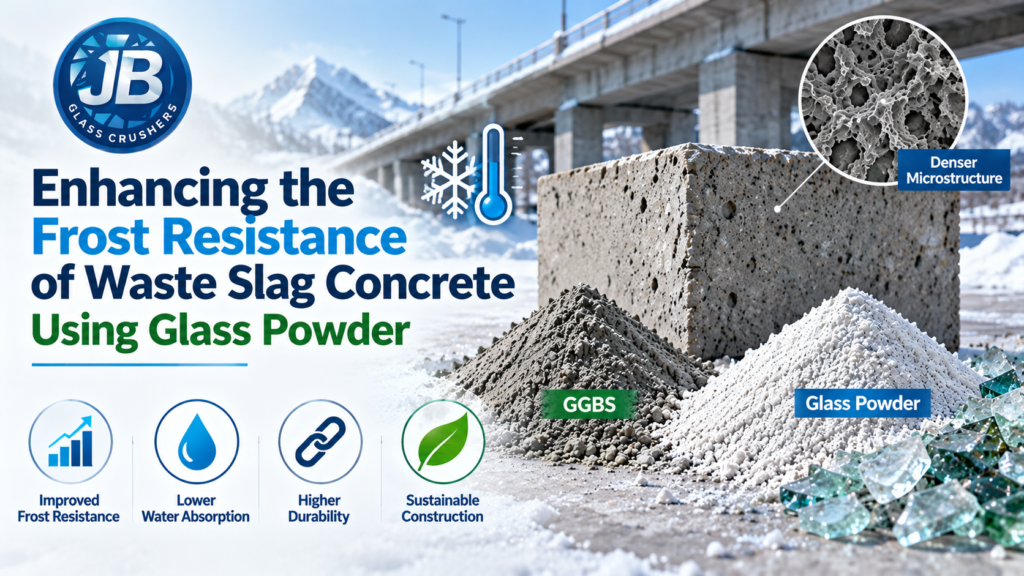
Concrete durability is essential for maintaining the strength, safety and service life of infrastructure exposed to challenging environmental conditions. In regions that experience freezing temperatures, repeated freeze–thaw cycles can gradually damage concrete, causing surface deterioration, cracking, mass loss and reductions in mechanical strength.
Researchers are investigating ways to improve concrete durability while reducing dependence on conventional cementitious materials. One promising area combines ground granulated blast-furnace slag (GGBFS) with finely ground glass powder to develop alternative binder systems.
Glass powder contains silica and other oxides that may contribute to the chemical reactions and microstructure development of suitable cement-based and alkali-activated materials. Depending on the formulation, it can help refine pore structure, reduce water absorption and improve resistance to frost-related damage.
Enhancing the frost resistance of waste slag concrete using glass powder is therefore an important research topic for sustainable construction, particularly where concrete must withstand repeated freezing and thawing.
This article examines how glass powder may influence slag-based concrete, the mechanisms behind improved frost resistance, relevant research findings and the material properties that should be evaluated before selecting glass powder for construction applications.
1. Understanding Waste Slag Concrete
Ground granulated blast-furnace slag is a finely ground industrial by-product obtained from iron production. It contains reactive constituents that can contribute to the development of binding materials when used in appropriate cementitious or alkali-activated systems.
Slag is widely investigated as a partial replacement for Portland cement and as a primary precursor in alkali-activated materials.
Depending on the formulation, slag-based concrete can offer useful mechanical properties and durability characteristics. Its performance, however, depends on factors such as slag composition, fineness, activator chemistry, water content, curing conditions and the intended application.
In alkali-activated concrete, slag reacts with a suitable alkaline activator to form binding products that hold the aggregate together.
Introducing glass powder into this system changes the overall composition of the binder. The resulting performance depends on how the glass interacts with the slag and the other mixture constituents.
2. Why Is Frost Resistance Important?
Frost resistance describes a material’s ability to withstand damage caused by repeated freezing and thawing.
Concrete contains pores that may hold water. When temperatures fall below freezing, water within the pore system can freeze and contribute to internal stresses. Repeated cycles can cause progressive deterioration, especially when the concrete is highly saturated or has an unsuitable pore structure.
Common indicators of freeze–thaw damage include:
- Surface scaling and spalling.
- Progressive cracking.
- Loss of specimen mass.
- Reduced compressive strength.
- Declining dynamic elastic modulus.
- Changes in the internal pore structure.
The severity of damage depends on several factors, including pore size and connectivity, moisture conditions, concrete composition and the number of freeze–thaw cycles.
Improving frost resistance therefore requires more than achieving high initial compressive strength. The internal structure must also be capable of limiting water-related damage during repeated temperature changes.
3. How Can Glass Powder Improve Frost Resistance?
Glass powder can influence the physical and chemical characteristics of suitable binder systems.
Its effect depends on the source glass, particle-size distribution, chemical composition, replacement percentage and processing conditions.
3.1 Improving particle packing
Finely ground particles can fill spaces between larger particles when their size distribution is suitable.
Improved packing may reduce the volume of some voids and help create a more compact hardened matrix.
A denser structure can limit water penetration, although the actual effect must be confirmed through porosity, water-absorption and durability testing.
3.2 Contributing reactive silica
Many common glass types contain substantial amounts of silica. Under suitable chemical conditions, some of this silica can participate in reactions within cementitious or alkali-activated systems.
In Portland-cement-based materials, reactive glass powder may contribute to pozzolanic reactions and the formation of additional calcium silicate hydrate (C-S-H).
In alkali-activated slag systems, the reaction products and mechanisms differ according to the binder chemistry. The glass powder may act as a supplementary precursor, but its reactivity depends on the specific formulation.
3.3 Refining pore structure
The distribution, size and connectivity of pores strongly influence the movement of water through hardened concrete.
If glass powder helps create a denser microstructure with reduced water absorption, it may improve resistance to freeze–thaw damage.
However, total porosity alone does not determine frost resistance. Pore-size distribution, connectivity, saturation and other material characteristics must also be considered.
3.4 Supporting long-term durability
A suitable glass powder formulation may reduce the rate at which concrete deteriorates under repeated freezing and thawing.
The outcome depends on the interaction between the glass powder, slag, activator and curing conditions. Long-term performance must therefore be demonstrated through appropriate durability tests rather than inferred from compressive strength alone.
4. What Does Recent Research Show?
Recent studies have investigated glass powder in several types of concrete, including alkali-activated slag systems, pervious concrete and conventional cement-based mixtures.
These studies provide useful evidence, although their results must be interpreted in the context of the materials and experimental conditions used.
Research on alkali-activated slag concrete
A 2026 study published in Cold Regions Science and Technology examined waste glass powder as a supplementary precursor in alkali-activated concrete based on ground granulated blast-furnace slag.
The researchers compared different glass powder contents and assessed compressive strength, capillary water absorption, pore structure and freeze–thaw durability.
For the mixture containing 15% glass powder, the study reported:
- An 11.1% increase in 28-day compressive strength compared with the control.
- A 15.8% reduction in capillary water absorption.
- A 15.5% reduction in porosity.
- A 29.2% increase in the frost durability index.
- After 300 freeze–thaw cycles, a 25.2% lower compressive-strength loss rate and a 20.8% lower mass-loss rate.
The authors associated the improved performance with pore refinement and reduced water absorption. Within the formulations investigated, 15% was identified as the optimum glass powder content.
These results are promising, but they apply to the specific alkali-activated system studied. They should not be treated as guaranteed outcomes for every slag concrete or industrial glass powder.
Research on pervious concrete
A 2024 study published in the Journal of Wuhan University of Technology—Materials Science Edition examined waste glass powder in pervious concrete.
The researchers investigated glass powder replacement levels of 0%, 10%, 15%, 20% and 25%, alongside different water-to-binder ratios.
The study reported that a mixture containing 20% glass powder and a water-to-binder ratio of 0.26 performed best in the investigated freeze–thaw tests after 100 cycles.
The researchers also observed a reduction in pore volume in the hardened paste containing 20% glass powder compared with the reference cement system.
This study demonstrates that the preferred glass powder content can vary with the concrete type and mixture proportions.
Research on conventional concrete
Other research has investigated glass powder as a partial replacement for cement in conventional concrete.
A 2018 study reported lower mass loss after 50 freeze–thaw cycles for concrete containing glass powder than for its reference concrete.
The findings support the potential of suitably formulated glass-containing concrete to improve durability under selected conditions.
Nevertheless, differences in binder chemistry, glass composition, water-to-binder ratio and test procedures make direct comparisons between studies difficult.
5. Why Does Glass Powder Content Matter?
The amount of glass powder added to concrete can significantly affect its performance.
At an appropriate replacement level, glass powder may improve particle packing and contribute to beneficial chemical reactions.
However, increasing the replacement level does not necessarily produce continuous improvements.
Excessive replacement can alter the availability of reactive components, change the binder chemistry or affect the hardened material’s microstructure.
The optimum percentage depends on several factors:
- The chemical composition of the glass.
- The properties and reactivity of the slag.
- The particle-size distributions of the binder constituents.
- The type and concentration of the alkaline activator.
- The water-to-binder ratio.
- The curing temperature and duration.
- The required strength and durability performance.
For this reason, glass powder replacement levels should be established through mix design and testing.
The 15% level reported in the 2026 alkali-activated concrete study is a useful research finding, not a universal specification.
6. Material Properties That Influence Performance
Selecting glass powder for slag concrete requires evaluating the properties that matter for the intended binder system.
Chemical composition
Glass composition influences the amount of silica and other oxides available in the material.
Depending on the application, testing may be required for silica, sodium oxide, calcium oxide, aluminium oxide and other relevant constituents.
Chemical composition should be assessed rather than assumed from the visual appearance or source of the glass.
Particle-size distribution
Particle size influences packing, surface area and potential reaction behaviour.
A nominal mesh grade provides useful information, but it does not describe the entire distribution of particle sizes.
Depending on the research requirements, measurements such as D10, D50 and D90 may be needed to understand the material more completely.
Moisture content
Moisture affects material handling and may influence the accuracy of water and binder proportions in a mix.
The acceptable moisture level depends on the formulation and the customer’s requirements.
Contamination control
Foreign particles and contaminants may affect binder chemistry or product consistency.
Testing requirements should be determined by the intended application and the composition of the starting material.
Batch consistency
Consistent material properties help researchers and concrete manufacturers reproduce mixture proportions and compare performance between batches.
For applications involving freeze–thaw durability, reliable specifications are particularly important because differences in material composition can affect water absorption, strength development and pore structure.
7. How Is Frost Resistance Evaluated?
Compressive strength is an important measurement, but it does not independently establish frost resistance.
A suitable experimental programme should examine both mechanical performance and changes caused by repeated freeze–thaw exposure.
Common evaluation methods include the following.
Mass loss: Measures the change in specimen mass after exposure to freeze–thaw cycles. Greater mass loss can indicate surface deterioration or material damage.
Compressive-strength loss: Compares compressive strength before and after exposure to assess changes in load-bearing capacity.
Relative dynamic elastic modulus: Helps identify changes in the internal condition of the material through repeated measurements.
Water absorption: Evaluates the material’s tendency to take up water, which is relevant to its exposure conditions.
Pore structure analysis: Techniques such as nuclear magnetic resonance or X-ray computed tomography can help researchers investigate changes in pore structure and internal damage.
Visual inspection: Identifies cracking, scaling and other visible forms of deterioration.
Testing should follow an appropriate recognised procedure for the concrete type and intended service conditions.
The number of freeze–thaw cycles, moisture conditioning and acceptance criteria should be defined before comparing different formulations.
8. Potential Applications of Frost-Resistant Slag Concrete
Glass-modified slag concrete may be relevant to applications where the binder system can meet the required mechanical and durability specifications.
Potential areas of investigation include:
- Precast concrete products.
- Paving and selected external concrete components.
- Industrial flooring.
- Masonry and construction units.
- Infrastructure in cold environments.
- Specialised alkali-activated construction materials.
Suitability must be established for each application. A mixture that performs well in laboratory freeze–thaw tests may still require additional evaluation for abrasion, shrinkage, chemical exposure, water penetration and long-term field performance.
In addition, pervious concrete and dense structural concrete have different pore structures and performance requirements. Findings from one type should not automatically be applied to another.
9. How Glass Powder Manufacturers Can Support Construction Research
Reliable material specifications are important when glass powder is used in advanced construction formulations.
Suppliers can support researchers and manufacturers by providing information about the glass source, available grades and tested material properties.
Depending on the application, useful documentation may include:
- Glass type and source.
- Chemical composition, where tested.
- Nominal mesh grade.
- Measured particle-size distribution.
- Moisture content.
- Colour and visible contamination.
- Batch identification and consistency.
These details help customers determine whether a particular material is suitable for further evaluation.
For Jai Bhavani Glass Crushers, the relevant opportunity is to supply industrial glass powder against defined technical requirements. Any use in slag-based concrete or alkali-activated materials should be validated through appropriate laboratory trials.
The performance results from published studies should not be presented as guaranteed results for a supplier’s material unless that material has been independently tested under comparable conditions.
10. Frequently Asked Questions
What is frost resistance in concrete?
Frost resistance is the ability of concrete to withstand damage from repeated freezing and thawing. It is influenced by pore structure, moisture conditions, binder composition and the material’s overall durability.
Can glass powder improve the frost resistance of slag concrete?
Research indicates that suitably formulated glass powder can improve frost resistance in certain slag-based concrete systems. The outcome depends on the glass powder, slag, mixture proportions, curing conditions and test procedure.
What percentage of glass powder should be used?
There is no universally optimal percentage. A 2026 study identified 15% as the optimum for its investigated alkali-activated slag concrete, while a separate study of pervious concrete reported the best performance at 20% under its tested conditions.
Why does water absorption matter for frost resistance?
Water within concrete pores can contribute to internal stresses during freezing. Reducing water absorption may help limit damage, but frost resistance also depends on pore structure, moisture saturation and other material characteristics.
Is higher compressive strength enough to prove frost resistance?
No. A concrete mixture can have high initial compressive strength but still experience freeze–thaw damage. Durability should be assessed using suitable freeze–thaw testing and relevant measurements of strength loss, mass loss and material deterioration.
Can industrial glass powder be used directly in slag concrete?
Suitability depends on its chemical composition, particle-size distribution, contamination levels and the requirements of the mixture. Laboratory mix design and performance testing are necessary before commercial use.
Conclusion
Enhancing the frost resistance of waste slag concrete using glass powder is a promising area of construction-material research.
Experimental studies indicate that appropriately formulated glass powder can improve selected mechanical and durability properties by influencing water absorption and the pore structure of hardened materials.
However, the best-performing replacement level depends on the concrete system and the properties of the constituent materials. Results from alkali-activated slag concrete cannot automatically be applied to conventional cement concrete or pervious concrete.
Successful application requires consistent raw materials, suitable mix design, controlled curing and systematic durability testing.
For construction-material manufacturers, this research highlights the importance of selecting glass powder according to measurable technical specifications rather than relying on mesh size alone.
Jai Bhavani Glass Crushers supplies industrial glass powder for customers evaluating materials for construction and other industrial applications. The suitability of a particular grade for slag concrete or frost-resistant formulations should be confirmed through application-specific testing.
Contact Jai Bhavani Glass Crushers
- Location: Hyderabad, Telangana, India
- Website: jbglasscrushers.com
- Phone: +91 89773 42277
- Email: info@jbglasscrushers.com
Technical disclaimer: Reported improvements in strength and frost resistance relate to the specific formulations and test conditions described in the cited research. They are not guaranteed performance claims for every glass powder or concrete mixture.