
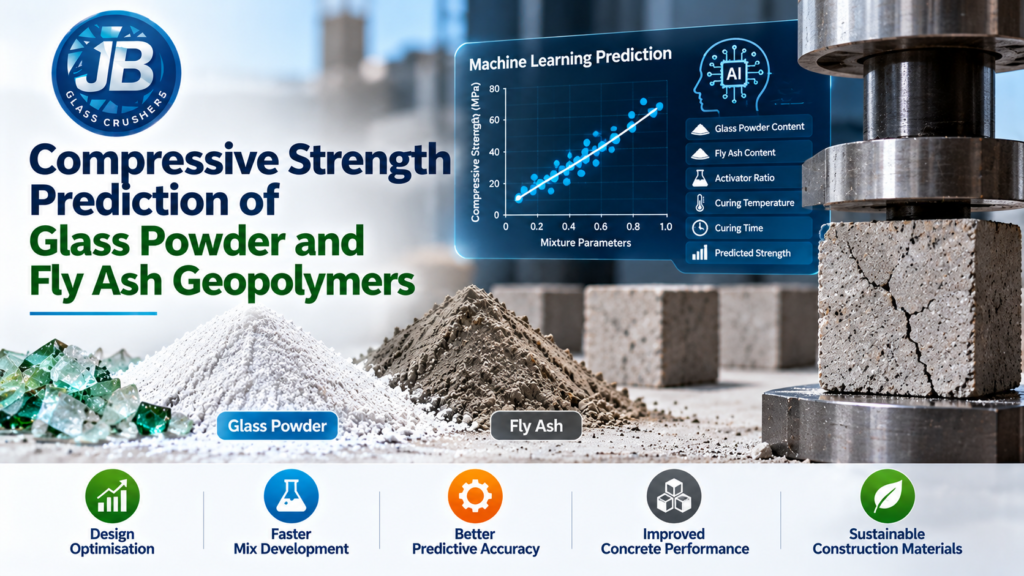
The construction industry is increasingly exploring alternative binder materials that can reduce reliance on conventional Portland cement while maintaining the mechanical performance required for modern construction. Geopolymers produced using industrial by-products such as fly ash are one area attracting significant research interest.
Glass powder is also being investigated as a supplementary material in geopolymer formulations. Depending on its composition, fineness and proportion in the mixture, glass powder can influence workability, reaction chemistry, microstructure and compressive strength.
However, determining the strength of a geopolymer is not straightforward. Its performance depends on several interacting factors, including the chemical composition of the raw materials, particle-size distribution, alkaline activator concentration, water content, curing temperature and curing duration.
This has created interest in machine learning models for predicting the compressive strength of glass powder and fly ash geopolymers.
By analysing experimental data, predictive models can help researchers identify influential mixture parameters, estimate potential strength and investigate promising formulations before conducting extensive laboratory testing.
For industrial glass powder manufacturers, this research also highlights why consistent material specifications and reliable quality control matter when supplying materials for advanced construction applications.
1. What Are Glass Powder and Fly Ash Geopolymers?
Geopolymers are inorganic binder materials formed through chemical reactions involving suitable aluminosilicate-rich precursors and alkaline activators.
Fly ash, a by-product of coal combustion in power plants, is commonly investigated as a precursor because it can contain reactive silica and alumina. Its suitability depends on its source, chemical composition, particle characteristics and mineralogical properties.
Glass powder contains substantial silica in many common glass types. When suitably processed and incorporated into an appropriate alkaline system, some glass powders can contribute to geopolymer formation and influence the resulting microstructure.
A glass powder and fly ash geopolymer mixture may contain:
- Fly ash as a primary aluminosilicate precursor.
- Glass powder as a partial replacement or additional reactive material.
- An alkaline activator, such as sodium hydroxide and sodium silicate.
- Water, according to the requirements of the mixture.
- Other supplementary materials, where specified by the formulation.
The final properties depend on how these constituents interact. Simply combining fly ash and glass powder does not guarantee a high-strength geopolymer.
2. Why Is Compressive Strength Important?
Compressive strength measures a material’s ability to withstand compressive loading before failure. It is one of the most important mechanical properties assessed when evaluating construction binders and concrete-like materials.
For geopolymer formulations, compressive strength can provide information about the effectiveness of the reaction process and the structure of the hardened material.
Strength testing is relevant when developing:
- Precast construction products.
- Masonry units and blocks.
- Geopolymer concrete and mortar.
- Industrial flooring and selected construction components.
- Specialised binders for applications requiring defined mechanical properties.
The required strength depends on the intended product, applicable standards and service conditions.
Compressive strength alone does not establish complete suitability. Durability, dimensional stability, water absorption, shrinkage, chemical resistance and other properties may also need evaluation.
3. How Does Glass Powder Influence Geopolymer Strength?
Glass powder can affect geopolymer performance through several mechanisms. The extent of each effect depends on the glass composition, particle size and mixture design.
3.1 Chemical contribution
Many common glass types contain silica, which can participate in reactions within an alkaline environment.
When the glass has suitable characteristics and the formulation provides appropriate reaction conditions, glass-derived silica may contribute to the formation of binding phases.
However, the amount of silica reported in a chemical analysis is not the same as the amount that will react under a given set of conditions. Reactivity depends on several factors, including glass structure, fineness and the chemistry of the activating solution.
3.2 Particle packing and microstructure
Fine particles may help fill spaces between larger particles, potentially improving packing and reducing some voids in the hardened material.
The resulting effect depends on the particle-size distribution of all the mixture constituents, not just the glass powder.
A well-designed particle distribution may support a denser microstructure, whereas unsuitable proportions or poor processing may produce a less favourable structure.
3.3 Influence of glass replacement level
Replacing part of the fly ash with glass powder changes the overall chemical and physical composition of the mixture.
A moderate replacement level may be beneficial in a particular formulation. Excessive replacement, however, may reduce the availability of reactive alumina or otherwise disrupt the chemistry needed for effective geopolymerisation.
The optimum replacement percentage therefore needs to be established for the actual materials and curing conditions.
3.4 Effect of particle fineness
Particle fineness can influence the surface area available for reaction.
In a study published in the Journal of Cleaner Production in 2018, researchers investigated high-calcium fly ash geopolymers containing finely ground fluorescent-lamp glass or container glass. They reported 7-day compressive strengths ranging from approximately 33 to 48 MPa across the investigated mixtures.
For the container-glass series, a 20% replacement level produced a reported strength of 47.6 MPa, compared with 45.7 MPa for the reference paste. The best-performing formulation depended on the glass type and replacement level.
These findings demonstrate that glass powder can be useful in some geopolymer formulations, but they do not establish a universal optimum for all glass powders or fly ashes.
4. Why Is Predicting Compressive Strength Challenging?
Traditional strength assessment relies on preparing specimens, curing them under controlled conditions and testing them at specified ages.
Although this approach is essential for validating performance, it can require considerable time and resources when many mixture combinations are being investigated.
The challenge is that geopolymer strength is influenced by multiple interacting variables.
Raw-material chemistry
The proportions of silica, alumina, calcium and other constituents influence the reaction pathways and the properties of the hardened material.
Glass powder replacement percentage
The proportion of glass powder changes the overall composition and may influence both physical packing and chemical reactivity.
Alkaline activator concentration
Activator chemistry affects the dissolution of reactive constituents and the development of binding phases.
Liquid-to-binder ratio
The amount of liquid influences workability and the pore structure that develops as the material hardens.
Curing conditions
Temperature, humidity and curing duration can influence reaction rates and the development of strength.
Specimen age
Compressive strength changes over time as reactions continue and the microstructure develops.
Because these variables interact, simple equations may not adequately represent the behaviour of every mixture. Predictive modelling provides another way to investigate these relationships.
5. How Machine Learning Predicts Geopolymer Compressive Strength
Machine learning is a data-analysis approach that identifies patterns in datasets and uses those patterns to make predictions for new observations.
For geopolymer research, a model can be trained using experimental records containing mixture proportions, material properties, curing conditions and measured compressive strength.
Once trained and validated, the model can estimate strength for candidate mixtures within the range represented by its training data.
A typical workflow involves five stages.
Stage 1: Collect experimental data
Researchers assemble records from laboratory tests or suitable published studies.
Each record should include the input variables required for prediction and a clearly defined compressive-strength measurement.
Differences in specimen geometry, curing procedures and testing methods need to be considered before combining data from multiple sources.
Stage 2: Select input variables
Potential input features include:
- Fly ash content.
- Glass powder content.
- Silica and alumina composition.
- Calcium oxide content.
- Alkaline activator concentration.
- Sodium silicate-to-sodium hydroxide ratio.
- Liquid-to-binder ratio.
- Curing temperature.
- Curing duration.
- Specimen age.
The appropriate variables depend on the data available and the intended prediction task.
Stage 3: Train predictive models
Researchers may compare several algorithms, including:
Random Forest: Combines predictions from multiple decision trees and can model nonlinear relationships.
Support Vector Regression: Uses statistical learning methods to estimate continuous outcomes.
Gradient Boosting: Builds an ensemble of predictive models sequentially to improve performance.
XGBoost: A gradient-boosting implementation that can model complex relationships in structured datasets.
Artificial Neural Networks: Learn patterns through interconnected computational units and may be useful when sufficient representative data are available.
No algorithm is automatically best for every dataset. Model performance depends on data quality, sample size, variable selection, validation strategy and parameter tuning.
Stage 4: Evaluate prediction accuracy
Predicted strength values must be compared with measured laboratory results using appropriate validation methods.
Common evaluation metrics include:
- R²: Indicates how well predictions explain variation in the observed data.
- Mean Absolute Error (MAE): Measures the average absolute difference between predicted and observed values.
- Root Mean Square Error (RMSE): Measures prediction error while giving greater weight to larger errors.
A model should be evaluated on data that were not used to train it. Where multiple records originate from the same experimental programme, the validation strategy should avoid placing closely related observations in both the training and test sets.
Otherwise, reported accuracy may overstate how well the model generalises to genuinely new mixtures.
Stage 5: Interpret the results
Interpretability methods can help identify which variables contribute most strongly to model predictions.
For example, researchers may investigate whether activator concentration, glass powder proportion, silica content or curing age is associated with higher or lower predicted strength.
These findings can guide further experiments, but feature importance does not by itself prove that changing a particular variable will cause a corresponding improvement.
6. What Does Published Research Demonstrate?
Research supports both the investigation of glass powder in fly ash geopolymers and the use of machine learning to predict geopolymer strength.
A 2018 study in the Journal of Cleaner Production examined glass powder as a partial replacement for high-calcium fly ash. The researchers reported that selected formulations achieved 7-day compressive strengths comparable to, or higher than, the reference paste.
A separate 2024 study investigated the temperature-dependent compressive strength of geopolymer blocks made using fly ash, glass powder and steel slag. It compared multiple machine learning techniques and reported an R² of approximately 0.95 for its best-performing support vector regression model under the study’s evaluation procedure.
These studies address related but different questions:
- The first investigates the experimental behaviour of glass powder and fly ash geopolymer pastes.
- The second examines strength prediction for geopolymer blocks containing additional materials and exposed to elevated temperatures.
Their results should not be treated as interchangeable because the material compositions, test conditions and prediction tasks differ.
Together, they illustrate how laboratory testing and computational modelling can complement one another in geopolymer development.
7. How Can Predictive Models Help Optimise Glass Powder Formulations?
A validated model can help researchers investigate how different mixture parameters relate to compressive strength.
For example, a research team could use a model to compare candidate formulations containing different proportions of glass powder, fly ash and alkaline activator.
The model may help narrow the range of formulations selected for laboratory testing.
Potential benefits include:
Faster preliminary screening: Researchers can estimate the likely performance of candidate mixtures before preparing every formulation.
More targeted experiments: Sensitivity analysis can help identify variables that deserve closer investigation.
Reduced trial-and-error: Predictive tools may help prioritise promising formulations for physical testing.
Better understanding of interactions: Nonlinear models can capture relationships that simple linear equations may miss.
Support for material optimisation: Predictions can help researchers balance strength, workability, curing requirements and material consumption.
Nevertheless, machine learning does not eliminate laboratory validation. Predictions should not be used as the sole basis for structural design, safety decisions or product certification.
8. What Should Industrial Glass Powder Manufacturers Consider?
The performance of glass powder in geopolymer formulations depends on the properties of the actual material supplied.
For industrial glass powder manufacturers, consistency and traceability can be important when customers are developing construction binders or conducting controlled research.
Relevant material characteristics may include:
Chemical composition
The silica content and levels of other oxides can influence how a glass powder behaves in an alkaline binder system.
A chemical analysis is preferable to assuming that all glass powders have identical compositions.
Particle-size distribution
Particle size affects packing, surface area and potentially reaction behaviour.
A nominal mesh grade provides useful information, but researchers may also require a measured particle-size distribution, including D10, D50 and D90 values.
Moisture content
Moisture can affect material handling and the accuracy of mixture proportions. Its importance depends on the formulation and the customer’s requirements.
Contamination control
Foreign particles and contaminants may alter the chemical composition or performance of a geopolymer mixture. Appropriate checks should be selected according to the application.
Batch consistency
Consistent specifications make it easier for researchers to compare experimental results and reproduce promising formulations.
These properties should be documented and evaluated against the requirements of the intended application rather than treated as universal indicators of suitability.
9. Can Glass Powder and Fly Ash Geopolymers Replace Conventional Cement?
Glass powder and fly ash geopolymers are being investigated as alternative binder systems, but their suitability depends on the intended use and the performance demonstrated by the specific formulation.
Potential benefits may include the utilisation of industrial by-products and the reduction of conventional cement demand in selected applications.
However, environmental performance is not determined by the binder ingredients alone. The production of alkaline activators, material processing, curing energy, transportation and service life can all influence the overall environmental impact.
Before a geopolymer product is adopted commercially, it should be assessed for the required mechanical properties, durability, production consistency and compliance with relevant standards.
The appropriate comparison is therefore between fully specified products and processes, not simply between individual raw materials.
10. Frequently Asked Questions
What is compressive strength prediction in geopolymer research?
It is the process of estimating the compressive strength of a geopolymer mixture using experimental data and mathematical or machine learning models.
Does adding glass powder always increase compressive strength?
No. The effect depends on the glass composition, fineness, replacement percentage, fly ash properties, activator chemistry and curing conditions. Experimental studies have found beneficial results for selected formulations, but these findings cannot be generalised to every mixture.
What is the role of fly ash in geopolymer materials?
Fly ash can provide reactive silica and alumina for geopolymer formation. Its suitability depends on its chemical composition, mineralogy and physical properties.
Which machine learning algorithm is best for predicting geopolymer strength?
There is no universally best algorithm. Random Forest, Support Vector Regression, gradient boosting and neural networks may all be useful, depending on the dataset. The best choice should be determined through robust validation.
Why are particle-size distribution and chemical composition important?
Particle-size distribution influences physical packing and potentially reaction behaviour, while chemical composition affects the material’s contribution to geopolymer chemistry. Both should be evaluated alongside other mixture parameters.
Can machine learning replace compressive strength testing?
No. Predictive models can help screen candidate formulations and guide experiments, but laboratory testing remains necessary to validate performance and establish compliance with relevant requirements.
Conclusion
Predicting the compressive strength of glass powder and fly ash geopolymers combines materials science, experimental testing and data-driven modelling.
Research indicates that selected glass powders can contribute to geopolymer formulations with promising mechanical properties. At the same time, machine learning offers a way to analyse complex relationships between material composition, activator chemistry, curing conditions and strength development.
The most effective approach combines reliable raw-material data, carefully designed experiments and predictive models that are validated against independent measurements.
For industrial glass powder manufacturers, this research highlights the importance of consistent material quality, documented specifications and collaboration with customers developing advanced construction materials.
Jai Bhavani Glass Crushers supplies industrial glass powder for applications where material selection and technical specifications matter. Any use in fly ash geopolymers should be assessed through suitable mix design, laboratory testing and application-specific validation.
Contact Jai Bhavani Glass Crushers
- Location: Hyderabad, Telangana, India
- Website: jbglasscrushers.com
- Phone: +91 89773 42277
- Email: info@jbglasscrushers.com