
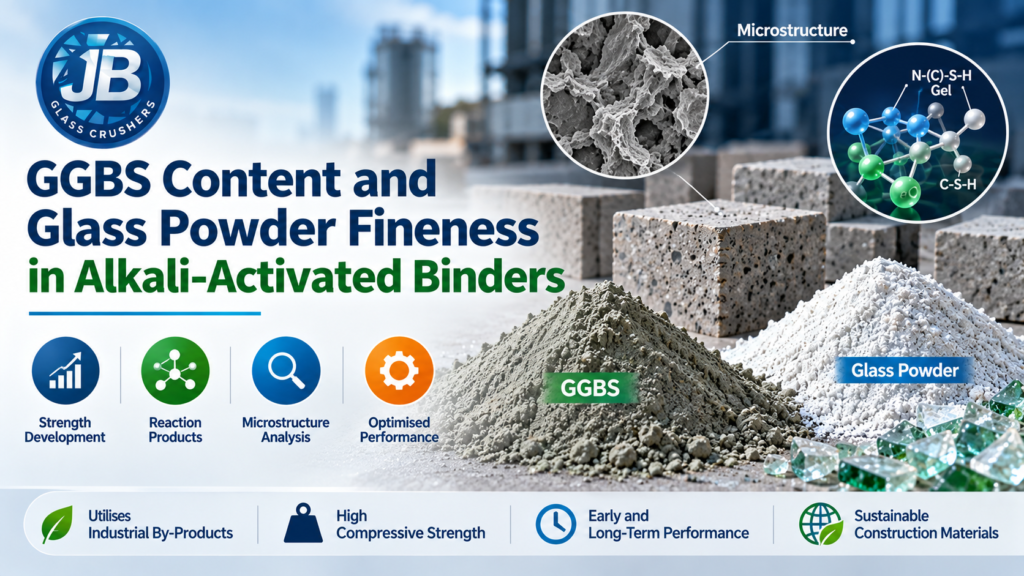
The development of low-carbon construction materials has increased interest in alkali-activated binders made from industrial by-products and silica-rich materials. Ground granulated blast-furnace slag (GGBS) and glass powder are two materials with potential for producing alternative cementitious binders.
GGBS is valued for its calcium-rich composition and relatively rapid reaction under alkaline conditions. Glass powder, particularly soda-lime-silica glass powder, provides a source of reactive silica. When combined and activated with sodium hydroxide (NaOH), these materials can form binding gels that contribute to the strength and microstructure of hardened composites.
However, the performance of these binders depends on more than their chemical composition. The proportion of GGBS, the fineness of the glass powder, curing conditions and the distribution of reaction products can all influence strength development over time.
Research by Lemesre, Idir and Cyr investigates how GGBS content and glass powder fineness affect the early-age and long-term performance of NaOH-activated glass–GGBS composite binders.
Understanding NaOH-Activated Glass–GGBS Binders
Alkali-activated binders are produced by reacting suitable solid precursors with an alkaline solution. In the system examined by the researchers, soda-lime-silica glass cullet powder (GCP) was combined with GGBS and activated using sodium hydroxide.
The two precursor materials contribute differently to the reaction.
Glass powder: Glass powder supplies silica that can dissolve under alkaline conditions and participate in the formation of sodium-rich silicate reaction products. Its reactivity is influenced by particle size, fineness and the chemical characteristics of the glass.
GGBS: GGBS provides calcium and other constituents that participate in the formation of calcium-containing binding gels. Its relatively rapid reaction can help improve strength development during the initial curing period.
Combining these materials offers a way to balance early strength development with the continued reaction of glass powder at later ages.
How GGBS Content Influences Strength Development
One of the central findings of the study is that GGBS content influences strength differently at different stages of curing.
1. Improving Early-Age Strength
Glass powder activated with NaOH alone exhibited very limited early mechanical performance in the investigated formulation. Its compressive strength remained below 0.4 MPa during the first seven days.
The addition of just 5% GGBS by mass produced a measurable one-day compressive strength of 0.6 MPa.
This result highlights the importance of precursor selection when early strength is required. The more rapidly reacting slag component can contribute to the initial formation of binding products while the glass powder continues to react.
2. Supporting Long-Term Strength Development
The researchers observed different contributions from the two precursors over time. GGBS played a significant role in the early-age response, while glass powder progressively supported later strength development.
This complementary behaviour means that the optimum blend cannot necessarily be identified by considering early strength alone. A formulation that performs well during the first few days may behave differently after several months of curing.
3. Why Increasing GGBS Does Not Always Increase Strength
The relationship between GGBS content and long-term compressive strength was not linear. At 360 days, the study reported a non-monotonic relationship, including a local strength minimum near 30% GGBS.
This finding is important because it demonstrates that adding more slag does not automatically produce a stronger binder.
The final performance depends on the balance between precursor reactivity, reaction-product chemistry, pore structure and microstructural development. The most suitable GGBS proportion therefore needs to be determined for the specific materials and processing conditions.
The Role of Glass Powder Fineness
Glass powder fineness is another important factor affecting the performance of alkali-activated binders.
Finer particles generally provide greater specific surface area, allowing more of the glass to come into contact with the alkaline solution. This can facilitate dissolution and influence the formation of binding products.
In the study, selected blends containing 10% or 20% GGBS were prepared using glass powder with Blaine fineness values of 3,000 and 6,000 cm²/g.
Increasing the glass powder fineness enhanced glass dissolution and the formation of sodium-rich silicate reaction products. The finer glass powder also accelerated strength development.
The selected blends containing finer glass powder achieved approximately 120 MPa compressive strength at 360 days under the study’s experimental conditions.
These results demonstrate the potential of fineness optimisation, but they should not be interpreted as a guaranteed strength level for all glass powders. Actual performance depends on glass chemistry, particle-size distribution, activator concentration, water content, curing conditions and specimen preparation.
Understanding the Reaction Products
The mechanical performance of an alkali-activated binder is closely related to the chemical composition and microstructure of the products formed during activation.
The researchers used techniques including solid-state silicon-29 nuclear magnetic resonance (²⁹Si MAS NMR), X-ray diffraction (XRD), thermogravimetric analysis (TGA), scanning electron microscopy with energy-dispersive X-ray spectroscopy (SEM-EDS), isothermal calorimetry and image analysis to investigate these processes.
Sodium-Rich Silicate Reaction Products
In blends containing a high proportion of glass powder, the principal reaction products were rich in sodium and silicon. These products were described as N-(C)-S-H-type gels, reflecting the presence of sodium, calcium and silicate in the reaction-product system.
The formation and development of these gels contribute to the binding structure of the hardened material.
Calcium-Rich Reaction Products
As the proportion of GGBS increased, the reaction products contained more calcium. The researchers identified calcium silicate hydrate (C-S-H) and minor amounts of hydrotalcite among the products associated with higher slag contents.
These findings demonstrate that changing the GGBS proportion affects not only the rate of reaction but also the nature of the resulting binder structure.
Why Reaction Extent Alone Cannot Predict Strength
An important observation involved two formulations designated G80S20 and G90S10. Although G80S20 had a higher reaction extent estimated using NMR, it developed lower long-term strength than G90S10.
This difference suggests that the quantity of reacted material is not sufficient to explain mechanical performance.
Strength also depends on factors such as:
- The type and distribution of reaction products.
- The continuity and uniformity of the binding matrix.
- The volume and distribution of pores.
- The effectiveness of particle packing.
- The quality of the interface between unreacted particles and the surrounding matrix.
Consequently, a formulation with a greater estimated reaction extent may not necessarily produce the strongest hardened material.
Experimental Conditions and Key Findings
The researchers investigated a range of GGBS contents, from 0% to 100% by mass, using a 3 mol/L NaOH solution and a water-to-solids ratio of 0.30. Specimens were cured at 20°C, and selected mixtures were also prepared with different glass powder fineness levels.
The principal findings are summarised below.
| Research variable | Main observation | Significance |
|---|---|---|
| GGBS content | Adding 5% GGBS produced measurable one-day strength in the tested system. | Slag can help address limited early-age performance. |
| Strength development | GGBS influenced early strength, while glass powder contributed progressively to later strength development. | The two precursors can provide complementary reaction behaviour. |
| Long-term GGBS proportion | Strength varied non-monotonically, with a local minimum near 30% GGBS at 360 days. | More slag does not automatically mean greater long-term strength. |
| Glass powder fineness | Increasing fineness enhanced dissolution and silicate-gel formation. | Particle fineness is an important mix-design variable. |
| Reaction products | Higher glass contents favoured sodium- and silicon-rich products; increasing GGBS promoted calcium-rich products. | Precursor proportions influence binder chemistry. |
| Reaction extent and strength | A higher estimated reaction extent did not always correspond to higher compressive strength. | Microstructure and reaction-product distribution also matter. |
| Finer glass powder blends | Selected formulations reached approximately 120 MPa at 360 days. | High long-term strength was possible under the specific experimental conditions. |
These values and observations relate to the mixtures tested in the research. They should not be treated as universal performance guarantees for commercially available glass powder or GGBS.
Implications for Sustainable Construction Materials
The study offers useful insights for researchers and manufacturers developing alternative cementitious materials.
Optimising the Blend Composition
The proportion of glass powder and GGBS should be selected according to the intended application. Early strength, long-term strength, workability and durability may require different combinations.
Controlling Glass Powder Quality
Consistent glass powder quality is important for reproducible results. Relevant parameters include:
- Particle-size distribution and specific surface area.
- Chemical composition and silica content.
- Moisture content.
- Colour and contamination levels where relevant to the application.
- Consistency between production batches.
A nominal mesh designation alone does not fully describe a powder’s fineness. Where precise performance is required, particle-size analysis and specific surface area measurements can provide additional information.
Evaluating the Complete Binder System
The performance of an alkali-activated binder cannot be predicted from glass powder fineness or GGBS content in isolation. The alkaline activator, water-to-solids ratio, curing regime and interaction between reaction products must also be considered.
Laboratory testing is essential before using a formulation in structural or other performance-critical applications.
The Importance of Glass Powder in Research and Development
Glass powder is being investigated for a range of construction-material applications, including alkali-activated binders and other composite systems. Its silica content and particle characteristics can make it a useful component in material development, provided its suitability is established for the intended formulation.
For manufacturers and researchers, the key challenge is to match the glass powder’s physical and chemical properties with the requirements of the application.
At Jai Bhavani Glass Crushers, glass powder grades are supplied for industrial applications. Researchers and manufacturers evaluating glass powder for binder systems should verify the required fineness, chemical composition and compatibility with their specific formulation before selecting a grade.
Frequently Asked Questions
1. What is the role of GGBS in NaOH-activated glass powder binders?
GGBS provides calcium-rich constituents and reacts relatively quickly under alkaline conditions. In the studied system, it helped improve early-age strength and influenced the formation of calcium-containing reaction products.
2. Why does glass powder fineness affect compressive strength?
Finer glass powder has a greater specific surface area, which can facilitate dissolution in an alkaline solution. This can accelerate reaction-product formation and influence strength development. The actual effect depends on the complete binder formulation.
3. Does increasing GGBS always improve long-term strength?
No. The study found a non-monotonic relationship between GGBS content and long-term strength. The optimum proportion depends on the precursor properties, activator and curing conditions.
4. Which reaction products form in NaOH-activated glass–GGBS binders?
The study identified sodium- and silicon-rich N-(C)-S-H-type products in high-glass blends. Increasing GGBS content promoted more calcium-rich products, including C-S-H and minor amounts of hydrotalcite.
5. Can ordinary industrial glass powder be used directly in an alkali-activated binder?
Not without evaluating its suitability. Glass chemistry, particle-size distribution, fineness, contamination and compatibility with the activator can all influence performance. Trial mixtures and laboratory testing are recommended before commercial use.
6. Does the study prove that every fine glass powder can achieve 120 MPa?
No. The approximately 120 MPa result was obtained with selected formulations under specific laboratory conditions. It should not be generalised to every glass powder, GGBS source or curing regime.
Conclusion
The study demonstrates that both GGBS content and glass powder fineness are important variables in NaOH-activated glass–GGBS composite binders.
GGBS can contribute to early-age strength, while glass powder supports continued strength development over longer periods. Increasing glass powder fineness can accelerate dissolution and influence the formation of silicate-rich reaction products. However, the relationship between composition, reaction extent and compressive strength is complex.
The central lesson is that successful binder design requires balancing precursor proportions, glass powder fineness, reaction-product chemistry and microstructural development. Optimisation should therefore be based on controlled experiments and measured performance rather than on a single material parameter.
About Jai Bhavani Glass Crushers
Jai Bhavani Glass Crushers supplies glass powder for industrial applications. Manufacturers and research teams evaluating glass powder for construction materials can contact us to discuss grade availability and technical requirements.
Jai Bhavani Glass Crushers
Hyderabad, Telangana, India
Website: jbglasscrushers.com
Phone: +91 89773 42277
Email: info@jbglasscrushers.com
Technical note: The research findings described above relate to the specific experimental formulations reported by the researchers. They do not constitute a performance guarantee for any commercial glass powder grade. Suitability should be confirmed through application-specific testing.