Glass Powder Research

Glass Powder Helps Concrete Capture Carbon and Reduce Emissions

Glass Powder Helps Concrete Capture Carbon and Reduce Emissions

As the construction industry faces increasing pressure to reduce carbon emissions, researchers are uncovering new ways to transform waste materials into climate-friendly building solutions. One promising innovation is the use of glass powder as a partial replacement for cement in concrete. Recent research has demonstrated that incorporating glass powder into concrete masonry products not only […]

Glass Powder Helps Concrete Capture Carbon and Reduce Emissions Read More »

finely milled silica-rich material

Ultra Finely Milled Silica-Rich Glass Powder: Applications, Benefits, and Industrial Uses

A finely milled silica-rich material produced from high-quality float glass, offering consistent particle size distribution, excellent particle packing characteristics, and smooth powder consistency for industrial applications Our 250 Mesh Float Glass Powder is a finely milled silica-rich material manufactured from float glass, designed to deliver uniform particle size distribution, reliable quality, and excellent blending characteristics

Ultra Finely Milled Silica-Rich Glass Powder: Applications, Benefits, and Industrial Uses Read More »

250 Mesh Float Glass Powder

250 Mesh Float Glass Powder: Applications, Benefits, and Industrial Uses

250 Mesh Float Glass Powder is a finely milled silica-rich material produced from high-quality float glass. With a particle size of approximately 63 microns, this ultra-fine powder is increasingly being evaluated and utilized across ceramic, refractory, construction, coating, composite, and specialty industrial applications. At JB Glass Crushers, we manufacture precision-milled float glass powder with consistent

250 Mesh Float Glass Powder: Applications, Benefits, and Industrial Uses Read More »

Glass Powder as a Performance Filler

Glass Powder as a Performance Filler and Supplementary Material Across Industries

Glass powder, produced by finely grinding recycled soda-lime or borosilicate glass, is emerging as an important industrial filler and supplementary material across multiple sectors. Traditionally treated as waste, finely processed glass now offers functional value because of its hardness, chemical stability, particle packing capability, and, in cementitious systems, pozzolanic behavior. Industries are increasingly exploring glass

Glass Powder as a Performance Filler and Supplementary Material Across Industries Read More »

Glass Powder in Polymer Applications

Why Finely Milled Glass Powder Is Gaining Attention in Polymer Manufacturing

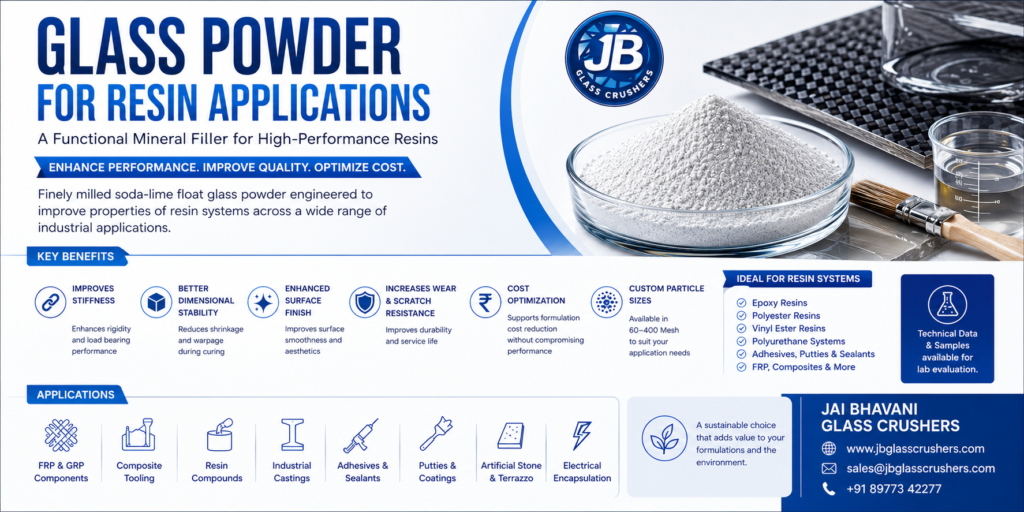
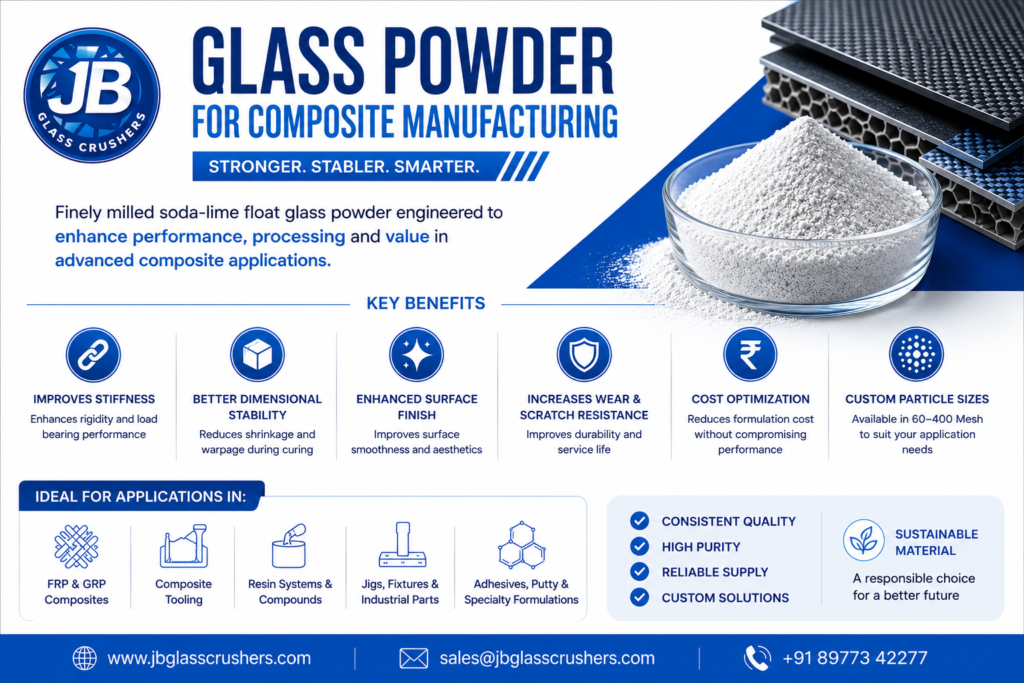
Modern polymer industries are continuously searching for materials that improve performance, enhance formulation consistency, and optimize production costs. One material increasingly being explored across polymer systems is finely milled glass powder. With controlled particle sizing, reliable purity, and strong thermal stability, glass powder can function as an effective industrial filler and performance-enhancing material in multiple

Why Finely Milled Glass Powder Is Gaining Attention in Polymer Manufacturing Read More »

Glass Waste to Controlled Raw Material

From Glass Waste to Controlled Raw Material: Why Consistency Matters

In industrial manufacturing, raw material consistency directly impacts product quality, process efficiency, and operational reliability. This is especially true for engineered glass-based materials. What was once considered discarded glass is now being transformed into controlled industrial raw material used across construction, coatings, ceramics, insulation systems, and other manufacturing applications. But simply processing glass is not

From Glass Waste to Controlled Raw Material: Why Consistency Matters Read More »

Electrical Insulation Applications

Glass Powder in Electrical Insulation Applications

High Dielectric Strength Meets Cost-Effective Performance Electrical insulation materials are expected to do more than simply block electrical current. Today’s manufacturers need materials that can withstand heat, resist moisture, maintain long-term stability, and still remain cost-effective in large-scale production. This is where glass powder is becoming an increasingly valuable solution. From cable insulation and transformer

Glass Powder in Electrical Insulation Applications Read More »

Glass Powder Can Lower Your Raw Material Costs

How Glass Powder Can Lower Your Raw Material Costs

Replacing conventional fillers with recycled glass powder can significantly cut industrial raw material costs. Glass powder (often 100% post-consumer recycled) can substitute expensive inputs like cement, quartz, or calcium carbonate. It typically costs far less than high-end virgin materials. Glass powder can also save energy (by reducing clinker use) and logistics (when sourced locally from waste streams).

How Glass Powder Can Lower Your Raw Material Costs Read More »

What Makes Glass Powder ‘Application-Ready’ Understanding Particle Size and Purity

What Makes Glass Powder ‘Application-Ready’? Understanding Particle Size and Purity

Industrial glass powder must be processed to tight particle-size and purity specifications so it performs reliably in downstream applications. “Application-ready” glass powder means uniform, calibrated fineness (with a well-defined particle-size distribution) and minimal contaminants or variable chemistry. Key attributes include a controlled mesh/pore size (often from ~50–1500 µm down to 1 µm), stable soda-lime composition, low moisture

What Makes Glass Powder ‘Application-Ready’? Understanding Particle Size and Purity Read More »

Glass Recycling Process: From Waste to Reusable Resource

Glass is one of the few materials that can be recycled endlessly without losing its quality or purity. This makes it a cornerstone of sustainable waste management and circular manufacturing. However, the journey from discarded bottle to new product involves several carefully controlled stages designed to ensure efficiency, safety, and high-quality output. This guide explains

Glass Recycling Process: From Waste to Reusable Resource Read More »