
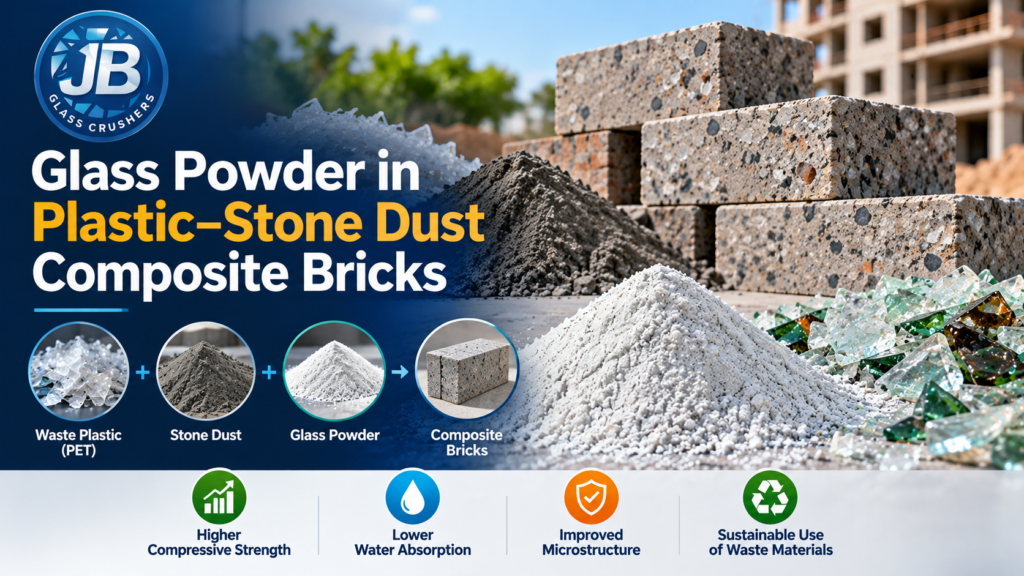
The construction industry is exploring alternative building materials that can reduce dependence on conventional clay bricks while making productive use of industrial and municipal waste materials. One promising research direction is the development of composite bricks using polyethylene terephthalate (PET) plastic, stone dust and glass powder.
Conventional clay brick manufacturing requires natural soil and energy-intensive processing. At the same time, discarded plastic, stone-processing residues and glass waste create environmental management challenges. Combining these materials in composite bricks offers a potential approach to addressing both construction-material demand and waste utilisation.
A 2026 study by Priya Jaswal, Rajan Singh and Lalit Goel, published in the Journal of Building Engineering, investigated how glass powder affects the strength and microstructure of PET–stone dust composite bricks.
The research examined the relationship between material composition, compressive strength, water absorption and internal structure. Its findings demonstrate that carefully selected glass powder proportions can improve the performance of these composite bricks under the conditions tested.
Understanding Plastic–Stone Dust Composite Bricks
Plastic–stone dust composite bricks differ from conventional cement-based or fired-clay bricks. Instead of relying primarily on cement hydration or clay firing, these composites use a thermoplastic material to bind mineral particles together.
The three principal components perform different functions.
1. PET Plastic as a Binding Matrix
Polyethylene terephthalate, commonly known as PET, is a thermoplastic polymer found in products such as beverage bottles and packaging.
When heated under controlled processing conditions, PET can soften and help bind mineral particles. Once cooled, the polymer forms a solid matrix around the particles.
In composite bricks, this matrix contributes to the cohesion of the material. However, the final mechanical performance depends on the polymer content, processing temperature, particle distribution and quality of the interfaces between the polymer and mineral constituents.
2. Stone Dust as a Mineral Component
Stone dust is generated during stone cutting, crushing and processing. It contains mineral particles that can serve as a solid component in composite building materials.
In PET-based bricks, stone dust provides a mineral framework within the polymer matrix. Its particle-size distribution and surface characteristics can influence packing density, void formation and the distribution of stresses under compression.
3. Glass Powder as a Functional Filler
Glass powder can be incorporated to modify the particle packing and microstructure of the composite.
Depending on its fineness and compatibility with the other materials, glass powder may help fill spaces between larger mineral particles. This can reduce voids and improve the continuity of the composite matrix.
In the investigated PET–stone dust system, the researchers found that replacing part of the stone dust with glass powder improved the performance of the optimised mixture.
Importantly, this mechanism differs from the pozzolanic reaction associated with glass powder in certain cement-based materials. In a thermoplastic-bound composite, improvements may primarily arise from physical packing, matrix structure and interfacial interactions rather than conventional cement hydration.
Experimental Approach: Optimising the Composite Brick
The researchers used a two-stage experimental approach to determine a suitable combination of PET, stone dust and glass powder.
Stage 1: Optimising PET and Stone Dust
The first stage examined different proportions of PET and stone dust to identify a suitable base composition.
Among the initial mixtures, the formulation designated M2, containing 33% PET and 67% stone dust, achieved the highest compressive strength.
This stage established the starting composition for investigating the influence of glass powder.
Stage 2: Incorporating Glass Powder
In the second stage, glass powder was introduced by replacing a portion of the stone dust in the selected base mixture.
Different replacement levels were evaluated to understand how glass powder affected the mechanical and physical properties of the resulting bricks.
The researchers assessed compressive strength and water absorption alongside microstructural characteristics. Scanning electron microscopy (SEM) and X-ray diffraction (XRD) were used to investigate changes in the internal structure and phase characteristics.
This approach allowed the researchers to evaluate the combined influence of material proportions and microstructural development rather than considering compressive strength alone.
Effect of Glass Powder on Compressive Strength
Compressive strength is an important property for determining whether a brick can withstand the loads expected in its intended application.
In composite bricks, strength depends on the ability of the polymer matrix to bind the mineral particles, the uniformity of the internal structure and the presence of defects such as pores and cracks.
The study found that introducing glass powder improved compressive strength in the optimised PET–stone dust formulation.
The Optimum Mixture
The mixture designated S3, containing 33% PET and incorporating glass powder as a 20% replacement of stone dust, achieved the best overall performance in the study.
Its reported compressive strength was 12.41 MPa, approximately 30% higher than that of the control mixture.
The improvement was associated with a more compact internal structure, improved particle packing and fewer micro-voids and cracks.
These findings indicate that glass powder can be an effective component in the formulation of selected plastic–mineral composite bricks.
However, the result should be interpreted within the context of the experimental mixture and manufacturing process. Other glass powders, particle-size distributions, plastic sources and processing conditions may produce different results.
How Glass Powder Changes the Microstructure
The microstructure of a composite brick helps explain its mechanical behaviour. Even when two specimens have similar compositions, differences in void distribution, particle contact and interfacial bonding can lead to different strength results.
The researchers used SEM and XRD to investigate these characteristics.
1. Improved Particle Packing
Glass powder can occupy spaces between larger stone dust particles when its particle-size distribution is suitable.
Better packing can reduce gaps within the composite and create a more continuous structure. This may help distribute compressive stresses across the specimen.
The degree of improvement depends on the relative particle sizes, powder characteristics and mixing procedure.
2. Reduction in Micro-Voids
Micro-voids are small empty spaces within a material. They can reduce the effective load-bearing area and act as points where stresses concentrate.
The SEM observations in the study indicated a reduction in micro-voids in glass powder-modified composites.
A reduction in these defects can contribute to a denser structure and help explain the improved compressive strength of the optimised mixture.
3. Fewer Microcracks
Cracks can develop because of inadequate particle bonding, processing defects or stress concentrations around interfaces.
The researchers observed reduced crack formation in the glass powder-modified composites. A more uniform internal structure can help improve stress distribution and limit the influence of local defects.
Nevertheless, the extent of improvement depends on the specific formulation and processing conditions.
4. Improved Matrix Continuity
A continuous polymer matrix helps transfer loads between the mineral particles.
When glass powder improves particle packing and reduces gaps, the resulting structure may provide more effective contact between the polymer matrix and the mineral components.
The study associated the enhanced mechanical performance with improved matrix continuity and stress distribution.
These observations reinforce the importance of examining microstructure alongside conventional strength measurements when developing composite bricks.
X-Ray Diffraction and Changes in Material Structure
X-ray diffraction is used to investigate the crystalline and amorphous characteristics of a material.
In the reported study, XRD analysis indicated an increase in amorphous character and a reduction in crystallite size following glass powder incorporation.
These observations provide additional information about changes in the composite’s structural characteristics.
However, XRD results must be interpreted carefully. A change in diffraction patterns does not, by itself, prove that the composite has undergone cement-like hydration or a pozzolanic reaction.
In PET–stone dust composite bricks, the relationship between diffraction characteristics and strength should be considered alongside the SEM observations, composition, processing conditions and mechanical test results.
Water Absorption and Compactness
Water absorption is another important property in evaluating masonry materials. It provides an indication of how much water a specimen takes up under the specified test conditions.
The researchers reported the following water absorption results for the control and selected glass powder-modified mixtures.
| Property | Control mixture | Optimised S3 mixture |
|---|---|---|
| Compressive strength | Approximately 9.55 MPa | 12.41 MPa |
| Water absorption | 1.45% | 0.75% |
The S3 mixture reduced water absorption from 1.45% to 0.75%, while increasing compressive strength by approximately 30%.
The lower water absorption is consistent with the improved compactness reported in the study.
However, water absorption alone does not establish long-term weather resistance, freeze–thaw performance, chemical resistance or fire safety. These properties require separate testing under appropriate conditions.
The study also reported that specimen S5 had the lowest water absorption, at 0.47%. Nevertheless, S3 was selected as the optimum formulation because it offered the highest ratio of compressive strength to water absorption.
This distinction illustrates why material optimisation should consider several performance indicators rather than selecting a mixture based on a single measurement.
Summary of the Research Findings
The principal findings of the study are summarised below.
| Parameter | Reported result | Significance |
|---|---|---|
| Initial PET–stone dust composition | 33% PET and 67% stone dust | Identified as the strongest base formulation among the mixtures evaluated in Stage I |
| Optimum glass powder-modified mixture | S3, with 20% replacement of stone dust by glass powder | Selected based on combined mechanical and water absorption performance |
| Compressive strength | 12.41 MPa | Approximately 30% higher than the control |
| Water absorption | 0.75% for S3, compared with 1.45% for the control | Indicates lower water uptake in the optimised formulation |
| Lowest measured water absorption | 0.47% for S5 | Demonstrates that the mixture with the lowest absorption was not necessarily the overall optimum |
| SEM observations | Reduced micro-voids and crack formation | Supports the observed improvement in matrix compactness |
| XRD observations | Increased amorphous character and reduced crystallite size | Indicates changes in the material’s structural characteristics |
| Potential application | Non-load-bearing masonry | The researchers reported that the developed bricks met the applicable compressive-strength requirements for this application |
The results above relate to the specific experimental materials, mixtures and procedures used in the study. They should not be treated as guaranteed values for other composite bricks.
Factors That Can Influence Composite Brick Performance
The research highlights the importance of material proportions, but several additional parameters should be controlled when developing plastic–mineral composite bricks.
Glass Powder Fineness
Particle size influences packing and the distribution of glass powder within the mineral framework.
A suitable combination of fine and coarse particles may help reduce voids. However, finer powder is not automatically better in every formulation; its effect depends on the other particle sizes and the processing method.
Chemical Composition and Contamination
Glass powder composition can vary depending on the source material. Consistent chemistry and controlled contamination levels are important when developing repeatable formulations.
For applications where appearance, colour or specific chemical properties matter, these characteristics should also be evaluated.
Mixing and Processing Conditions
Uniform mixing helps distribute glass powder and stone dust throughout the polymer matrix.
Processing temperature, residence time, cooling conditions and compaction can influence polymer flow, particle coating, internal voids and final dimensions.
These parameters should be controlled to minimise defects and achieve consistent production quality.
Quality-Control Testing
Before commercial use, composite bricks should be evaluated using appropriate test methods for:
- Compressive strength.
- Water absorption.
- Density and dimensional consistency.
- Thermal behaviour.
- Weathering and durability.
- Fire performance.
- Leaching or other environmental requirements, where applicable.
The appropriate tests depend on the intended use and the relevant building regulations.
Potential Applications of Plastic–Stone Dust Composite Bricks
The study identifies potential for these composite bricks in non-load-bearing masonry applications.
Possible uses may include selected partitioning and other non-structural building applications, subject to validation against the applicable performance requirements.
The reported compressive strength does not automatically establish suitability for load-bearing walls, foundations or other structural elements. Such applications require additional engineering assessment and compliance testing.
Further investigation is also needed to establish long-term durability, thermal performance, fire behaviour and environmental safety under real service conditions.
Frequently Asked Questions
1. What is a plastic–stone dust composite brick?
It is a composite building unit made by combining a thermoplastic material, such as PET, with mineral particles such as stone dust. Glass powder can be incorporated as an additional filler to modify particle packing and the resulting material structure.
2. How does glass powder improve the strength of composite bricks?
In the investigated system, glass powder incorporation was associated with improved particle packing, fewer micro-voids and reduced crack formation. The optimised mixture achieved 12.41 MPa compressive strength, approximately 30% higher than the control.
3. What is the optimum glass powder content?
The study identified S3, in which glass powder replaced 20% of the stone dust in the selected base formulation, as the best overall mixture. This percentage is specific to the study and should not be assumed to be optimal for every formulation.
4. Does lower water absorption mean better durability?
Lower water absorption can be a useful indicator of a more compact material. However, it does not independently establish resistance to fire, ultraviolet exposure, temperature changes, chemicals or long-term weathering. Those properties require separate testing.
5. Can glass powder be used in all types of plastic bricks?
Not without evaluating the particular formulation. Glass powder fineness, composition, particle distribution, plastic type and manufacturing conditions can influence the final properties. Laboratory trials are recommended before scaling up production.
6. Are these composite bricks suitable for load-bearing construction?
The study reported that its developed bricks met compressive-strength requirements for non-load-bearing masonry applications. Load-bearing use should not be assumed without further testing, engineering validation and compliance with relevant standards.
Conclusion
The study by Jaswal, Singh and Goel demonstrates the potential of incorporating glass powder into PET–stone dust composite bricks.
The optimised mixture achieved a compressive strength of 12.41 MPa and water absorption of 0.75%. SEM observations indicated fewer micro-voids and cracks, while XRD analysis showed changes in the composite’s structural characteristics.
Together, these findings suggest that carefully selected glass powder proportions can improve the compactness and mechanical performance of certain plastic–mineral composite bricks.
The broader lesson is that glass powder performance depends on its interaction with the other materials, particle distribution and manufacturing conditions. Consistent material specifications and application-specific testing are essential for developing reliable composite building products.
Glass Powder for Industrial Applications
Jai Bhavani Glass Crushers supplies glass powder for industrial applications. Manufacturers and research teams evaluating glass powder for composite materials can contact us to discuss available grades and technical requirements.
Jai Bhavani Glass Crushers
Hyderabad, Telangana, India
Website: jbglasscrushers.com
Phone: +91 89773 42277
Email: info@jbglasscrushers.com