
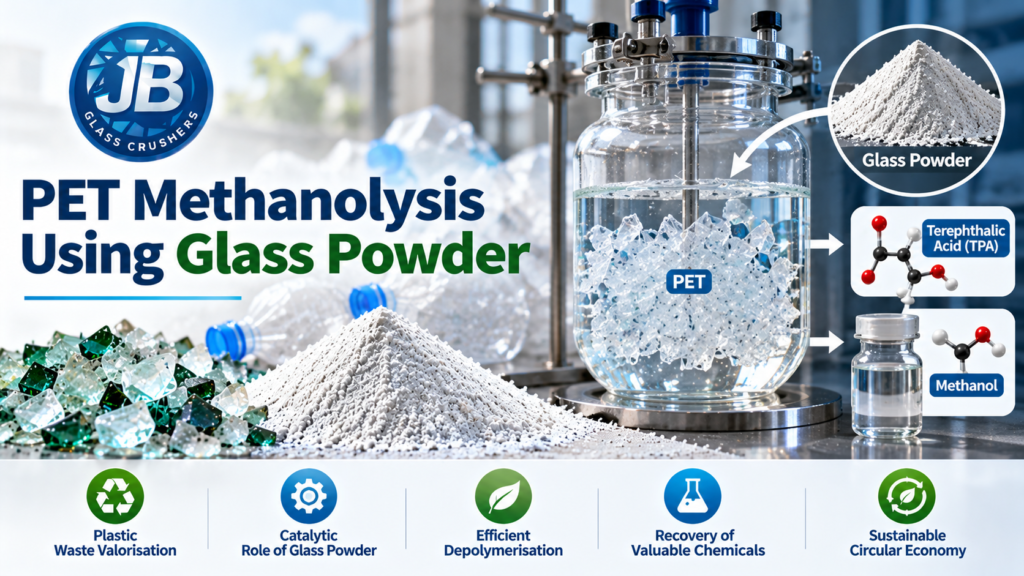
The growing demand for sustainable materials and resource-efficient manufacturing is encouraging researchers to explore innovative ways to transform industrial waste into valuable resources. Two materials attracting interest are polyethylene terephthalate (PET), a widely used plastic, and glass, which can be processed into fine glass powder for potential industrial applications.
One research area connecting these materials is PET methanolysis using glass powder.
PET methanolysis is a chemical recycling process that breaks down PET polymer chains using methanol. Under suitable reaction conditions, this process can produce dimethyl terephthalate (DMT) and ethylene glycol, two important chemical intermediates used in polyester manufacturing.
At the same time, glass powder is being investigated across a range of industrial and material-development applications. Its potential role in PET methanolysis depends on its chemical composition, surface properties and how it is incorporated into the reaction system.
Could glass powder contribute to a more resource-efficient PET depolymerization process? Answering this question requires a closer look at the chemistry, material properties and experimental evidence.
1. Understanding PET Methanolysis
Polyethylene terephthalate, commonly known as PET, is used in beverage bottles, food packaging, polyester fibres, films and other products. Although PET is widely collected and mechanically processed, some waste streams are difficult to reuse because of contamination, mixed materials or changes in polymer quality.
Chemical depolymerization offers an alternative route by breaking PET into smaller chemical compounds that may be recovered and used as industrial feedstocks.
During methanolysis, PET reacts with methanol through a transesterification reaction. Depending on the process design and operating conditions, the main target products include:
- Dimethyl terephthalate (DMT): An aromatic ester used as a feedstock in polyester production.
- Ethylene glycol (EG): An industrial chemical used in polyester manufacturing and other applications.
The objective is to recover useful chemical building blocks rather than simply processing the plastic into another physical form.
Several factors influence methanolysis performance, including temperature, pressure, reaction time, methanol-to-PET ratio, catalyst properties and the quality of the incoming PET feedstock.
The choice of catalyst, where one is used, can be particularly important because it may influence reaction rate, product selectivity and the conditions needed for depolymerization.
2. Why Explore Glass Powder?
Glass powder is produced by reducing glass material to smaller particle sizes. Common soda-lime glass contains silica along with other oxides, such as sodium oxide and calcium oxide. The exact composition varies according to the source and type of glass.
Processing glass into powder creates a material whose particle size and surface characteristics may be suitable for different industrial applications.
In PET methanolysis research, the potential value of glass powder lies not simply in adding it to a reaction, but in determining whether its properties can contribute to a useful catalytic or material-support system.
Three research directions are worth investigating.
Glass powder as a potential catalyst support
A catalyst support is a material used to carry an active catalytic component. The support can influence how that component is distributed and exposed to the reacting chemicals.
Glass powder could be evaluated as a support for selected catalytic substances. However, ordinary glass powder is not automatically an effective catalyst support. Its surface area, porosity, chemical stability and interaction with the active component must be established experimentally.
Development of glass-based catalytic materials
Researchers may also investigate modified glass-based materials that combine glass-derived components with catalytically active substances.
In such systems, performance depends on the active component, preparation method, surface chemistry and reaction conditions. The modified material must be tested to determine whether it offers a measurable advantage over existing alternatives.
Particle-size optimisation
Particle size is another important material parameter. Smaller particles generally provide more external surface area per unit mass, but finer powder does not necessarily deliver better catalytic performance.
Surface chemistry, porosity, agglomeration and the distribution of active sites can have a significant influence on the final result.
For this reason, research should use measured particle-size distributions rather than relying only on nominal mesh grades.
3. How PET Methanolysis Works
A typical PET methanolysis process involves several stages. The specific process configuration depends on the feedstock, catalyst and desired product quality.
Step 1: PET preparation
The PET feedstock is sorted to remove unsuitable materials and contaminants. Washing, drying and size reduction may be required, depending on the source.
Consistent feedstock quality helps reduce variability during the reaction and can simplify the recovery and purification of the final products.
Step 2: Catalyst or material preparation
The catalyst is prepared according to the selected process.
If glass powder is being investigated, researchers should characterise its chemical composition, particle-size distribution, moisture content and relevant surface properties before use. If the glass is modified with a catalytic component, the resulting material should also be characterised.
Step 3: Chemical reaction
PET reacts with methanol under controlled operating conditions. A suitable catalyst may help facilitate the breakdown of the polymer into smaller molecules.
The required temperature, pressure and reaction time depend on the process design. Because methanol is flammable and toxic, and heated systems can develop substantial pressure, experiments must be conducted using appropriately designed equipment and established chemical-safety controls.
Step 4: Product recovery
After the reaction, the mixture is processed to separate the desired products from unreacted material, catalyst and other components.
DMT recovery and purification are important considerations