
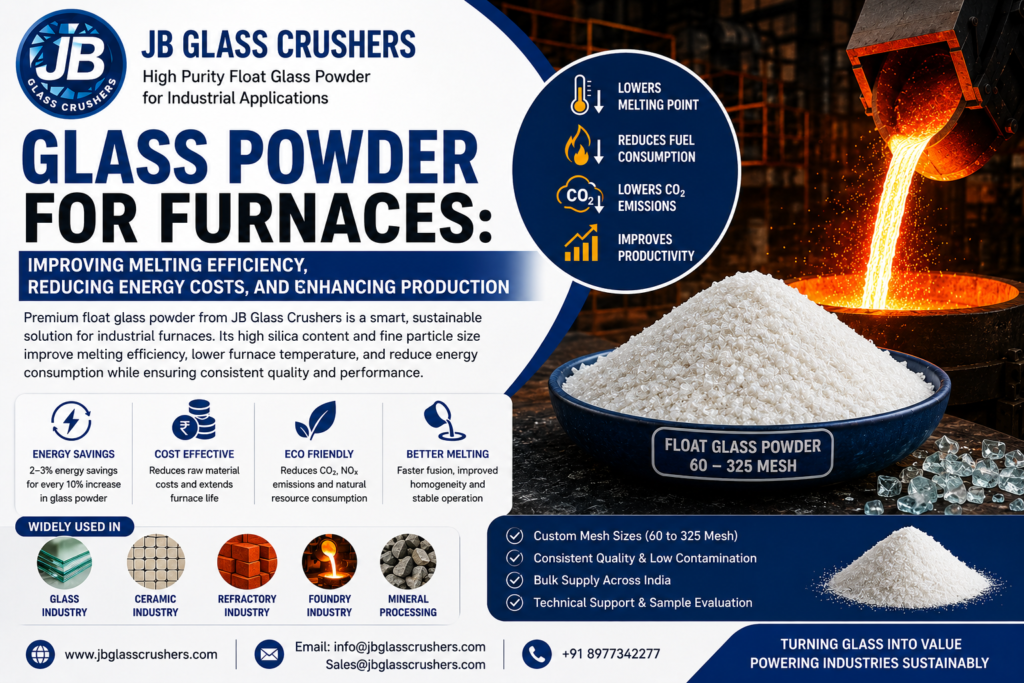
Industrial furnaces are under constant pressure to reduce energy consumption, lower production costs, and improve sustainability without compromising product quality. One material that is transforming furnace operations across several industries is high-quality float glass powder.
Manufactured from carefully processed soda-lime float glass, glass powder acts as both a silica source and a fluxing material. Its unique chemical composition enables faster melting, improved heat transfer, and reduced dependence on virgin raw materials.
At JB Glass Crushers, we manufacture premium industrial-grade float glass powder with controlled particle size distribution and consistent chemical composition, making it suitable for a wide range of furnace applications.
What is Glass Powder?
Glass powder is produced by crushing and grinding high-quality soda-lime float glass into fine particles ranging from coarse powder to ultra-fine micron sizes.
Unlike silica sand, glass powder has already undergone vitrification. Since it has previously been melted during glass manufacturing, it requires less energy to melt again, making it an ideal furnace feedstock.
Why Glass Powder is Used in Industrial Furnaces
Industrial furnaces consume enormous amounts of thermal energy. Replacing a portion of virgin raw materials with glass powder provides multiple operational advantages.
1. Faster Melting
Glass powder begins softening much earlier than quartz or silica sand.
Instead of waiting for raw materials to react chemically inside the furnace, glass particles rapidly fuse into the molten batch, significantly improving melting kinetics.
Benefits include:
- Faster batch fusion
- Reduced unmelted particles
- Improved heat distribution
- Stable furnace operation
2. Lower Furnace Temperature
One of the major benefits of float glass powder is its natural fluxing ability.
Because it already contains alkali oxides such as sodium oxide, it lowers the melting temperature of the overall batch.
This enables:
- Lower firing temperatures
- Reduced burner load
- Less thermal stress
- Better furnace efficiency
3. Reduced Energy Consumption
Numerous industry studies have shown that increasing recycled glass content reduces furnace energy demand.
Typical industry results indicate:
- Around 2–3% energy savings for every 10% increase in glass feedstock
- Lower fuel consumption
- Reduced electricity usage
- Higher overall furnace efficiency
For large industrial furnaces operating continuously, these savings can translate into substantial reductions in operating costs over time.
How Glass Powder Improves Furnace Performance
When glass powder is added to the furnace batch:
- Fine particles heat rapidly.
- Early melting begins.
- Liquid phases form sooner.
- Raw materials dissolve more efficiently.
- Heat transfer improves.
- The furnace reaches a homogeneous melt faster.
The result is a smoother melting process with fewer cold spots and improved production consistency.
Environmental Benefits
Glass powder supports more sustainable manufacturing by helping industries lower emissions and reduce natural resource consumption.
Advantages include:
- Lower CO₂ emissions
- Reduced NOₓ emissions
- Lower fuel usage
- Reduced mining of virgin silica
- Reduced industrial waste
- Improved resource efficiency
Replacing part of the virgin batch with glass powder also decreases the decomposition of carbonate raw materials, further lowering process emissions.
Industries Using Glass Powder in Furnaces
Glass Manufacturing
Float glass manufacturers and container glass plants incorporate clean glass powder or cullet to increase furnace efficiency while reducing raw material requirements.
Ceramic Industry
Glass powder functions as a flux, lowering firing temperatures and improving vitrification in ceramic bodies and glazes.
Applications include:
- Floor tiles
- Wall tiles
- Sanitaryware
- Tableware
- Ceramic frits
Refractory Industry
Refractory manufacturers use glass powder to improve sintering behaviour while reducing energy consumption during production.
Foundries
Glass powder acts as an effective slag conditioner by improving slag fluidity and enhancing impurity removal during metal melting.
Mineral Processing
Glass powder is also used as a fluxing agent in mineral processing furnaces where controlled melting characteristics are required.
Recommended Particle Sizes
Different furnace applications require different particle sizes.
| Mesh Size | Typical Application |
|---|---|
| 60–100 Mesh | Furnace feedstock |
| 100–150 Mesh | Fluxing applications |
| 150–250 Mesh | Ceramic & refractory |
| 250–325 Mesh | Fine furnace additives |
| Ultra Fine | Specialty industrial applications |
JB Glass Crushers supplies customized particle sizes based on customer requirements.
Quality Matters
Not all glass powder performs the same.
High-quality furnace-grade glass powder should provide:
- Consistent particle size distribution
- Low contamination
- Low moisture
- Controlled iron content
- Stable chemical composition
- Reliable batch-to-batch consistency
These factors directly influence melting efficiency, product quality, and furnace performance.
Why Choose JB Glass Crushers?
At JB Glass Crushers, we manufacture premium float glass powder designed for industrial applications.
Our capabilities include:
- Custom mesh sizes
- Controlled particle size distribution
- Low contamination
- High silica content
- Consistent quality
- Bulk supply across India
- Technical support for application evaluation
Whether you are looking to improve furnace efficiency, reduce fuel costs, or replace a portion of virgin raw materials, our glass powder is engineered to deliver reliable and consistent performance.
Frequently Asked Questions
Can glass powder replace silica sand?
Yes. Depending on the application and formulation, glass powder can partially replace silica sand while improving melting efficiency.
Does glass powder reduce fuel consumption?
Yes. Since glass powder melts more easily than virgin raw materials, it helps reduce furnace energy requirements.
Is glass powder suitable for continuous furnaces?
Yes. High-quality glass powder with controlled particle size and consistent chemistry is suitable for continuous industrial furnace operations.
Can JB Glass Crushers supply custom particle sizes?
Yes. We manufacture glass powder in multiple mesh sizes and can customize particle size distribution according to customer specifications.
Partner with JB Glass Crushers
As industries seek higher productivity, lower energy costs, and more sustainable manufacturing, float glass powder has become a valuable furnace raw material. Its ability to improve melting efficiency, reduce fuel consumption, and support cleaner production makes it an excellent choice for modern industrial furnaces.
If you are evaluating glass powder for your furnace process, JB Glass Crushers can provide technical guidance, product samples, and customized material solutions tailored to your application.
Contact us today to discuss your furnace requirements and discover how our premium glass powder can help improve your production efficiency.