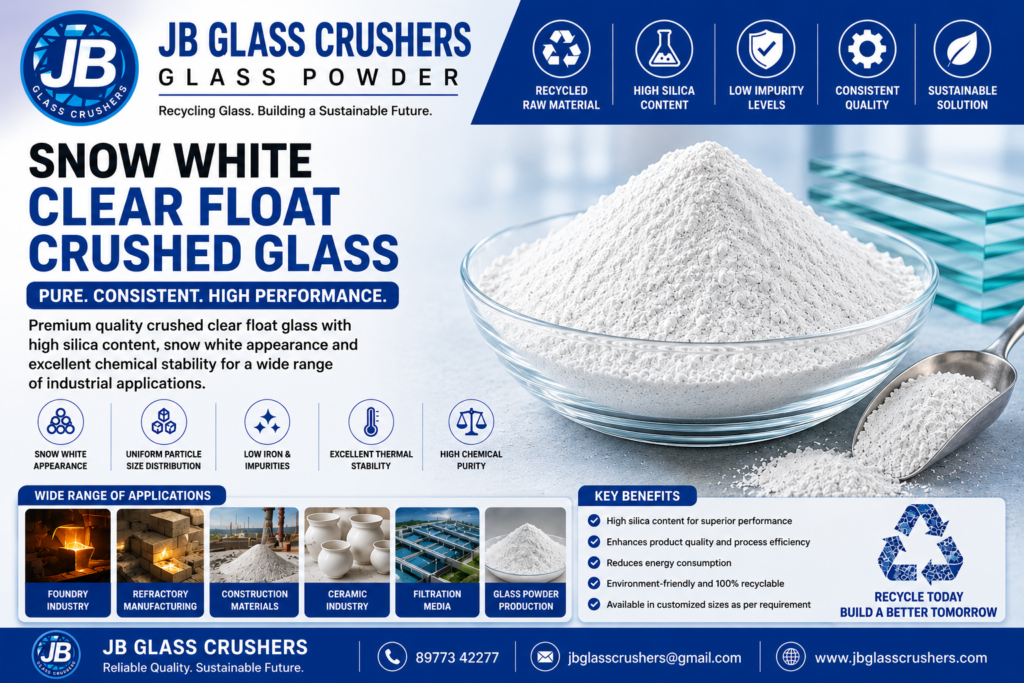
Glass Powder vs Feldspar: Which Is the Better Flux for Ceramic Tiles?

Flux materials are essential in ceramic tile manufacturing because they control melting, vitrification, and the final properties of ceramic bodies and glazes. Traditionally, feldspar minerals have been the primary flux used in ceramic formulations. However, the growing availability of recycled glass powder has introduced an alternative flux that offers both technical and environmental advantages. Understanding […]

Glass Powder vs Feldspar: Which Is the Better Flux for Ceramic Tiles? Read More »

How Soda-Lime Glass Powder Works as a Flux in Industrial Applications

How Soda-Lime Glass Powder Works as a Flux in Industrial Applications

Flux materials are essential in many high-temperature industrial processes. Their main function is to lower melting temperatures, promote vitrification, and improve bonding between particles during heating. Among the materials used for this purpose, soda-lime glass powder has become increasingly valuable because of its chemical composition, melting behavior, and availability through recycling. Industries such as ceramics,

How Soda-Lime Glass Powder Works as a Flux in Industrial Applications Read More »
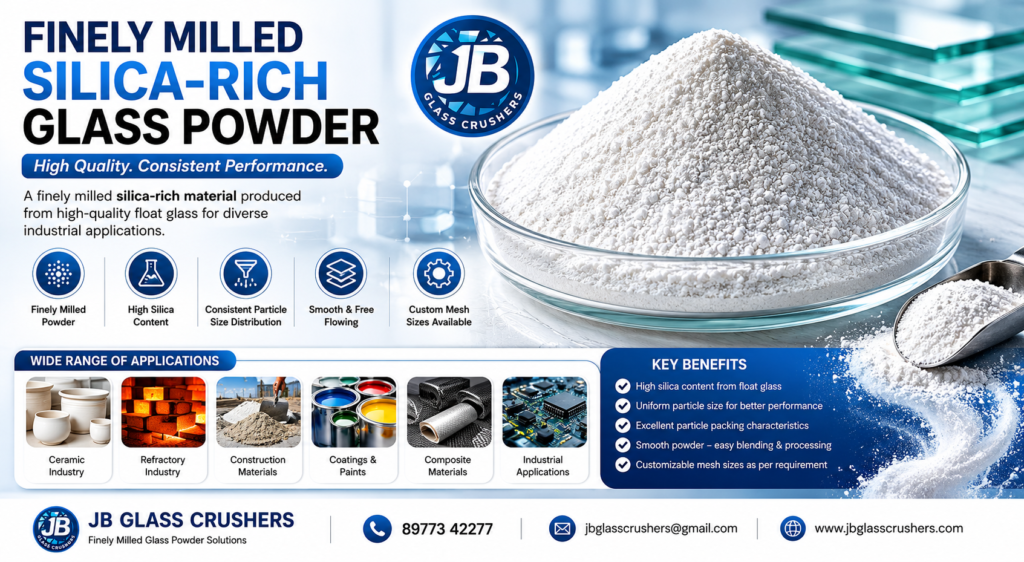
17 Micron Glass Powder: A High-Performance Flux for Ceramic Tiles

The ceramic tile industry relies on carefully balanced raw materials to achieve proper melting, vitrification, and surface quality during firing. Among these materials, fluxes play a crucial role because they lower the melting temperature of ceramic bodies and glazes, helping manufacturers reduce energy consumption while improving product strength and finish. One material gaining increasing attention

17 Micron Glass Powder: A High-Performance Flux for Ceramic Tiles Read More »

Use of Glass Powder in Industrial Settings

High-Performance Industrial Applications by JB Glass Crushers – Glass powder, finely milled and processed from recycled glass cullet is a highly versatile industrial material. At JB Glass Crushers, we manufacture premium quality glass powder in mesh sizes ranging from 100 mesh to 300 mesh, delivering performance benefits across multiple industrial sectors. Whether you are developing

Use of Glass Powder in Industrial Settings Read More »

Use of Glass Powder in Paint Formulations

Glass powder is increasingly being used in modern paint and coating formulations due to its durability, chemical stability, and eco-friendly properties. Finely processed recycled glass powder acts as a functional filler that enhances performance while supporting sustainable manufacturing practices. With industries shifting toward cost-effective and environmentally responsible raw materials, glass powder has emerged as a

Use of Glass Powder in Paint Formulations Read More »

What is Mesh Size in Minerals? A Practical Guide for Glass Powder Users

Understanding mesh size is essential for anyone working with powdered materials, whether in construction, ceramics, coatings, filtration, or industrial manufacturing. Glass powder, like many mineral products, is classified by mesh size. But what does “mesh size” actually mean, and why does it matter for performance? This guide provides a comprehensive overview of everything you need

What is Mesh Size in Minerals? A Practical Guide for Glass Powder Users Read More »

Uses of 100 Mesh Glass Powder in Industrial Applications

100 mesh glass powder (approximately 150 microns) is one of the most versatile and cost-effective grades used across multiple industries. Due to its relatively coarser particle size compared to 200 or 300 mesh grades, it functions more as a fine aggregate or functional filler rather than a highly reactive pozzolanic material. Its balanced particle size

Uses of 100 Mesh Glass Powder in Industrial Applications Read More »